Synopsys and Ansys power the future of innovation—connecting silicon to systems.
-
-
학생용 무료 소프트웨어에 액세스하기
차세대 엔지니어에게 힘을 실어주는 Ansys
학생들은 세계적 수준의 시뮬레이션 소프트웨어를 무료로 이용할 수 있습니다.
-
지금 바로 Ansys에 연결하십시오!
미래를 설계하기
시뮬레이션이 다음 혁신을 어떻게 지원할 수 있는지 알아보려면 Ansys와 연결하십시오.
무료 트라이얼
제품 및 서비스
학습하기
회사 정보
Back
제품 및 서비스

According to SPIE, almost 5,000 companies in 59 countries are producing optical and photonics components to generate, control, manipulate, and detect light at the microscale. Larger companies and household names dominate in terms of market share, but 86% of the core photonics companies worldwide are small- and medium-sized enterprises (SMEs).
Many of these companies are using Ansys Lumerical photonic simulation software to drive innovation. With their high degree of product complexity and high development costs, photonics-based optics systems are a natural candidate for simulation-driven product development. Lumerical software is a proven solution that helps optics and photonics engineers understand and predict light behavior in complex structures, down to the microscale.
The top applications for photonics-based optical solutions today include:
- High-tech and semiconductor applications. Compact smartphone cameras and displays, as well as virtual and augmented reality glasses, rely on high-performing photonics. One of the more exciting emerging applications for photonics are photonic integrated circuits (PICs), which help meet the demand for higher-performing semiconductor technologies.
- Healthcare innovations. Photonics and optics advancements are driving new non-invasive laser surgeries, advanced imaging systems, and other medical solutions that dramatically improve patient outcomes.
- Data transmission. Fiber optics networks, which are powered by light, face increasing demands for greater speed and larger bandwidth. Photonics and optics innovations are critical enablers.
- Sustainable energy generation. Photonics is the foundation for photovoltaics systems that transform sunlight into energy. Advancements in photonics are making solar panels smaller, more efficient, and more affordable.
Driven by the need for faster data transmission, advancements in laser technology, and growing applications in healthcare and automotive applications, photonics are seeing incredible market growth. While the global market for photonics is worth about $989 billion today, it’s expected to reach $1.73 trillion by 2035. Photonics-based optical components account for about a third (32.5%) of the total photonics market today.
High Complexity, High Costs — Enter Simulation
While thousands of companies around the world are working on a diverse range of photonics-based optics innovations, they all share one common need. They must drive time and cost out of their development cycles to launch their innovations quickly and capture market share.
These companies must also understand how their optical and photonics components are affected by imperfections that occur during the manufacturing process, as well as during everyday use. Called tolerance analysis, these studies are faster and much more cost-effective if conducted during the design and modeling phase, when compared with manufacturing multiple prototypes and subjecting them to real-world environmental conditions.
Given the tremendous growth opportunity and the intense competition, photonics and optics development teams can’t afford to waste time. But, given the critical nature of their product applications, such as healthcare and data transmission, they also can’t afford to take shortcuts in design analysis and verification.
Leading product development teams use Lumerical software every day to explore innovations like new materials, structures, and light-manipulation techniques that make optical systems smaller, more efficient, higher-performing, more reliable, and less expensive to produce. For both large industry leaders and SMEs, simulation with Lumerical software is part of their overall strategy to innovate confidently and gain market share.
Focusing on the Future With Lumerical Software
By revolutionizing the product development process for optics systems, Lumerical software enables engineers to explore innovations quickly, cost-effectively, and precisely. Simulation-driven product development is driving innovations that are changing photonics-based optics categories, including:
Photonics integrated circuits. Semiconductor engineers use Lumerical software to model and optimize the behavior of light within complex PIC designs, including components like modulators, waveguides, and detectors.
PICs are critical in meeting the ever-growing demand for superior chip speed and performance, while minimizing energy use.
Certified by Global Foundries, Lumerical software is uniquely able to simulate both the optical and electronic behaviors of PICs, from the smallest component to the most complex systems.
Designers can use the PyAnsys pythonic access tool for Ansys software API to conduct sophisticated analysis like gradient descent optimization to make tradeoffs across multiple PIC performance parameters.
Co-packaged optics. Lumerical software supports the development of co-packaged optics, or CPOs, as semiconductor teams stack chips to create multi-die 3D-IC packages.
Lumerical software is the ideal solution, as it integrates with the broader Ansys, part of Synopsys, simulation portfolio that includes optics, electro-magnetic, thermal, mechanical, and semiconductor solutions.
Simulation via Ansys software ensures efficient optical coupling, electro-optical signal integrity, and thermal and structural integrity for CPOs.
Ansys has also developed a novel signal integrity analysis approach for CPOs.
Metalens technologies. A metalens is a phase-manipulation device that employs a subwavelength meta-atom pattern on a dielectric surface to bend or redirect light.
Lumerical tools enable the complete design of metalens solutions, from the nanoscale of the meta-atom and the macroscale of the lens to its full-scale integration into a smartphone camera, endoscopic surgical device, or virtual reality headset.
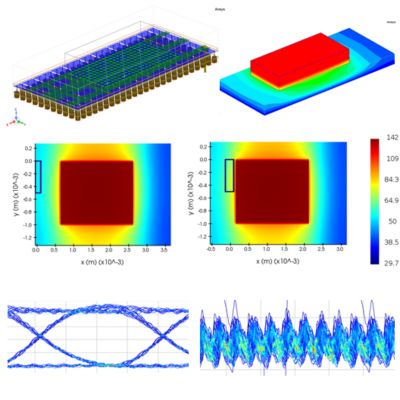
Ansys Lumerical INTERCONNECT photonic integrated circuit (PIC) design and simulation software and Ansys Icepak electronics cooling simulation software PIC integration
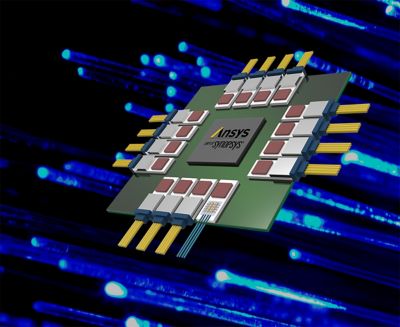
Ansys, part of Synopsys, co-packaged optics
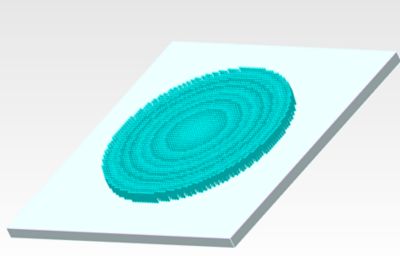
Metalens simulation in Lumerical software
From enabling global connectivity to making healthcare and renewable energy more accessible, photonics-based optics are transforming industries and improving people’s lives. Ansys is gratified to play a role in these revolutionary breakthroughs.
Growing Capabilities for a Growing Field
Given the undeniable importance of photonics and optics, Ansys continues to invest in new capabilities for its Lumerical suite of products. New features and functionality released this year include GPU-accelerated solvers, AI-assisted optimization, and co-simulation across optical, electrical, and thermal domains.
These improvements facilitate faster, more accurate, and more scalable design workflows that make it even easier to manage complex photonics and optics simulations. Ansys Cloud Burst Compute is an on-demand, cloud-based computing capability that sends Lumerical jobs to a cloud equipped with the latest high-performance GPU/CPU hardware, accelerating solve times to an even greater degree.
With Lumerical software, users can take advantage of multiple solvers, including Ansys Lumerical FDTD advanced 3D electromagnetic FDTD simulation software for studying and designing photonic components and the Ansys Lumerical MODE optical waveguide design tool. For electronics applications like PICs, users can rely on the Ansys multiphysics suite for charge and heat simulations. Ansys Lumerical INTERCONNECT photonic integrated circuit design and simulation software simulates classical and quantum photonic integrated circuits while enabling the co-design and co-simulation of photonic and electronic circuits.
Lumerical software also integrates with Ansys HFSS high-frequency electromagnetic simulation software and Ansys Mechanical structural finite element analysis software, as well as third-party computer-aided design (CAD) tools for layout and verification. This easy interoperability enables a connected multidisciplinary design process that is truly reshaping optics and photonics product development.
Ansys also continues to invest in its full suite of Ansys Optics software that integrates seamlessly with Lumerical software. Ansys Speos CAD integrated optical and lighting simulation software and Ansys Zemax OpticStudio optical system design and analysis software enable users to move from photonic component modeling to optical component and system-level modeling.
Learn more about Ansys Optics and the Lumerical product suite. Or contact the Ansys Optics team to discuss your own unique design challenges and opportunities.

Just for you. We have some additional resources you may enjoy.
Learn More
Explore the Ansys Optics and the Lumerical product suite. Or contact the Ansys Optics team to discuss your own unique design challenges and opportunities.



The Advantage Blog
The Ansys Advantage blog, featuring contributions from Ansys and other technology experts, keeps you updated on how Ansys simulation is powering innovation that drives human advancement.