Synopsys and Ansys power the future of innovation—connecting silicon to systems.
-
-
학생용 무료 소프트웨어에 액세스하기
차세대 엔지니어에게 힘을 실어주는 Ansys
학생들은 세계적 수준의 시뮬레이션 소프트웨어를 무료로 이용할 수 있습니다.
-
지금 바로 Ansys에 연결하십시오!
미래를 설계하기
시뮬레이션이 다음 혁신을 어떻게 지원할 수 있는지 알아보려면 Ansys와 연결하십시오.
무료 트라이얼
제품 및 서비스
학습하기
회사 정보
Back
제품 및 서비스

As optical systems grow more complex, the old ways of simulating and iterating simply can’t keep up. The challenge isn’t just accuracy anymore; it’s scale, speed, and the freedom to explore more ideas without being slowed by computational limits. That’s where high‑performance optical simulation comes in — giving teams the power to tackle massive design spaces, move faster, and make confident decisions in an era of increasingly ambitious optical technology.
Engineers are expected to explore broader design spaces, iterate quickly, and still deliver pixel‑perfect accuracy, often with tools that weren’t built for this level of complexity. To keep pace, optical simulation itself has had to evolve. High-performance simulation at scale isn’t just about running faster, it’s about unlocking the freedom to test more ideas, ask better questions, and design with confidence as optical systems grow ever more intricate.
Traditional Optical Simulation Limitations
Traditional optical simulation workflows often depend on central processing unit (CPU)-based solvers that struggle with the heavy computational demands of complex optical systems, leading to lengthy simulation times. Fixed on-premises hardware exacerbates these challenges, limiting scalability and causing delays during peak workloads. Optimization processes frequently rely on manual parameter sweeps or heuristic methods, which are time-intensive and prone to missing optimal design solutions. Fragmented toolchains further hinder efficiency, as data inconsistencies arise from disconnected workflows across optical, mechanical, and electronic domains.
“What used to take hours — or even days — of simulation can now be predicted in seconds using AI surrogate models. That speed lets us ask better questions earlier and move forward with much more confidence," says Adam Reid, executive director of R&D at Synopsys.
The Role of AI and Optimization in Optical Simulation
Artificial intelligence (AI) revolutionizes optical simulation by automating and optimizing processes that were previously labor-intensive. Advanced algorithms help to streamline design exploration by focusing computational resources on the most promising areas of the design space. This targeted approach significantly reduces the number of simulations needed, while maintaining high accuracy. AI also facilitates automated optimization, enabling engineers to evaluate complex optical systems with a wide range of parameters, such as material properties, geometries, and performance criteria.
Ansys GeomAI is an AI‑driven geometry optimization tool that helps engineers explore and improve designs without being limited by predefined parameters. Instead of manually tweaking shapes and running countless simulations, GeomAI software learns from simulation data to predict performance and guide designers toward better geometries faster, enabling engineers to evaluate more design options early in the process.
These capabilities empower teams to uncover innovative design solutions and address intricate engineering challenges without the exhaustive manual effort typically required. Beyond tuning a set of predefined parameters, AI opens the door to exploring entirely new geometries, without being boxed in by traditional design variables. That freedom makes it much easier to uncover strong solutions in complex or non‑intuitive design spaces where human intuition alone may fall short.
AI also dramatically speeds things up. Once a surrogate model is trained, it can deliver predictions in seconds instead of the hours required for traditional simulations. That time savings enables engineers to explore thousands of design variations in the time it once took to analyze just a few, accelerating insight, iteration, and innovation. Optimization helped Volvo dramatically accelerate light‑guide design by eliminating slow, manual testing. What once allowed only six to eight design iterations per day expanded to as many as 300 designs and simulations in a single day, enabling faster exploration of the design space, better decisions, and quicker paths to high‑quality solutions.
Leveraging Cloud Infrastructure
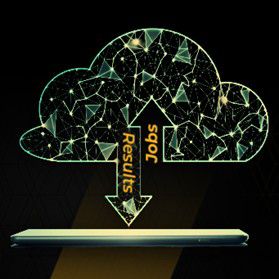
Cloud infrastructure provides on-demand access to HPC resources, transforming optical simulation workflows to ensure that large-scale simulations can run without interruption. This eliminates bottlenecks caused by local hardware limitations and long simulation queues, particularly during high-demand periods. Teams can leverage distributed compute resources for massive parallel processing, enabling them to explore extensive design spaces efficiently. Cloud-based platforms also integrate seamlessly with advanced simulation workflows, supporting tasks like parameter sweeps and AI-driven optimization.
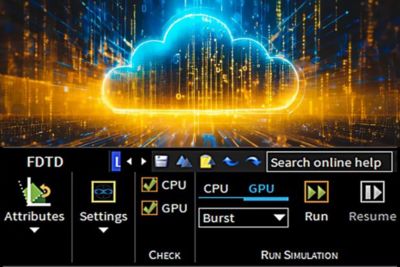
Graphics processing unit (GPU)-accelerated, cloud-enabled optical simulation built to scale with artificial intelligence (AI)-driven workflows
GPU Acceleration for Enhanced Performance
Graphics processing unit (GPU) acceleration transforms computational performance in optical simulation by processing complex tasks like ray tracing and sub-wavelength structure modeling with unmatched speed. Unlike CPUs, GPUs excel in parallel computation, efficiently handling millions of rays and intricate optical environments simultaneously. This capability is vital for analyzing detailed lighting systems, high-resolution meshes, and complex material interactions. Applications such as artificial reality/virtual reality (AR/VR) optics and automotive lighting benefit from accelerated rendering and real-time feedback, enabling engineers to refine designs quickly. GPUs also make it possible to get higher-fidelity results in simulations with challenging environmental conditions, such as fog or glare, without increasing computational time.
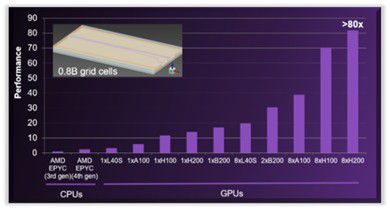
Performance-scaling comparison of central processing unit (CPU) and GPU architectures for large-scale optical and photonic simulations
Integrated Workflows in Ansys Optics
Ansys Optics integrates AI-driven optimization, cloud scalability, and GPU acceleration into a unified workflow, enhancing simulation efficiency and precision.
When AI, cloud computing, and GPU acceleration stop acting like separate tools and start working as a team, each one plays a distinct role, but it’s their interaction that really changes how optical design gets done.
“The real power comes from combining AI, cloud, and GPU technologies into one workflow. Each iteration makes the next one smarter and faster, allowing us to keep pace with the growing complexity of modern optical systems,” says Ilya Tolchinsky, principal product manager of AI at Synopsys.
AI helps steer engineers in the right direction early on, highlighting promising design paths and cutting down the need for time‑consuming full‑fidelity simulations, ultimately saving valuable design time.
From there, the cloud takes over the heavy lifting. Instead of being constrained by local hardware, teams can run large batches of simulations to explore entire families of design variations at once. That means more ideas tested, faster—without worrying about compute limits. With Ansys SimAI Premium, GPU acceleration and cloud compute (via AWS) are built directly into the backend, making this scale‑up seamless.
GPUs then bring it all together with speed and precision. High‑performance GPU solvers deliver fast, high‑fidelity results, making it easier to validate designs and move quickly from concept to confidence.
And the process doesn’t stop there. The results feed back into the AI models, continuously sharpening their predictions and accelerating the next round of refinement. Each cycle becomes smarter and faster than the last — creating a workflow that scales with the growing complexity of modern optical systems.
In short, it’s not just faster simulation, but a smarter way to design.
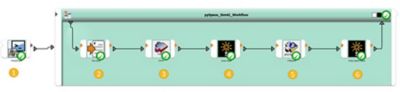
Automated Ansys SimAI software data generation via an Ansys optiSLang workflow
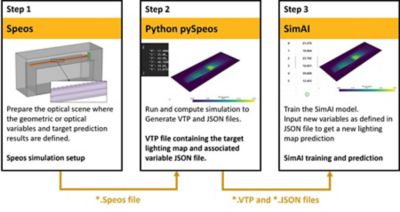
The simulation workflow and key results
Business and Technical Advantages
Integrating AI, cloud computing, and GPU acceleration into optical simulation workflows significantly enhances productivity and cost efficiency. Teams can explore expansive design variations while maintaining precision, enabling a deeper understanding of performance and compliance early in the development cycle. By automating complex optimization tasks and accelerating simulation runtimes, these technologies reduce the reliance on physical prototyping and minimize engineering overhead. Cloud-native scalability enables organizations to match computational resources to project demands without investing in expensive on-premises infrastructure, lowering operational costs. The enhanced speed and accuracy of GPU-accelerated workflows further streamline critical tasks, such as regulatory validation and environmental testing. This advanced approach empowers engineering teams to address modern optical challenges while optimizing resources, enabling businesses to deliver highly reliable solutions within tighter timelines and budgets.
The Future of Optical Engineering
The growing demands of modern optical systems require advanced, scalable solutions that traditional workflows cannot provide. By integrating AI, cloud computing, and GPU acceleration, engineering teams can achieve unprecedented levels of performance, precision, and efficiency in their simulations. These technologies enable faster iteration cycles, broader design exploration, and deeper insights into complex optical challenges. The unified approach streamlines workflows, reduces development costs, and accelerates innovation, empowering organizations to deliver high-quality solutions while staying competitive.
Read more about accelerating your designs with AI, cloud, and GPU capabilities in this white paper.
Interested in taking your optical systems to the next level? Check out these webinars:
- Enhancing Optical System Performance with Ansys optiSLang and Ansys Zemax OpticStudio
- Driving Design Optimization with Ansys optiSLang and Ansys Lumerical
- Optimize Your Simulation with Ansys Speos and Ansys optiSLang | Ansys
- Accelerate Photonic Simulation with Ansys Cloud Burst Compute for Lumerical FDTD
- Accelerating Photonics Simulations with Ansys Cloud Burst Compute™ for Lumerical

Just for you. We have some additional resources you may enjoy.
“What used to take hours — or even days — of simulation can now be predicted in seconds using AI surrogate models. That speed lets us ask better questions earlier and move forward with much more confidence."
— Adam Reid, Executive Director of R&D, Synopsys



The Advantage Blog
The Ansys Advantage blog, featuring contributions from Ansys and other technology experts, keeps you updated on how Ansys simulation is powering innovation that drives human advancement.