The Reynolds number (Re) of a flowing fluid is a dimensionless quantity sometimes used by engineers to help predict flow patterns for different situations. It represents the ratio of inertial forces to viscous forces. The ratio indicates whether the movement of a liquid or gas follows a mean streamline (laminar flow) or if there are unsteady fluctuations around the mean streamline (turbulent flow).
The chaotic behavior of the fluid in turbulent flow occurs when the resistance to change in velocity (the inertial forces) exceeds the forces that oppose relative motion between different layers in the fluid and any solid boundaries, known as the viscous forces.
A higher Reynolds number indicates flow where inertial forces are dominating and turbulent flow develops. In turn, a lower Reynolds number indicates flow dominated by viscous forces and exhibits smooth or sheet-like laminar flow.
From a practical standpoint, the Reynolds number is a fundamental dimensionless quantity in fluid mechanics that effectively reduces the number of variables needed and enables meaningful correlations of physical phenomena in scalable systems. Engineers and scientists can use a calculated value for Reynolds number to predict if and where a flow field will transition from laminar to turbulent flow to decide which equations to apply when simulating types of flow and to compare flow fields across different applications or scales.
Whether designing an airfoil or modeling the complex behavior of fluids in industrial systems, fluid dynamists can start by calculating the Reynolds number for the flow situations they are studying.
The concept of characterizing when turbulent flow might develop based on the ratio of inertial and viscous forces was introduced by George Stokes in 1851, in the work leading to the development of the Navier-Stokes Equation. However, a practical application of the concept didn’t emerge until Osborne Reynolds began studying the development of turbulent flow in pipes. He published a paper in 1883 describing “An Experimental Investigation of the Circumstances Which Determine Whether the Motion of Water Shall Be Direct or Sinuous, and of the Law of Resistance in Parallel Channels.”
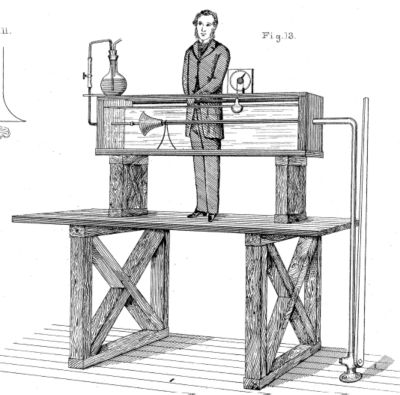
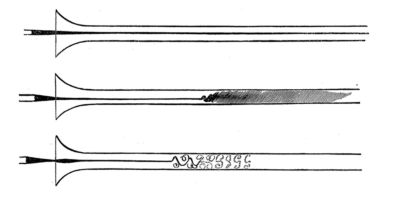
The experiments introduced a stream of dye into the center of a clear glass pipe carrying water. Reynolds used a control valve to vary the flow, and when the velocity was low, the dye stayed together in the center. However, when the velocity increased, the layer of dye broke up and spread into the water. The paper defined the location where the diffusion started as the transition point.
A drawing of the test apparatus that Osborne Reynolds used from his 1883 paper
When reviewing the data, Reynolds derived a dimensionless parameter to predict the laminar-to-turbulent flow transition as a function of fluid density, pipe diameter, flow velocity, and fluid viscosity change. Reynolds did not name the dimensionless number after himself. That happened in 1908 when Arnold Sommerfeld used the value in a paper and named it after Reynolds.
The basic Reynolds number equation is a ratio of inertial and viscous forces. Engineers have developed several different forms depending on the desired application. Every application has a characteristic length scale that defines a distance, like diameter or length, and a characteristic velocity that represents the flow rate in terms of flow velocity, mass flow, or volume flow.
Here is a listing of the most common forms used for Reynolds number:
$$R_e = \frac{Inertial Force}{Viscous Force} $$
$$R_e (dynamic \space viscosity) = \frac{\rho uD_h}{\mu} $$
$$R_e (kinematic \space viscosity) = \frac{uD_h}{\nu} = $$
$$ R_e (volumetric \space flowrate)= \frac{\rho QD_h}{\mu A} $$
$$ R_e (mass flowrate) = \frac{WD_h}{\mu A} $$
$$ R_e (airfoil) = \frac{VL_c}{\nu}$$
$$ R_e (flat ~ plate) = \frac{Vx}{\nu}$$
Where (with MKS units):
Fluid properties
| ⍴ | density of the fluid (kg/m3) |
| 𝜇 | dynamic viscosity of the fluid (kg/mᐧs) |
| $$ {\nu}$$ | kinematic viscosity of the fluid, (m2/s) |
Characteristic velocity
| u | mean velocity of the fluid (m/s) |
| Q | volumetric flow rate of the fluid (m3/s) |
| W | mass flow rate of the fluid (kg/s) |
| V | velocity of an airfoil through the fluid (m/s) |
Characteristic length scale
| Dh | hydraulic diameter of a pipe, tube, or duct (ms) |
| A | cross-sectional area of the pipe(m2) |
| Lc | chord length of the airfoil (m) |
| x | length from the leading edge of the plate (m) |
Anyone involved in the study or use of fluid dynamics wants to understand the flow patterns in the system he or she is working with. Sometimes people want laminar flow, and sometimes they want turbulent flow. Therefore, it is crucial to understand the flow conditions under which fluid motion becomes turbulent.
For flow in a circular pipe where the diameter is the characteristic length, laminar flow occurs when Re is less than 2,300, and turbulent flow develops at Re greater than 2,900. You can see here that a low Reynolds number indicates that viscous forces keep the flow steady and along streamlines. This lower value, 2,300 for pipes, is referred to as the critical Reynolds number because it indicates the point at which the flow will transition from laminar to turbulent.
Illustrations from Reynolds’ original paper showing (from top to bottom) laminar flow at low velocity, mixing at higher velocity, and eddies revealed by an electric spark.
For flow over a flat plate, the characteristic length is the distance from the upstream (or leading) edge of the plate. The velocity is the freestream velocity well outside the boundary layer. With this definition, the critical Reynolds number where the flow becomes turbulent for a flat plate is typically 5 x 10⁵.
In the past, fluid dynamists determined the values used for the critical Reynolds number to indicate fully developed turbulent flow through experimentation for each application for a given type of fluid and geometry topology. They then used these values to predict where turbulence would occur and make changes to encourage or discourage that type of flow. Nowadays, engineers employing computational fluid dynamics (CFD) will sometimes use Reynolds numbers to decide which turbulence models to use and where to apply them.
Reynolds numbers are highly context-sensitive and use simplified representations of flow. The following is a list of the most common mistakes engineers make when using Re:
The ratio of internal forces to viscous forces represented by a Reynolds number has other applications that engineers use to calculate different values and drive their designs. Some of the most common are:
Engineers use Ansys CFD software in a wide range of industries to simulate fluid flow and heat transfer in complex geometries. From concept design and optimization to final-stage testing, Ansys CFD solutions provide streamlined workflows, advanced physics modeling capabilities, and accurate results that can be trusted to make design decisions.
Learn more about Ansys Fluent fluid simulation software, the industry-leading fluid simulation software known for its advanced physics modeling capabilities and accuracy.
Consider Ansys CFX computational fluid dynamics software, the industry-leading CFD software for turbomachinery applications, which provides an accurate, efficient way to simulate the complex flow physics of turbomachinery, such as compressors, turbines, and pumps.
如果您面臨工程挑戰,我們的團隊將隨時為您提供協助。憑藉豐富的經驗和對創新的承諾,我們邀請您與我們聯絡。讓我們共同合作,將您的工程障礙轉化為成長和成功的機會。立即與我們聯絡,開始對話。