Synopsys and Ansys power the future of innovation—connecting silicon to systems.

Medical devices typically provide challenges in terms of developing and building scalable workflows for design and customization to individual patients. However, modern fabrication tools and software are making it easier for manufacturers to speed up and even automate large parts of their production process. One key area of growth involves the use of new technologies to create high-quality, customizable devices.
Over the last few years, we’ve greatly expanded the medical applications of Ansys Simpleware Medical software, from adding Food and Drug Administration (FDA) 510(k) clearance and CE-marking certifications for Simpleware Medical, to developing artificial intelligence (AI) technology for speeding up common segmentation and landmarking tasks involving 3D image data.
We collaborated with Carbon and nTopology to demonstrate a seamless design and fabrication workflow to create a patient-specific tibial surgical cutting guide, using technologies such as 3D printing, design automation, and processing of anatomical scan data. So, how does this automated digital workflow come together?
Automated Segmentation and Landmarking in Simpleware Software
The workflow begins with acquiring patient-specific image data in the form of MRI or CT scans and processing it in Simpleware software. For this project, we used the Simpleware Knee CT tool, part of our Simpleware AS Ortho module, which uses AI-based machine learning (ML) algorithms to power automatic segmentation. Compared to manual, tedious work by users on segmenting regions of interest, this approach employs a one-click solution to rapidly segment bones of the knee and identify common anatomical landmarks. The algorithms are also trained by experts and verified for clinical professionals, and are also available for ankle CT, knee MRI, and hip CT data to give a 20 to 50 times faster rate of segmentation over manual operations.
In this case, we:
- Imported DICOM CT data of the knee and checked tags to ensure files were anonymized
- Visualized the image data as 2D slices and in 3D using background volume rendering
- Used the Knee CT tool in Simpleware AS Ortho software to automatically segment parts with a single click and a fast processing time
- Reviewed a summary detailing the segmented bones and anatomical landmarks
- Exported landmarks as a set of coordinates for use by nTopology in the design of the cutting guide
- Converted segmented bones into surface objects through the ‘mask to surface’ option for 3D printing and added an ID number using the emboss text tool
- Exported bones (surface objects) as 3MF files (other formats available include STL, OBJ, and 3D pdfs which can aid planning)
This workflow can be automated to process many patient cases with minimal input from the user to greatly speed up the generation of patient-specific bone geometries and the detection of anatomical landmarks.
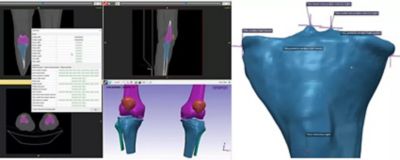
Automated tibia segmentation using Simpleware AS Ortho
Designing the Cutting Guide in nTopology Software
The Simpleware bone geometries and anatomical landmarks were then used in nTopology software to design the patient-specific tibial cutting guide. nTopology provides a geometry design and management platform that uses implicit modeling technologies to generate unbreakable geometries and fast, reusable workflows. Although the software is applied to different industries, in the field of medical devices it provides many options for customizing designs to different requirements. The nTopology approach can also be easily adapted and scaled to different patient anatomies to speed up workflows.
When working with Simpleware image data, nTopology:
- Created a conformal geometry for the cutting guide based on the patient-specific anatomy
- Implemented manufacturing considerations such as structural support columns
- Added cutting guide features based on key anatomical landmarks including an insertion panel and cutting plane
- Meshed the model and exported as a 3MF file for efficient printing
- Design workflow can be adapted to different anatomies depending on the patient and the device
- The workflow can be easily adapted and scaled to different patient anatomies
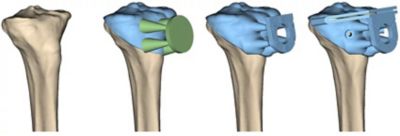
Cutting guide design workflow in nTopology
Printing the Finished Model Using Carbon 3D Printers
Finally, the actual patient-specific tibial cutting guide was manufactured using the Carbon DLS™ process to ensure a robust final product.
To do so, Carbon:
- Uploaded and oriented the file to their M2 printer
- Selected MPU 100 material due to its biocompatibility
- Added support structures
- Positioned and duplicated the part in the printer interface before printing
- Used their Smart Part Washer and removed supports
Baked the print, resulting in a finished cutting guide ready for inspection, sterilization, and packaging
The workflow from the image data processing in Simpleware software, via nTopology, to the 3D print in Carbon is very quick and flexible, with adjustments possible depending on the particular case and design requirements. In addition, as more data is added to the AI algorithm used for the Simpleware knee segmentation, the range of different features and pathologies can be expanded.
Future Plans
The success of this approach shows the potential of streamlining the process of going from image data to a print, offering benefits for medical device manufacturers and pre-surgical planning. In the future, the entire workflow could be housed within a dedicated 3D printing hub within a hospital, improving communication and making 3D printed models an even more valuable resource for patient care.
Learn more about Ansys Simpleware Medical software.
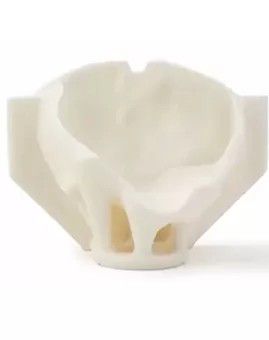
3D printed cutting guide using a Carbon printer

The Advantage Blog
The Ansys Advantage blog, featuring contributions from Ansys and other technology experts, keeps you updated on how Ansys simulation is powering innovation that drives human advancement.