Skip to Main Content

How Simulation Is Supercharging Automotive Electronics Modeling

六月 09, 2026

READ ALOUD

PAUSE READ

Laura Carter | Media Relations, Senior Staff, Ansys, part of Synopsys
banner-for-metamodeling

Today’s automotive electronics simulations push the boundaries of computational modeling in their size and complexity. Ansys, part of Synopsys, and EMA help customers leverage metamodeling to reduce time, effort, costs, and risks.

In an era where expectations for electrification, autonomy, and greater functionality are driving vehicle development, simulation will remain a proven method for diverse automotive system optimization for electromagnetic compatibility (EMC). Leading automotive manufacturers, as well as their Tier 1 suppliers, rely on simulation to predict electronics performance at the earliest stages of design for enhanced signal clarity and communication among multiple, densely packed systems.

This proliferation of automotive electronics has engineering teams pushing against the computational limits of processors, as well as traditional modeling approaches. Data volumes are growing, signals are multiplying, and sources of electromagnetic interference (EMI) are harder to discern and address among the growing electromagnetic “noise.”

“Modern vehicles are insanely complex in terms of the electromagnetic environment,” notes Sebastian Soldwisch, Senior Scientist and Product Manager at EMA (Electro Magnetic Applications), an Ansys Technology Partner. “For example, a modern car can have more than 1500 cables associated with its electric systems,” he says. “Even a small change, like moving a single cable, can result in major performance issues for the vehicle’s software and systems. Precision is critical. But, as numerical complexity increases, engineering teams are pressured to model and solve problems accurately, while still meeting urgent time and cost constraints.”

simulation-image-metamodel

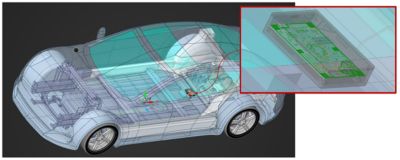
A printed circuit board (PCB) with an electronics enclosure inside a full-platform automotive model with a harness

Signal Metamodeling: The Wave of the Future

Ansys and EMA are partnering to increase the automotive industry’s adoption of an advanced technique, metamodeling, that provides a clear pathway forward for simulation power users.

Electric signal metamodeling uses simulation rules, prior results, established mathematical relationships, and custom algorithms to accurately replicate electromagnetic inputs and outputs, predict potential sources of interference, and isolate other predefined classes of problems in electronics engineering. Modern metamodeling approaches enable engineers to replace numerically large and complex models with more computationally efficient approximations so they can cut through the noise faster and more elegantly.

Metamodels empower teams to explore design innovations such as new cable layouts and advanced materials — or even design a complete electric vehicle architecture — without the huge computational burden traditionally associated with such an analysis. They can train a smart model once, then explore design adjustments instantly.

Not only does metamodeling reduce the time, cost, and risk associated with one simulation, but it also enhances reusability, flexibility, and efficiency as engineers create subsequent models. Emerging techniques, including adaptive neural networks, artificial intelligence (AI), machine learning (ML) techniques, and multiphysics integration are further refining the speed and accuracy of metamodeling.

“Think of metamodeling as building a model for modeling,” explains Soldwisch. “Automotive electrical engineers can now predict electromagnetic behavior in real time and across broader parameter spaces. When combined with today’s graphics processing unit (GPU) processing breakthroughs, metamodeling represents a productivity revolution. For some EMC and EMI studies, we’re seeing a 10x to 50x speedup. Engineers can simulate more physics, larger models, and more design iterations, faster and more efficiently than ever before.”

As competition grows in the global automotive industry and consumers demand more electronics features, metamodeling is quickly shifting from a best practice to a standard operating procedure in automotive engineering.

Get on the Fast Track to Metamodeling With Ansys and EMA

It’s no surprise that Ansys is at the forefront of signal metamodeling. We’ve made aggressive investments in this area and formed strong partnerships with leaders like EMA and NVIDIA that place our automotive customers at the forefront of simulation innovation.

Our metamodeling capabilities are significantly enhanced by our long partnership with EMA, a global leader in electromagnetic simulation, consulting, and measurement services, specializing in areas like EMI, EMC, and charging processes and phenomena. Together, we’ve developed a robust suite of solutions for optimizing automotive electronics.

By applying this comprehensive toolkit, electrical engineering teams can automatically generate and analyze large multiphysics datasets for cable and system configurations. Because they no longer have to make manual adjustments during each simulation cycle, engineers can rapidly explore hundreds or even thousands of design variations. ML algorithms, such as deep neural networks, help establish metamodels that predict signal integrity and interference with high accuracy.

These metamodels transform the traditionally discrete, step-by-step simulation process into a continuous design space, enabling real-time adjustments and optimization. This capability directly addresses urgent challenges in automotive engineering, such as handling dense wiring harnesses, ensuring compliance with safety standards, and reducing crosstalk between high-voltage and low-voltage systems. And, by using GPU acceleration, metamodel-enabled simulations can be performed at remarkable speeds, even for large-scale systems.

Driving Real Results: Metamodeling in Action

“The breakthrough results of metamodeling aren’t just theoretical. They’re already transforming the automotive industry,” says Soldwisch.

As one example, an Ansys automotive customer was recently challenged to optimize cable routing in a new vehicle architecture to mitigate crosstalk between high- and low-voltage cables. By using EMC Plus software and optiSLang software in tandem, engineers were able to automate their evaluation of various cable layouts, including adjustments to parameters like proximity, length, and orientation. Through a series of iterative simulations, data was generated to train a deep neural network, resulting in a highly accurate metamodel capable of predicting electromagnetic behavior across countless configurations.

The customer team specifically focused on the effect of minor variations in cable geometry, which significantly impacted both mode conversion and EMI. For example, just a 1 mm change in conductor length within a twisted pair cable resulted in a 60+ dB shift in mode conversion.

Because the metamodel generated these and other valuable real-time insights, engineers quickly identified optimal layouts that minimize interference, reduce crosstalk, and comply with automotive performance and safety standards. This example illustrates how advanced metamodeling and automated workflows accelerate the development of complex automotive systems, while still addressing critical safety and functionality challenges.

Charge Up Your Development Efforts, Starting Now

simulation-image-metamodel-2

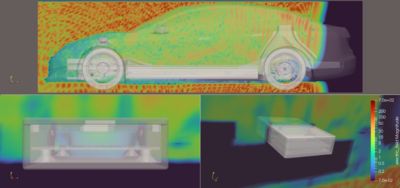
Fields impinging on a full-platform automotive simulation with an electrical enclosure

As electric and autonomous vehicles continue to grow in adoption, ensuring electromagnetic compatibility within densely packed systems remains a critical challenge. Engineering teams that can predict and mitigate issues like crosstalk and EMI at the earliest stages of design will have a significant marketplace advantage.

Contact us to learn more about how Ansys and EMA can help your team embrace metamodeling to supercharge your EMI and EMC analysis.


Just for you. We have some additional resources you may enjoy.

TAKE A LOOK


“Modern vehicles are insanely complex in terms of the electromagnetic environment.”

— Sebastian Soldwisch, senior scientist and product manager, Electro Magnetic Applications (EMA)


Laura Carter
資深企業傳訊經理

Laura 是一位多元作家兼創意專家,她致力提供有趣又豐富的文章,協助 Ansys 吸引讀者。在為原始設備製造商和各層級製造商管理帳號和撰寫文章方面,她具備豐富經驗,並提供獨特的汽車產業觀點和專業。

Recommendations

How Simulation Is Supercharging Automotive Electronics Modeling

How Simulation Is Supercharging Automotive Electronics Modeling

Learn how Ansys, part of Synopsys, and EMA help customers leverage metamodeling to reduce time, effort, costs, and risks with automotive electronics simulations.

邁入電動馬達設計的下一階段

邁入電動馬達設計的下一階段

Optiphase Drive Systems 使用 Ansys 軟體推出創新的五相馬達設計,可推動變革。

與模擬一起邁向不同的未來

與模擬一起邁向不同的未來

Learn about the evolution of software-defined vehicles and the need for model-based engineering solutions.

The Advantage Blog

The Ansys Advantage blog, featuring contributions from Ansys and other technology experts, keeps you updated on how Ansys simulation is powering innovation that drives human advancement.