Synopsys and Ansys power the future of innovation—connecting silicon to systems.

Simulation technologies have revolutionized the way sports teams approach equipment development. In cycling, where minor gains can determine success, the application of computational fluid dynamics (CFD) enables precise analysis of aerodynamic properties. Unlike traditional wind tunnel tests, CFD offers a virtual environment to quickly and cost-effectively evaluate and refine designs, minimizing the need for physical prototypes. By simulating airflow interactions with bike components, engineers can identify opportunities to reduce drag and improve speed with exceptional detail. This method is particularly valuable for components like rims and hubs, where even minor adjustments can significantly impact overall performance.
With more than 500 races, 14 French national champion jerseys, three monuments of cycling, and 38 Grand Tour stages under their tires, France-based Équipe cycliste Groupama-FDJ United proves success starts with research and development (R&D). Through the Besancon Performance Center, its R&D team, led by Frédéric Grappe, and technical department, led by Jérémy Roy, Équipe cycliste Groupama-FDJ United uses computational fluid dynamics (CFD) to optimize the aerodynamics of their bikes, helmets, rider position and more.
Ahead of the 2026 season, Équipe cycliste Groupama-FDJ United ran a simulation study in partnership with high-end cycling component manufacturer Miche to develop and improve the aerodynamic performance of their wheel rim and hub designs. These components play a critical role in minimizing drag, directly impacting speed and efficiency. The team, closely collaborating with Victor Simonin, R&D Engineer and CFD expert at Équipe cycliste Groupama-FDJ United, targeted improvements across a range of side-to-side — or yaw — angles to account for the varying wind directions during real-world cycling scenarios. Using detailed CFD simulations created with Ansys Discovery structural simulation software, and Ansys Fluent fluid simulation software, they optimized the airflow interaction between the tire and rim while addressing the overall aerodynamics of the wheel. By evaluating multiple prototypes, they identified the optimal configuration that not only decreased drag but also maintained consistent performance under different conditions. Their new wheel configuration gets its inaugural ride in the 8-stage Paris-Nice race from March 8-15, 2026.
The Methods to the Madness
The simulations relied on the k-ω SST turbulence model, which can capture a variety of flow conditions. This method enabled the team to analyze intricate airflow patterns and their effects on drag. To replicate realistic riding conditions, the team used a consistent inlet velocity of 13.89 m/s (50 km/h) with a turbulence intensity of 0.5%. Mesh parameters were carefully calibrated, with around 47–51 million cells and a clearance of 5mm between the wheel and the ground, ensuring high-resolution results.
The complexity of high-resolution simulations often leads to extended computation times, presenting a key challenge in aerodynamic analysis. To address this, the team used simplified geometries, omitting spokes and incorporating a 140mm rotor diameter alongside a basic hub design, and adjusted computational settings to balance accuracy with efficiency. The use of advanced parallel computing significantly reduced processing durations, allowing for more iterations within a feasible timeframe. Fine-tuning boundary conditions and validating assumptions helped ensure reliable results while avoiding the need for overly detailed models that could increase computational load. Compatibility with engineering software tools was essential for translating simulation outcomes into actionable design changes. Streamlining data transfer between simulation platforms and prototype development workflows minimized delays and improved productivity. These strategies allowed the team to navigate the inherent complexities of CFD while maintaining the accuracy and relevance of their aerodynamic evaluations.
Each simulation accounted for multiple yaw angles (-10°, -5°, 0°, 5°, 10°), representing the range of wind directions a cyclist might encounter. The rims were tested with GP5000 STR 28mm tires to ensure consistency, and the designs were compared using weighted drag coefficients to evaluate performance. By standardizing key variables and refining computational settings, the team ensured the reliability and comparability of results across all prototypes.
The project analyzed several rim and hub prototypes to identify configurations that enhanced aerodynamic efficiency. The Miche Kleos RD 50 served as the reference model, with additional prototypes incorporating adjustments such as optimized hub profiles and altered rim shapes. These changes were designed to influence airflow patterns and reduce drag by improving the interaction between the tire and the rim.
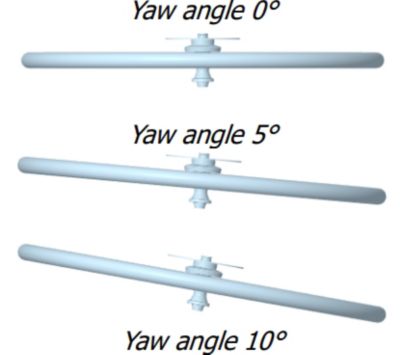
Different yaw angles Équipe cycliste Groupama-FDJ United studied
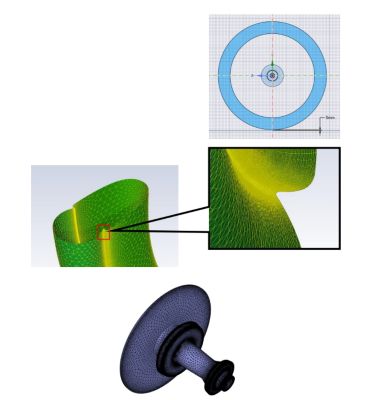
Mesh parameters
Simulations revealed how each design modification affected performance under various wind conditions, with the optimized prototypes delivering measurable aerodynamic gains. For example, one option introduced a refined rim and hub combination that demonstrated superior airflow management, particularly at wider yaw angles, resulting in significant drag reduction. By examining the aerodynamic behavior of these designs at high resolution, the team uncovered specific characteristics that contributed to improved efficiency. The variations in hub design and rim geometry provided insights into how design elements interact dynamically, spotlighting opportunities for further optimization.
Getting Results
The simulation results showcased how each prototype performed across different yaw angles, highlighting distinct aerodynamic behaviors. At wider yaw angles, such as 10°, option 2 stood out due to its improved interaction between the tire width and rim geometry. This design adjustment effectively managed airflow, leading to notable drag reduction compared to the reference model. At lower yaw angles, the prototypes exhibited performance variations, with minor improvements observed in drag coefficients. The analysis revealed that hub design significantly influenced the aerodynamic performance of the rim behind it, particularly under oblique wind conditions. The refined rim shapes in the optimized designs improved airflow alignment, reducing turbulence and enhancing overall efficiency. Detailed airflow visualizations and pressure distributions further supported these findings, demonstrating how design changes impacted wake structures and pressure gradients. These results provide valuable insights into the nuanced effects of design features on the aerodynamic performance of cycling components.
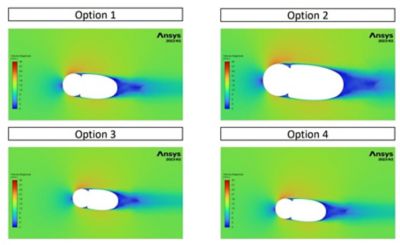
Velocity simulation at 5°
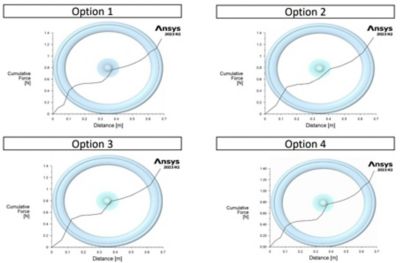
Drag evolution of the wheel at 0°
Through careful simulation and analysis, the team identified specific design elements that enhanced efficiency, particularly in rim and hub interactions leading to a significant reduction for the wheel. These results emphasize the importance of evaluating how design changes perform under realistic conditions, including varying wind angles, to ensure practical gains on the road.
The success of this approach paves the way for exploring more advanced designs and refining existing methodologies to further optimize performance. Expanding CFD applications to other bicycle components, such as frames and handlebars, could unlock additional opportunities for drag reduction. As computational tools and techniques continue to evolve, incorporating real-world variables and refining multi-component interactions will further enhance accuracy and reliability. Équipe cycliste Groupama-FDJ United's commitment to innovation sets a strong example for integrating simulation-driven design into sports engineering, showcasing how data-driven insights can contribute to tangible performance improvements.
Learn more about how Discovery and Fluent software can help with your aerodynamic optimizations.



The Advantage Blog
The Ansys Advantage blog, featuring contributions from Ansys and other technology experts, keeps you updated on how Ansys simulation is powering innovation that drives human advancement.