Synopsys and Ansys power the future of innovation—connecting silicon to systems.
-
-
학생용 무료 소프트웨어에 액세스하기
차세대 엔지니어에게 힘을 실어주는 Ansys
학생들은 세계적 수준의 시뮬레이션 소프트웨어를 무료로 이용할 수 있습니다.
-
지금 바로 Ansys에 연결하십시오!
미래를 설계하기
시뮬레이션이 다음 혁신을 어떻게 지원할 수 있는지 알아보려면 Ansys와 연결하십시오.
무료 트라이얼
제품 및 서비스
학습하기
회사 정보
Back
제품 및 서비스

The rapid rise of artificial intelligence (AI) is bringing a growing dependency into sharp focus: electricity. In recent months, several leaders in the technology sector have publicly acknowledged that deploying new AI capacity is constrained less by component availability than by the ability to power the necessary infrastructure. Energy has now emerged as a structural factor in digital performance.
This reminder is essential. AI relies on substantial physical assets: data centers, cooling systems, electrical grids, and dispatchable generation capacity. When these building blocks are not aligned, the value created remains partial and investments struggle to reach their full potential.
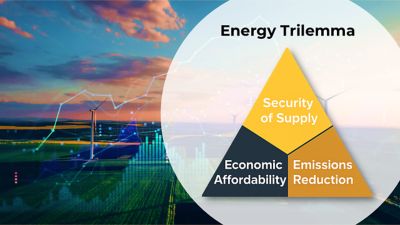
The Energy Trilemma Under Increasing Strain
This reality echoes a challenge well known to the energy sector: the trilemma of security of supply, economic affordability, and emissions reduction. In Europe, the energy crisis triggered by the war in Ukraine highlighted the fragility of this balance, exposing import dependence, price volatility, and the constraints imposed by climate trajectories. In the Middle East, in just the first weeks of the Iran war, the global oil supply was reduced by 8% and 20% of the world’s natural gas supply went offline — from production shipment restrictions, spare parts delivery risks, and damaged facilities.
The ramp-up of AI is taking place in this already constrained context. It does not introduce a conceptual rupture, but it does intensify existing tensions. Digital demand is rising rapidly and requires energy that is stable, continuous, and of industrial-grade quality. According to McKinsey & Co., the global investment required to expand data center capacity could reach USD 6.7 trillion by 2030. This dynamic further increases pressure on power systems that must, at the same time, integrate a growing share of low-carbon energy and absorb the electrification of other uses.
Efficiency as an Immediate Strategic Lever
In the face of these tensions, debate often focuses on developing new generation capacity. Yet in the short term, one of the most effective levers remains improving efficiency, as nearly two-thirds of the energy produced worldwide is ultimately lost across the stages of production, conversion, and consumption. Reducing these losses delivers immediate benefits, both in terms of energy availability and emissions reduction.
The orders of magnitude are striking. Nearly one-third of global emissions come from producing electricity and heat, a significant share of which is then consumed by industrial uses, particularly electric motors (45%). In this context, efficiency gains at scale — even modest ones — can have measurable effects across the entire system. Improving existing assets thus becomes a condition for sustainability, on par with developing new energy sources.
A Transition Complicated by Long-Lived Infrastructure
The energy sector has a defining characteristic: the longevity of its assets. Power plants, grids, and industrial equipment have been designed to operate for several decades. Many were installed before the widespread adoption of sensors, connectivity, and industrial data.
Transformation therefore must take place on systems that are already in operation, under stringent requirements for safety, service continuity, and regulatory compliance. This constraint complicates the transition but also raises the stakes. Modernizing and optimizing these assets improves availability, reduces losses, anticipates failures, and enables better trade-offs among cost, resilience, and environmental performance.
The Structuring Role of Digital Engineering
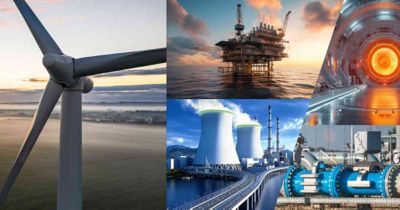
Advancements in simulation and analysis are revolutionizing the entire energy ecosystem, spanning energy sourcing across wind, solar, nuclear and gas, energy conversion, and ultimately energy consumption. In this context, digital engineering applies digital technologies to engineering activities across the entire life cycle of energy systems, from design through operation. The objective is to reduce technical uncertainty, accelerate decision-making cycles, and limit the risks associated with capital-intensive choices, enabling faster, more robust deployment of energy networks.
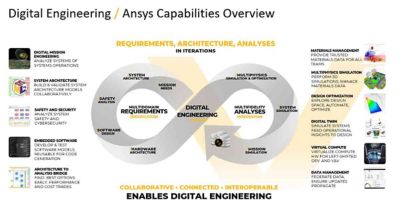
The digital engineering ecosystem
Multiphysics simulation enables detailed analysis of interactions among thermal, mechanical, electrical, and fluid phenomena. Systems engineering, through approaches such as model-based systems engineering (MBSE), helps structure complex architectures and maintain coherence among requirements, design, and operation. Simulation process and data management (SPDM) provides traceability, reproducibility, and collaboration across projects that are often distributed. Finally, integrating AI accelerates computation, broadens exploration of design spaces, and leverages data generated during operation.
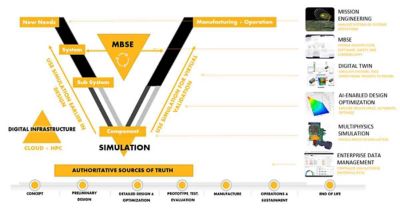
Model-based systems engineering (MBSE): bridging requirements to simulation at scale
Digital twins extend this logic once assets are in service. By linking the real behavior of equipment to its digital model, twins enable performance optimization, anticipate maintenance needs, and shift from corrective to predictive approaches. In a capital-intensive sector, such as energy, these operational gains directly impact availability, safety, and cost.
For example, in developing direct air capture systems, Climeworks used multiphysics simulation to evaluate more than 500 design variants, achieving design cycles five to 10 times faster than physical testing while reducing energy consumption, cost, and failure risk.

Advantages of digital engineering
Energy and AI: A Now Reciprocal Dependency
AI contributes to rising energy demand, but it can also become a tool to optimize systems — provided that it remains anchored in the physical reality of infrastructure. Conversely, without available, reliable, and progressively decarbonized energy, the promises of AI remain limited. Digital, industrial, and energy strategies are now deeply intertwined.
For industrial players, these choices increasingly determine competitiveness, production capacity, and ultimately the attractiveness of industrial sites themselves.
Investing in AI without simultaneously investing in energy leads to a dead end: undercapacity. The trajectory of digital growth will depend on the ability to secure supply, improve efficiency, and transform existing infrastructure. The energy trilemma is no longer a theoretical framework; it now conditions the pace and credibility of technological development.
Addressing it requires clear industrial choices and tools that can accelerate transformation without compromising reliability. Only under these conditions can AI become a credible lever of the energy transition rather than an additional constraint on systems that are already under strain.
As AI continues to reshape the global landscape, the energy sector sits at the center of this transformation. From ensuring grid reliability to optimizing low‑carbon technologies, every part of the energy value chain now plays a critical role in enabling AI’s growth — and benefiting from it. Ansys, part of Synopsys, plays a critical role in offering system‑to‑silicon solutions that help organizations design, optimize, and scale next‑generation technologies with accuracy and speed.
At Ansys, we support organizations across all major energy sectors, including:
- Nuclear power generation: existing and advanced nuclear systems, such as fusion, small modular reactors (SMRs), and microreactors
- Oil and gas: upstream, midstream, and downstream operations
- Renewables: wind, solar, hydrogen, and carbon capture
- Power generation: gas turbines and combined cycle plants
- Transmission and distribution: grid stability, power electronics, and substations
- Industrial electrification: motors, drives, and energy‑intensive manufacturing
- Emerging energy systems: energy storage, geothermal, and direct air capture
Our high-fidelity, multiphysics simulations and digital engineering solutions help energy leaders strengthen system resilience, improve efficiency, accelerate innovation, and navigate the tight balance of the energy trilemma. Our capabilities uniquely bridge physics-based simulation, semiconductor design, and full‑system analysis, empowering innovators to meet the energy and performance demands of AI at every level of the technology stack.

Visit us at Booth No. 723 at the Global Energy Show in Canada from June 9 to 11. Discover how Ansys helps energy leaders tackle today’s toughest industry challenges with powerful digital engineering solutions.
We’re also proud to participate in an executive panel discussion, where we’ll share insights on the future of energy innovation. We look forward to connecting with you there.

Just for you. We have some additional resources you may enjoy.
Meet With Us
Visit us at Booth No. 723 at the Global Energy Show in Canada from June 9 to 11. Discover how Ansys helps energy leaders tackle today’s toughest industry challenges with powerful digital engineering solutions.

The Advantage Blog
The Ansys Advantage blog, featuring contributions from Ansys and other technology experts, keeps you updated on how Ansys simulation is powering innovation that drives human advancement.