Synopsys and Ansys power the future of innovation—connecting silicon to systems.
-
-
학생용 무료 소프트웨어에 액세스하기
차세대 엔지니어에게 힘을 실어주는 Ansys
학생들은 세계적 수준의 시뮬레이션 소프트웨어를 무료로 이용할 수 있습니다.
-
지금 바로 Ansys에 연결하십시오!
미래를 설계하기
시뮬레이션이 다음 혁신을 어떻게 지원할 수 있는지 알아보려면 Ansys와 연결하십시오.
무료 트라이얼
제품 및 서비스
학습하기
회사 정보
Back
제품 및 서비스

NExT is poised to change the future of public transportation with its innovative modular electric vehicle designs, with help from the Ansys Startup Program.
While media attention, environmental mandates, and government policy debates focus largely on privately owned cars and trucks, public transportation holds even bigger promise to drive increased sustainability. Around the world, 3.78 billion people rely on public transport every day, supporting a growing industry with annual revenues of $233 billion.
Electric buses are the fastest-growing transportation category, projected to grow from 279,236 vehicles in 2024 to over 1 million units by 2032. It’s no surprise, really, as the benefits of bus electrification are undeniable. In China alone, it’s been estimated that electric buses eliminate 440,000 tons of CO₂ annually.
But Tommaso Gecchelin — founder and chief technology officer at NExT, an Italian startup company — believes that the global transportation industry can do even better. “We often see buses running totally empty,” says Gecchelin. “It’s a normal scenario in every big city because public transportation vehicles are sized based on the maximum capacity. They’re unable to adapt to varying demand throughout the day.”
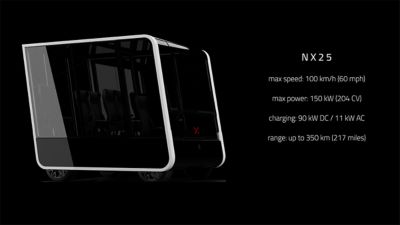
Modular vehicles from NExT can reach speeds of 60 miles per hour and have a charging range of 200 miles or more. NExT estimates that the vehicles reduce energy consumption by 50%-60% compared with traditional electric buses.
Gecchelin founded NExT in 2017 to address this problem. The company’s fleet of modular electric vehicles, or pods, are built to dynamically adapt transportation capacity based on demand. During peak commuting periods, up to five pods can be joined together using a robotic system. The result? A single, structurally sound vehicle with no articulation (up to 3 pods), which matches the capacity of a large urban bus. During less busy periods, transit authorities can convert them to smaller, lower-capacity configurations of one or two pods.
Because NExT’s zero-emission vehicles can adapt flexibly to demand, the company estimates that they have the potential to reduce electricity consumption by 50%-60% in public transit applications. This is due to lower propulsion needs and reduced heating and cooling requirements in their interior spaces during off-peak hours. And, because public transit operators can charge unused pods on a scheduled basis, cities can strategically distribute energy usage and reduce the strain on electricity grids.
With 50% less wear-and-tear than rigid capacity buses, NExT’s modular pods could potentially reduce maintenance needs and extend product life for lower long-term waste. Their smaller profile bus could also reduce traffic congestion by up to 80%.
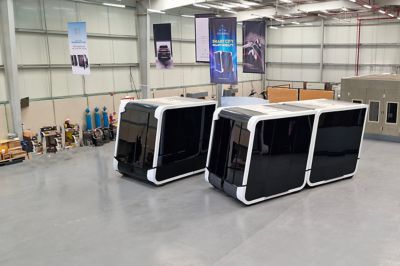
NExT’s modular vehicles can be flexibly configured to meet changing transportation demand. Transit authorities can employ a single pod during low-demand periods or join up to five pods to match the capacity of a traditional 18m bus.
Charging Up Innovation With the Ansys Startup Program
It all adds up to a winning proposition — but also significant engineering challenges. Optimizing vehicle performance is the job of an eight-person development team at NExT that includes Edoardo Fantin, chief engineer of NExT. Through the Ansys Startup Program, and with support from Braitec Srl, Fantin uses advanced simulation solutions to optimize NExT product solutions for safety, aerodynamics, stress, and other key performance characteristics.
Created to fuel innovation in small companies with limited funding, the Ansys Startup Program has provided more than 2,700 startups with advanced Ansys software, high-performance computing (HPC) resources, technical support, and access to learning resources.
According to Fantin, the ability to leverage the power of simulation has been critical in advancing the design of NExT’s modular vehicle concept. “The engineering challenge is significant, as our vehicles are an absolute novelty in terms of form, motion docking capabilities, vehicle dynamics, and fleet management systems,” says Fantin. “We basically started from the ground up to answer the question, ‘How can we take electric public transport to a new level of efficiency?’”
In refining and improving the design concept, Fantin has studied a wide range of performance dimensions using Ansys software. “I often use Ansys Mechanical structural finite element analysis software to perform FEM analyses on critical vehicle components such as the cabin structure, the vehicle frame, and the coupling system,” he notes. “The latter, in particular, is a highly stressed component due to the masses of the vehicles involved, and we need to verify how those stresses are transmitted to the vehicle frames.

Nine prototype vehicles have been successfully road-tested in Padua and Dubai. NExT is beginning mass production this year, supported by simulations that optimized manufacturability.
“Being able to simulate stress and deformation of components before manufacturing them saves a significant amount of time compared with verifying it in the real world with physical testing,” Fantin adds. “We’ve been able to improve vehicle performance while also eliminating weight and driving substantial production cost savings. That’s extremely important for a startup.”
Fantin has also performed dynamic simulations, such as cabin rollover, with Ansys LS-DYNA nonlinear dynamics structural simulation software. Additionally, he’s applied Ansys Fluent fluid simulation software to optimize the vehicle’s aerodynamic drag coefficient, a key factor in estimating and reducing energy consumption.
“I first used Ansys software during my engineering studies at the University of Padua,” says Fantin. “The software is considered the industry standard, and the simulations accurately represent real-world behavior. I feel fortunate to be able to access Ansys solutions and other resources through the Ansys Startup Program.”
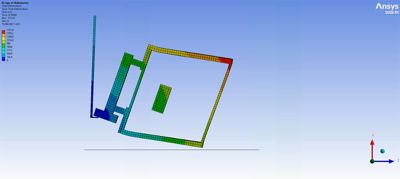
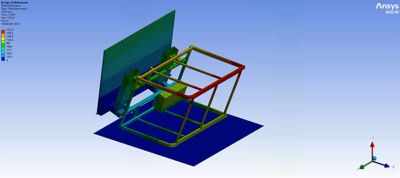
Vehicle rollover crash test simulation ECE R66
The Future of Transport: Coming to a City Near You
This year, NExT is beginning mass production of its modular pods. It intends to roll out 30 vehicles in 2025, followed by another 100 in 2026. The company is undertaking a multistage development and testing plan with Dubai’s Road and Transport Authority to support Dubai’s ambitious goal of becoming the most sustainable city on the planet by 2050. Nine prototype vehicles have already been tested in Dubai and Padua, where the company headquarters is.
“The steps we’re taking right now are among the most important in the company’s history,” says Fantin. “We’re beginning mass production of the NExT vehicle, thanks in large part to strategic partners like Ansys who believed in our vision and supported us. They’re an important driver of our success.”
Learn more about how the Ansys Startup Program can help you.

Just for you. We have some additional resources you may enjoy.
“Being able to simulate stress and deformation of components before manufacturing them saves a significant amount of time compared with verifying it in the real world with physical testing.”
— Edoardo Fantin, chief engineer, NExT




The Advantage Blog
The Ansys Advantage blog, featuring contributions from Ansys and other technology experts, keeps you updated on how Ansys simulation is powering innovation that drives human advancement.