Synopsys and Ansys power the future of innovation—connecting silicon to systems.
-
-
학생용 무료 소프트웨어에 액세스하기
차세대 엔지니어에게 힘을 실어주는 Ansys
학생들은 세계적 수준의 시뮬레이션 소프트웨어를 무료로 이용할 수 있습니다.
-
지금 바로 Ansys에 연결하십시오!
미래를 설계하기
시뮬레이션이 다음 혁신을 어떻게 지원할 수 있는지 알아보려면 Ansys와 연결하십시오.
무료 트라이얼
제품 및 서비스
학습하기
회사 정보
Back
제품 및 서비스

When you think about the technologies shaping our connected world — faster data transfer, more efficient networks, and scalable computing — photonics quietly sits at the center of it all. By using light instead of electricity to move information, photonic devices promise higher speeds, lower power consumption, and new possibilities for communications and computing.
According to McKinsey & Co., photonics-enabled systems already account for a roughly $1.4 trillion global market, with continued growth driven by the expanding adoption of light-based technologies across industries.
In this rapidly growing field, where light and data are harnessed to power technologies of the future, there’s no room for guesswork. Increasingly, photonics is recognized as a cornerstone for technologies such as artificial intelligence, quantum computing, and next-generation internet systems.
Simulation is Vital for Alcyon Photonics
Companies like Alcyon Photonics are using solutions from Ansys, part of Synopsys, to stay ahead of the curve. Alcyon specializes in developing photonic integrated building blocks and circuits (BBs and PICs), referred to as PIP cores® (Photonics IP Cores), that have been manufactured and validated at commercial semiconductor foundries. In simple terms, Alcyon designs photonic components that other companies can confidently integrate into larger systems, knowing they will work as expected. Its innovations are used in everything from high-speed data communication to advanced sensors.
As with any other division of the tech industry, working in this field presents a unique set of challenges. Designing photonic devices, which are often measured in micrometers, requires an extraordinary level of precision. Because light behaves in complex ways, especially at the nanoscale, tiny changes in geometry or materials can significantly impact performance. Add to this the pressure of rapid innovation and the demand for cost-effective production, and it’s clear why simulation tools are vital for companies like Alcyon.
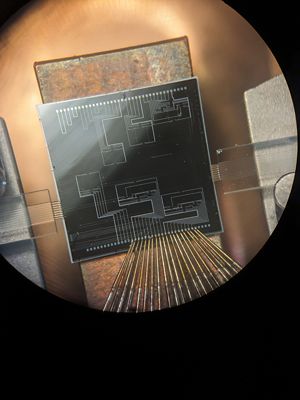
A close-up of an Alcyon Photonics chip in the test bench
Before incorporating advanced simulation tools, Alcyon faced challenges such as lengthy development cycles, costly prototyping, and the need for greater design predictability. The company needed a solution that could not only model its designs but predict performance in real-world conditions without the need for endless trial and error.
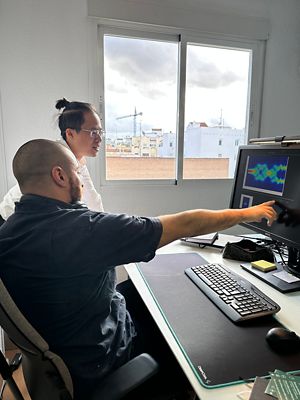
Alcyon Photonics engineers designing robust photonic building blocks using Ansys Lumerical software
Putting Simulation to the Test
For Alcyon, the integration of Ansys tools became a key component of its design and testing process upon its founding in 2018. It began using Ansys Lumerical FDTD advanced 3D electromagnetic finite-difference time-domain simulation software, the Ansys Lumerical CHARGE physics-based charge transport solver, and Ansys Lumerical INTERCONNECT photonic integrated circuit design and simulation software to test and refine designs virtually, saving both time and resources.
Thanks to the advanced capabilities of simulation to model complex physical phenomena with exceptional accuracy, Alcyon can simulate how light behaves as it passes through different materials and components. Using the Lumerical suite, Alcyon can analyze light interactions with devices at a microscopic level, ensuring optimal performance even before building a physical prototype.
Additionally, Ansys’ optimization tools help Alcyon refine its designs for maximum efficiency by running simulations that test different parameters and configurations. With that advantage, it can identify the optimal designs for devices without needing to build prototypes. This iterative process is not only faster, but also significantly reduces development cycles.
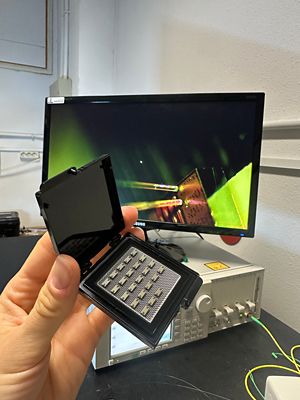
Manufactured chips for validating Alcyon Photonics’ building block designs. Optical testing carried out to characterize Alcyon Photonics’ designs is shown in the background.
“We managed to lower the simulations running for days down to hours. This allowed us to finish a design cycle in a much, much shorter time,” says Panaiot Zotev, technical lead building blocks at Alcyon.
Precision Marks the Spot
The use of Ansys tools has transformed how Alcyon approaches design and innovation. It has expedited development cycles by leveraging virtual simulations, enabling what used to take weeks or months to be completed in just days. This accelerated turnaround keeps the company ahead of the curve in such a competitive market, all the while providing the perfect domain for creating precise, high-performance designs.
Prototyping in the field of photonics remains a particularly challenging and risky feat. It’s not simple or economical to consistently recreate the exact environments needed to test complex designs. With the ability to test designs in a virtual environment, lengthy prototyping is a thing of the past. Simulation enables Alcyon to efficiently design robust photonic devices, which is crucial in a market where iterative prototyping can quickly deplete a budget.
To ensure that Alcyon’s devices are not only delivered faster but also more robust and reliable under varying conditions, it’s crucial to simulate real-world conditions. Factors such as temperature changes and physical stress are considered and measured through simulation. In an industry where failure is not an option, these simulations are critical.
In photonics, prototyping is about reducing uncertainty (technical, physical, and economic) before committing to fabrication or deployment. Because of the highly sensitive nature, modeling light-matter interactions with geometry, materials, and boundary conditions is not optional — it is foundational.
Ansys tools enable Alcyon to design devices with unparalleled precision and efficiency. By accurately modeling the behavior of light and other physical phenomena, the company can ensure that its devices fulfill strict performance requirements in real-world conditions. This is particularly important for applications in critical industries, such as telecommunications and computing, where reliability is non-negotiable.
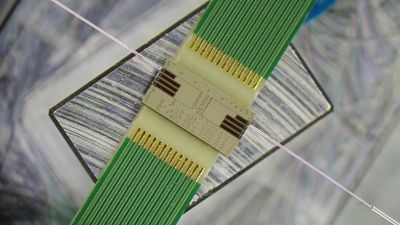
Image of an optical test of Alcyon Photonics’ validated designs using edge coupling
Transforming Simulations With GPUs
Alcyon achieved major victories through the use of graphics processing unit (GPU)-accelerated simulations, which are a game-changing feature of Ansys tools and capabilities. In its sub-wavelength grating (SWG) techniques — a computationally expensive design technique used in photonics which enables highly robust and broadband performance — Alcyon harnessed the speed of GPUs.
Irene Ayuso Pérez, technical lead building blocks at Alcyon, explains: “The problem with SWG is that it is difficult to fabricate. It’s not straightforward. It requires higher computational time to capture the essence of the SWG structure. It was actually the first design that we did with GPUs, and we were very happy to see an 8 times increase in the simulation speed.”
“We also did some particle swarm optimization algorithms for some of our designs, which was amazing in terms of the speedup of the GPUs,” says Ayuso Pérez.
“A particle swarm optimization algorithm requires hundreds of simulations until it finds the particular combination of parameters for optimization," she explains. “We could only do this thanks to GPU acceleration. With CPU computing, the number of simulations is simply overwhelming for our hardware.”
As a result of the greater operational efficiency provided by incorporating simulation, Alcyon is able to focus more on innovation, dedicating more resources to pushing the boundaries of the photonics industry.
A Bright Future in Photonics
For Alcyon, the adoption of Ansys tools has been a game changer. The ability to simulate, test, and optimize its designs — all virtually — has not only solved many of the challenges that it faced but has opened opportunities for innovation. By leveraging the advanced capabilities of Ansys software, the company has developed pioneering photonic devices that meet the demands of today’s technology landscape.
Looking ahead, Alcyon is poised to continue driving innovation in the photonics industry. With Ansys tools as a key part of its workflow, it has the flexibility and capability to tackle even more complex challenges. With the growing demand for high-speed communication, advanced sensors, and quantum technologies, Alcyon is well equipped to address those needs and continue shaping the future of photonic technology.
In today’s ever-evolving photonics landscape, where light is essential for data and connectivity, the collaboration between Alcyon and Ansys tools beautifully demonstrates the role of technology in fostering innovation. A commitment to precision, efficiency, and adaptability not only addresses current needs but sets a strong foundation for the groundbreaking technologies of the future.
Explore how to get started with GPU-accelerated Lumerical FDTD software, access the entire Lumerical suite with Ansys Optics, and scale your simulations with Ansys Cloud Burst Compute software for Lumerical software.

Just for you. We have some additional resources you may enjoy.
“We managed to lower the simulations running for days down to hours. This allowed us to finish a design cycle in a much, much shorter time.”
— Panaiot Zotev, technical lead building blocks, Alcyon Photonics



The Advantage Blog
The Ansys Advantage blog, featuring contributions from Ansys and other technology experts, keeps you updated on how Ansys simulation is powering innovation that drives human advancement.