Synopsys and Ansys power the future of innovation—connecting silicon to systems.
-
-
학생용 무료 소프트웨어에 액세스하기
차세대 엔지니어에게 힘을 실어주는 Ansys
학생들은 세계적 수준의 시뮬레이션 소프트웨어를 무료로 이용할 수 있습니다.
-
지금 바로 Ansys에 연결하십시오!
미래를 설계하기
시뮬레이션이 다음 혁신을 어떻게 지원할 수 있는지 알아보려면 Ansys와 연결하십시오.
무료 트라이얼
제품 및 서비스
학습하기
회사 정보
Back
제품 및 서비스

From optimizing logistics networks to revolutionizing drug discovery, quantum computing is poised to solve problems beyond the reach of today’s most powerful supercomputers. But there’s a catch: Building and scaling quantum computers is a monumental challenge that requires innovations not just in software but in the hardware that supports these groundbreaking machines. This is where photonics — the science of using light for information transfer — comes into play. At the intersection of photonics and quantum computing is Miraex, a company driving the hardware innovation needed to make quantum computing a reality. Based in Écublens, Switzerland, Miraex is tackling the complexities of quantum systems with the help of Ansys, part of Synopsys.
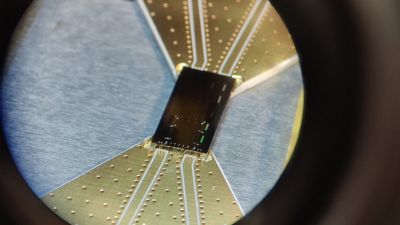
A chip with superconducting circuits wire bonding and ready for cryogenic testing. The cutouts on the sides allow optical access.
A 2024 graduate of the Ansys Startup Program, Miraex is a compact yet innovative company supported by Ansys Elite Channel Partner CADFEM. Miraex’s mission is to connect quantum components — in particular superconducting qubits — across larger networks, while also continuing to develop capabilities of connecting optical qubits (optical-optical conversion) on its platform, enabling even broader networking. While today’s computers use electrons to process and transfer information, quantum computers can benefit significantly from photonics.
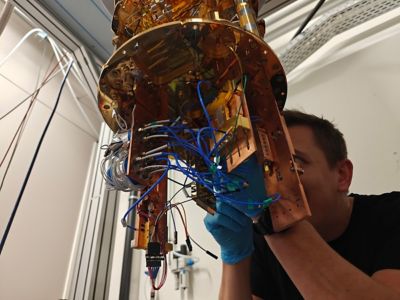
Quantum converter prototypes are loaded into a dilution refrigerator for testing at temperatures where superconducting qubits would typically operate (<0.1 K).
At Miraex, this work involves developing specialized hardware that converts microwave-frequency signals used in superconducting qubits into optical signals. These optical signals can then be transmitted over fiber-optic cables with minimal loss and interference. The goal is to establish quantum data centers where quantum devices can communicate seamlessly, all connected by Miraex’s cutting-edge optical systems.
By addressing challenges such as signal interference and compatibility between quantum components, Miraex enables new possibilities in the design and scalability of quantum computers.
Addressing Quantum Challenges With Simulation
When designing quantum hardware, there’s no room for guesswork. Simulation plays a critical role in ensuring that designs are optimized before a single component is physically manufactured. At Miraex, Ansys simulation tools are a cornerstone of the workflow, with tools like Ansys HFSS high-frequency electromagnetic simulation software, the Ansys Lumerical suite, and the Ansys Maxwell advanced electromagnetic field solver being essential for both microwave and optical circuit design.
“We’re taking fairly well-understood structures and putting a lot of them together in a rather complex arrangement. We need simulation to verify that when we put all the pieces together, things still work,” says Christopher Axline, chief technology officer of Miraex.
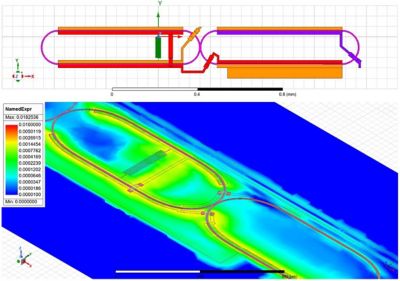
Verified with electromagnetic simulations, this simulation of a quantum converter includes a complex stack-up of superconducting and electro-optic materials, photonic waveguides, and out-of-plane airbridge crossings. The design comprises a “photonic molecule” made from two coupled optical racetrack resonators and a quasi-lumped element microwave resonator.
Quantum computing comes with its own unique set of challenges. From scaling up quantum devices to managing signal interference (cross talk) and handling extreme thermal conditions, building a robust quantum network is no small feat. Miraex encounters these challenges daily as it develops optical hardware for quantum systems.
One of the key issues is the cryogenic environment required for quantum devices to function. Superconducting qubits and their supporting hardware must operate at near absolute zero temperatures, making thermal management a top priority. Simulation tools enable Miraex to model how its components will perform under such extreme conditions, ensuring effective heat dissipation. Managing heat is critical: if too much is generated, it can directly affect qubits or exceed the system’s cooling capacity. When that happens, the quantum processor cannot scale efficiently, limiting the size and performance of the system.
Cross talk and scalability are also well-known challenges. When designing hardware that needs to accommodate hundreds or even thousands of quantum devices, ensuring clean signal transmission is critical. Simulation helps Miraex predict how its devices will interact, enabling engineers to minimize interference and maximize overall system performance. By reducing crosstalk, more devices can be densely integrated onto a single chip, increasing the number of channels and expanding system capabilities. This is especially important in dilution refrigerators, where both physical space and cooling power are limited.
By addressing these challenges through simulation, Miraex can create prototypes that are more reliable, cost-effective, and scalable from the start.
Simulating Across Microwave and Optical Domains
On the microwave side, HFSS software enables the team to model devices, such as resonators and traveling-wave structures. These components need to operate with extreme precision, resonating at specific frequencies and minimizing losses. HFSS software enables Miraex to simulate and fine-tune these designs for optimal performance before moving on to physical fabrication.
On the optical side, Lumerical software helps the team simulate lightwave behavior in components. This is crucial for developing efficient optical interfaces that can seamlessly convert signals between quantum devices. By integrating Python scripting into the workflows, Miraex can automate repetitive design tasks and easily co-analyze data from both microwave and optical simulations, making it easier to run complex simulations and refine designs quickly.
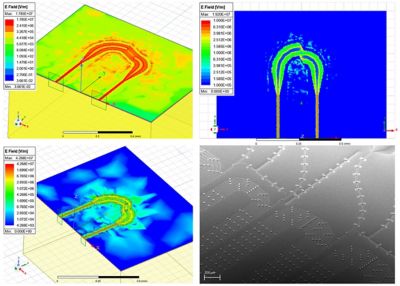
Electromagnetic simulation is used to fine-tune the design of a bend that steps over an optical waveguide. The field profiles are used to check for radiative loss while S-parameters verify low transmission or reflection loss. The bottom right photo shows the resulting microfabricated electro-optic circuits.
Saving Time, Reducing Risk, and Enabling Innovation
The benefits of simulation for Miraex extend far beyond troubleshooting technical challenges. One of the most significant advantages is the time and cost savings achieved by identifying potential issues early in the design process.
“The design and fabrication cycle can take about four months, let’s say. Without simulation, you would very likely lose four months because you would only be relying on test results, and you’d need another design cycle,” says Axline.
Simulation also enables Miraex to test ideas that would be too costly or risky to experiment with in the physical world. By modeling different configurations and material properties virtually, the team can explore a wider range of possibilities, increasing the chances of finding innovative solutions.
Scaling Design With Python-Driven Automation
To further accelerate design time and enhance simulation capabilities, Miraex also leverages Python scripting across various Ansys simulation tools.
By integrating with HFSS software on the microwave side of device design, Python enables the team to interact with HFSS software via an application programming interface (API)-driven workflow, allowing simulations to be configured, executed, and iterated programmatically rather than manually. This approach is especially valuable given the complexity of Miraex’s hybrid quantum-photonic hardware, where many well-understood components must be assembled, parameterized, and verified together in larger circuits. By scripting these processes, Miraex can efficiently explore design variations and manage complexity without slowing down the overall development cycle.
Programmatic control enables the team to build streamlined workflows that support high-volume simulation runs and final design verification, helping ensure that devices behave as expected before entering long fabrication cycles. “It’s enabled us to create a workflow that’s very straightforward and allows us, with high throughput, to assemble rather complex designs … and make sure that they are working at that desired final verification stage,” says Axline.
As Ansys continues to expand and enhance its Python integration, Miraex views this automation capability as a significant advantage — one that enables the company to expedite processes, lessen manual effort, and maintain confidence in increasingly complex, simulation-driven design decisions.
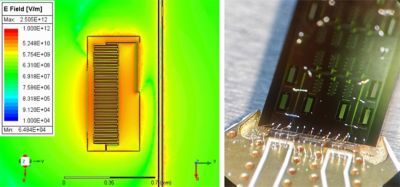
Superconducting resonators are used to verify the performance of Miraex’s superconducting platform. By comparing simulated and measured resonator performance, they can also be used as “yardsticks” to evaluate the performance of materials used in the stack.
Laying the Infrastructure for Quantum at Scale
Looking ahead in the world of quantum computing, Miraex envisions a future where its optical interfaces become the backbone of scalable quantum networks. In the next few years, it plans to further refine its hardware to support even larger quantum systems, enabling new applications in areas like data security, artificial intelligence, and material science.
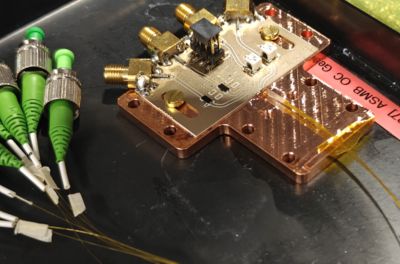
Cryogenic photodiodes are evaluated as part of a system designed to be used alongside quantum converters to optically control and read out superconducting qubits.
Simulation will remain a key enabler as Miraex expands its product offerings and takes on increasingly complex design challenges, pushing the boundaries of what’s possible in quantum computing and photonics.
While the path to scalable quantum computing is still being paved, simulation is helping companies like Miraex lay the groundwork for a technology that could transform industries and solve some of the world’s most pressing problems.

Just for you. We have some additional resources you may enjoy.
“The design and fabrication cycle can take about four months, let’s say. Without simulation, you would very likely lose four months because you would only be relying on test results, and you’d need another design cycle.”
— Christopher Axline, chief technology officer, Miraex



The Advantage Blog
The Ansys Advantage blog, featuring contributions from Ansys and other technology experts, keeps you updated on how Ansys simulation is powering innovation that drives human advancement.