Synopsys and Ansys power the future of innovation—connecting silicon to systems.
-
-
학생용 무료 소프트웨어에 액세스하기
차세대 엔지니어에게 힘을 실어주는 Ansys
학생들은 세계적 수준의 시뮬레이션 소프트웨어를 무료로 이용할 수 있습니다.
-
지금 바로 Ansys에 연결하십시오!
미래를 설계하기
시뮬레이션이 다음 혁신을 어떻게 지원할 수 있는지 알아보려면 Ansys와 연결하십시오.
무료 트라이얼
제품 및 서비스
학습하기
회사 정보
Back
제품 및 서비스
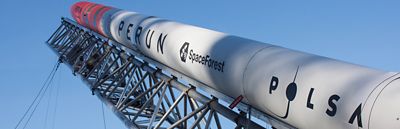
Long before a rocket launches into space, engineers must perform comprehensive computational fluid dynamics (CFD) analyses. These analyses enable engineers to accurately study the airflow and aerodynamics of their rockets, which is an essential step in the rocket development process.
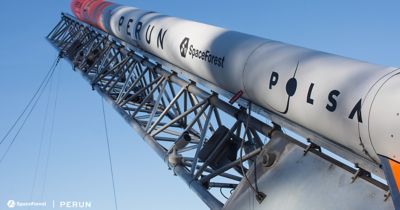
At SpaceForest — a Polish company developing and commercializing innovative solutions, including radars, advanced electronics, microwaves, and rockets — engineers use CFD analyses to design and develop their suborbital rocket, PERUN.
“PERUN is a single-stage suborbital rocket designed to carry 50 kg of payload to altitudes of more than 100 km,” explains Dr. Adam Matusiewicz, manager of the experimental rockets department, manager of the SALTO and LIDER projects, and technical manager of ESA BOOST! According to Matusiewicz, PERUN’s unique features include that it:
- Has reusable payload and booster sections
- Relies on an eco-friendly nitrous oxide/paraffin hybrid rocket motor. “This type of propulsion offers high safety and relative simplicity, combined with the possibility of shutting the motor off,” says Matusiewicz.
- Is guided by a Thrust Vector Control (TVC) system and proprietary algorithms
- Offers different payload modules (PMs) that accommodate a variety of payload volumes
- Uses a nondestructive flight termination system. “In case of a flight anomaly, the flight director can send the mission termination command, which shuts down the motor and separates the rocket into two segments,” says Matusiewicz. “Increased aerodynamic drag causes the segments to rapidly lose velocity so the rocket doesn’t keep going in the wrong direction. In such a scenario, recovery systems remain active, so segments will land safely on parachutes.”
- Is designed to be completely mobile and independent of external infrastructure, meaning that it can be launched from anywhere
All these features help SpaceForest reach its goal of making “access to space more affordable and faster so that more scientists and even private organizations can send things to space,” says Matusiewicz. This unlocks a variety of suborbital applications that span from scientific to commercial. In fact, PERUN already has previous and current missions involving biological, medical, and electronic payloads.
One such mission involved a tactical tourniquet dedicated for Polish Air Force pilots. “The experiment was designed as a stand-alone, 3D-printed chassis containing arm phantoms with (a) firmly applied military tourniquet,” says Matusiewicz. This experiment provided essential data on tourniquet performance over high loads.
As another example, take the Tremor Observation and Response (ThOR) project, which seeks to study how launch and suborbital flight conditions affect biological samples stored on three types of transport carriers. According to ThOR’s creators, “The results obtained will serve as a basis for the development of innovative methods for delivering biological payloads in a viable state to orbit.” This is essential research since transporting live biological samples is an enormous hurdle for those in the space industry. Tackling this issue is a key component to advancing space medicine, experimental biology, and more.
And these are just the beginning of PERUN’s potential applications. Due to its innovative, versatile design, Matusiewicz shares that “PERUN opens a new possibility for affordable access to space.”
The Inherent Challenges of Designing Innovative Rockets
Designing a unique, guided, and reusable rocket like PERUN requires a detailed understanding of aerodynamics, stability, and thermal performance under high-speed flight conditions.
As an example, consider the aerodynamic coefficients required to describe PERUN. Traditionally, obtaining these coefficients would require wind tunnel tests in aerodynamic tunnels; however, SpaceForest faced significant obstacles in this process. First, there are no wind tunnels in Poland large enough to accommodate the full PERUN rocket, which is necessary since the coefficients are applied to the whole rocket. Additionally, typical wind tunnel airflows are limited to speeds up to 100 m/s, which is far below PERUN’s flight velocities of up to 1,500 m/s. As a result, “it would be impossible to measure the aerodynamic coefficients for the whole range of velocities,” says Matusiewicz.
Another option would be to construct small-scale models and measuring setups for the supersonic aerodynamic tunnel testing. This option has its own pitfalls, though. Making these models is expensive, and the process often yields results that may not accurately reflect full-scale performance due to flow phenomena that do not scale effectively.
How Ansys CFD Solutions Help SpaceForest Innovate
To address these challenges, the SpaceForest team turned to CFD. “This is exactly where CFD saves the day,” says Matusiewicz. “It allows (us) to calculate required parameters without wind tunnel tests. This gives the first iteration of values, which are then used to set initial guidance parameters, and first flights can be made.”
As for its CFD solution, SpaceForest relied on Symkom, an Ansys, part of Synopsys, select channel partner, Ansys Fluent fluid simulation software, and HPC Pack licenses. Through these resources, the SpaceForest team was able to optimize essential elements of PERUN’s geometry, such as the housing of its onboard camera.
“Because this element protrudes from the body of the rocket, it is exposed to aerodynamic heating at high velocities,” explains Matusiewicz. “The camera also generates heat and has limited operating temperatures, so a series of aerodynamic heating calculations had to be made in order to optimize the design of this small element.”

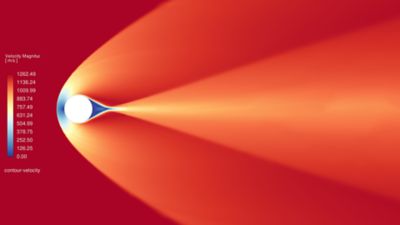
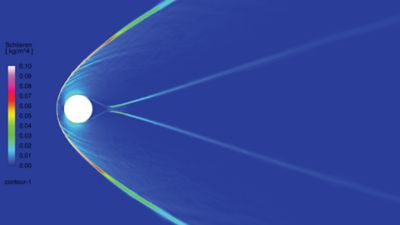
Simulation results showing PERUN’s side-on atmospheric entry. Image credit: SpaceForest.
Beyond cameras, the SpaceForest team can also use Fluent software to study the airflow around the entire rocket during all flight phases, gaining a better understanding of internal and external ballistics, refining control surfaces, ensuring stability at varying speeds, improving payload safety, and analyzing other essential design elements, such as the combustion chamber and nozzle.
When used in this way, simulation solutions provide a trustworthy method for maximizing thrust, enhancing reliability, lowering operational costs, and more. With Ansys solutions, SpaceForest can save time and money, performing its first “flights” in a virtual environment.
And this is not where its use of simulation ends, either. Looking ahead, SpaceForest plans to expand its capabilities to orbital missions, which will require additional simulation tools, including Ansys Systems Tool Kit (STK) digital mission engineering software.
Pioneering the Future of Affordable, Accessible Space Missions
SpaceForest’s innovative use of Ansys simulation tools has aided in the success of PERUN, thereby helping SpaceForest with its goals of opening the door to more affordable and accessible space missions and enabling groundbreaking work in suborbital environments. Already, SpaceForest has found significant triumphs. For instance, PERUN had its third successful test flight Nov. 22, 2025.
The system's advanced maturity is confirmed by successfully completing test flights, such as this one, with actual research payloads on board. SpaceForest is also currently conducting a call for experiments for upcoming suborbital missions — both those carried out in Poland and planned international flights in Portugal and Denmark. This will provide scientific and technological teams with the opportunity to test their technologies in space environments without the need for costly orbital missions.
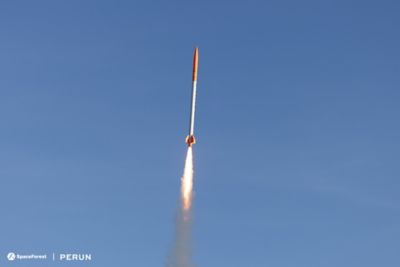
PERUN in flight. Photo credit: Strato Lens.
These successes mean that Matusiewicz is achieving one of his professional dreams: building a rocket that will go to space. At SpaceForest, “I found other people that had the same dream, and we have been working on rockets for the last 11 years,” says Matusiewicz. “PERUN is the second-biggest project in my life — the first one is raising children. … I’m generally proud of what we have managed to achieve. Having limited time and resources, we have made a rocket with functionalities that bring a lot of new possibilities to suborbital flights and can be later used for orbital launchers.”
Want to explore how Ansys simulation solutions are helping the space industry shoot for the stars? Check out other space industry success stories, and head this way to learn more about Ansys CFD solutions.

Just for you. We have some additional resources you may enjoy.
“Having limited time and resources, we have made a rocket with functionalities that bring a lot of new possibilities to suborbital flights and can be later used for orbital launchers.”
— Dr. Adam Matusiewicz, manager, experimental rockets department, manager, SALTO and LIDER projects, and technical manager, ESA BOOST!


The Advantage Blog
The Ansys Advantage blog, featuring contributions from Ansys and other technology experts, keeps you updated on how Ansys simulation is powering innovation that drives human advancement.