Birefringence (also known as double refraction) is an optical phenomenon that is present in certain materials. Most transparent materials feature a single refractive index that changes the path of light when it passes through the material. However, in birefringent materials, a light ray will experience two refractive indices, causing it to split into two rays that follow different trajectories.
The phenomenon of double refraction depends on both the material’s structure (i.e., the atomic lattice of the material) and the polarization and propagation direction of the incoming light ray. Unpolarized light entering a birefringent material is split into two different light rays known as the ordinary ray (o-ray) and the extraordinary ray (e-ray). The o-ray is polarized perpendicular (or orthogonal) to the optical axis — the direction in which light does not undergo double refraction — whereas the e-ray is polarized in a direction that is not strictly perpendicular to the optical axis. The two polarized light rays travel at different angles and speeds once refracted.
There are different crystals that naturally exhibit anisotropy and birefringent behavior. In optics, anisotropy refers to a material property that varies depending on the direction in which it is measured. Some materials that have these qualities include:
Additionally, there are several synthetic materials with noncrystalline anisotropic structures that can also exhibit birefringence, including:
There is a specific type of birefringence known as stress birefringence, which occurs when an external force or deformation is applied to a material. Stress birefringence is caused by the photoelastic effect ― also known as the piezooptic effect — which is usually prevalent in materials such as plastics and stretched films.
The introduction of stress causes changes at the molecular level, leading to a nonuniform distribution of atoms and different mechanical properties. The effect causes a material’s refractive index to change under an applied stress or load.
The photoelastic effect is similar to the piezoelectric effect in some ways. The piezoelectric effect is a physical phenomenon in which materials generate an electric charge when subjected to mechanical stress, while the photoelastic effect involves an applied load altering the charge distribution of a material. However, instead of a material’s electrical properties changing, it is the optical properties of the material that change under the atomic rearrangement.
Because birefringence occurs under an applied mechanical load, it enables the visualization of a material’s stress distribution. This is a useful way for testing the applied stresses and strain on optical components when they are integrated into larger systems, such as artificial and virtual reality (AR/VR) headsets.
There are many science and technology applications in which birefringence is used.
Birefringence is used to study material properties in different analytical characterization techniques, including:
Polarized light microscopy: This technique involves directing polarized light onto a sample, and the sample's birefringent properties alter the light’s polarization. The analyzer component in a microscope can then selectively transmit only the light with altered polarization, thereby increasing image contrast and providing information about the sample's intrinsic properties, such as structural and compositional details.
Optical coherence tomography (OCT): This technique uses the birefringence of different biological materials, such as human tissue, to add contrast to microscope images.
LCD screens use birefringent liquid crystals to display images and video. These liquid crystals change their refractive index when an electric field is applied. By controlling the orientation of the liquid crystals, the screen can control both the polarization and intensity of the light passing through.
Birefringence is used in fiber optic cables to transmit signals. Birefringence is used in fiber-optic components called wavelength selector switches, which act as optical gates that specifically select and route certain wavelengths along specific paths in the cable. Birefringent materials maintain the transmitted light’s polarization as it passes along the cable, which minimizes distortion and leads to more reliable communication lines.
Birefringence is also used in polarizing filters for cameras, microscopes, and other optical instruments. Polarizing filters are composed of materials with a grid-like, anisotropic structure. These control how light with different wavelengths passes through by blocking one of the two polarized components of light. This enables you to generate unique visual effects, as well as images with reduced glare and higher image clarity.
While there are many areas where birefringence can enhance functionality, stress birefringence can reduce an optical component’s performance.
In some applications, engineers have transitioned from using glass to plastics in lenses to make optical systems lighter and mass producible. However, polymers such as acrylics and PMMA are more susceptible to stress birefringence. While the effect is not as prevalent in glass, plastic optics can deform and change how light interacts with the material on a molecular level. Stress birefringence needs to be accounted for in all plastic lenses that are used in high-performance technology like smartphones, head-up displays (HUDs), and AR/VR headsets.
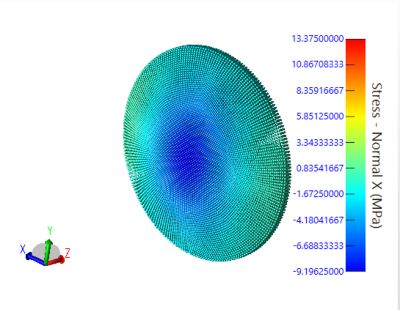
There are two main sources of stress birefringence in optical devices: manufacturing and mounting. During manufacturing, processes like injection molding can trap residual stresses inside the lens as it cools, as the outer edges cool faster than the interior.
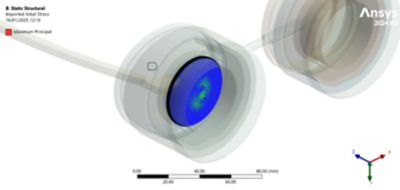
Additionally, when a lens is secured into its mount or housing, mechanical stresses introduced by that process can change the refractive index distribution inside the plastic lens. Because these stresses can alter a material’s intrinsic optical properties, they must be accounted for in simulation and modeling to ensure optimal lens performance and minimize optical losses, such as reductions in brightness and intensity.
Even loss of just a few percent in overall light transmission can reduce image quality and brightness outside of the specified ranges if not taken into account. This effect is noticeable in HUDs and AR/VR headsets, leading to low-contrast images that must be remedied by supplying more power to the system. For headsets, this is not ideal because it creates additional heat, which can be uncomfortable for the wearer and drain the battery faster.
There will always be some degree of optical error caused by birefringence, but manufacturers rarely provide information on how it affects their materials’ optical performance. As engineers develop more advanced optical components, understanding how birefringence impacts different materials’ performance will become increasingly important. Simulation and computational modeling can provide design insights by accounting for multiphysics effects such as stress birefringence and are key to unlocking the next generation of optical designs.
Advanced optical systems are becoming increasingly expensive to develop, prototype, test, and produce. Because of this, reducing the number of physical prototype testing cycles is essential for advancing product development while staying within budget. This helps save time, effort, and money by ensuring that the first physical prototypes are close to the intended specifications.
Ansys offers a range of tools, such as Ansys Zemax OpticStudio optical system design and analysis software and Ansys Mechanical structural finite element analysis (FEA) software, to understand different materials and their birefringence properties for a range of optical devices and end-use applications. These applications are also compatible with external tools such as MATLAB and Moldex3D.
Residual stresses in VR headset
Stress simulation in an injection-molded VR lens
Learn how Ansys solutions can help you simulate stress birefringence within advanced optical systems by contacting our technical team today.
如果您面臨工程挑戰,我們的團隊將隨時為您提供協助。憑藉豐富的經驗和對創新的承諾,我們邀請您與我們聯絡。讓我們共同合作,將您的工程障礙轉化為成長和成功的機會。立即與我們聯絡,開始對話。