Case Study
“Ansys Twin Builder software’s 1D System Simulation, its ability to support various modeling languages, and reduced order modeling technology are extremely powerful features. Both steady-state and transient conditions can be modelled, which has become a significant strength in the development of further glass solutions for EVs and development of our production process.”
— Tsunehiro Saito
Professional / Senior Manager, Innovative Technology Laboratories, AGC Inc.
Challenges
Today's EVs have the capacity to travel several hundred miles on a single charge. However, cabin thermal performance can significantly impact this range. Heat escapes through glass surfaces in winter, while solar heat enters through the glass in summer. This can make the cabin either extremely cold or extremely hot. Either scenario can cause an increase in HVAC system energy consumption that significantly contributes to range drop. "For EVs, the power consumption of a motor in standard driving mode is a few kilowatts,” says Saito. “The air conditioner also uses 2kW-3kW during summer and winter, which can be comparable to the motor's power consumption, potentially halving the driving range. Theoretically, if there were no heat loss in EVs, this waste of power could be eliminated. AGC has developed a range of automotive glass solutions designed to enhance thermal insulation and solar control to mitigate this loss.” The real-world physical testing AGC needs to evaluate its high-performance glass sufficient to improve EV range is often limited to an environmental wind tunnel that can simulate both summer and winter conditions. This testing method is not feasible for OEMs, as it is often subject to limited availability at a much higher cost. Additionally, building a wind tunnel inhouse would be prohibitively expensive for AGC in terms of both actual dollars and energy consumption.
Engineering Solutions
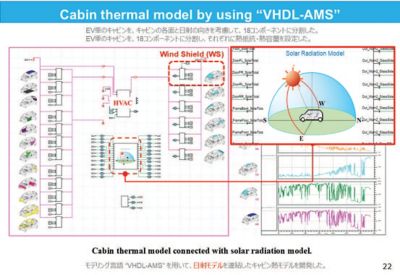
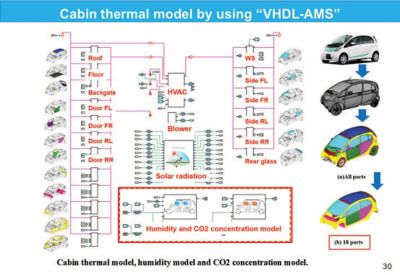
Since 2010, interest in model-based development (MBD) has gained attention in the Japanese automotive industry, leading to increased research activities within the Society of Automotive Engineers of Japan (JSAE) and the formation of an MBD committee, with AGC participating as a member. In addition, Japan’s Ministry of Economy, Trade and Industry (METI) established the MBD Promotion Center (JAMBE) with the aim of advancing the automotive industry. As part of the JSAE’s MBD activities, AGC used Ansys Twin Builder software to create a digital twin of the EV cabin, including a heat transfer model of the EV body and an HVAC model. A digital twin is an integrated, data-driven virtual representation of real-world entities and processes, with synchronized interaction at a specified frequency and fidelity. Twin Builder software enabled AGC to simulate and quantify the impact of solar radiation on the body and glass surfaces on cabin temperature and the resulting variations in driving range due to the use of air conditioning. It also helped AGC obtain accurate quantitative evaluations of range improvements of vehicles equipped with its glass, driving increased interest from OEMs in its high-performance EV solutions. “Compared to other competitive tools, Ansys Twin Builder software offers us some key advantages,” says Saito. “It enables easy construction of complex, multilayered hierarchical models and supports multiple programming languages. Its AI-enabled reduced order modeling (ROM) capability enables more advanced simulations that were difficult to achieve with conventional MBD tools. Models can also be exported to facilitate co-simulation with control models outside of the software.”
Benefits
- AGC developed both an EV vehicle model and a cabin thermal model in Twin Builder software, leveraging many part models already created within the JSAE committee.
- Calculating potential range improvements enabled AGC to present the quantitative benefits of its glass solutions to OEMs.
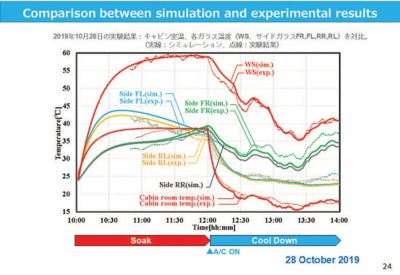
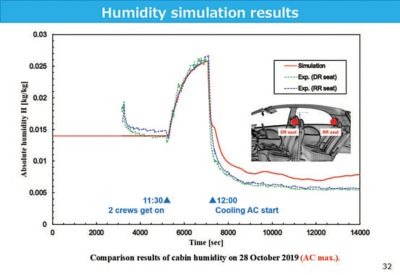
- Coming out of a virtual simulation environment, the range calculation of the resulting EV cabin model achieved a very high accuracy within ± a few percent compared to actual measurements.
- The Twin Builder-based EV model is now a key technical sales tool in AGC’s Automotive division as it enables the quantitative presentation of various glass solutions to many original equipment manufacturers (OEMs). AGC looks to Ansys to Improve Automotive Glass Performance So EVs Can Go Further // 2CASE STUDY
- AGC plans to use simulation to develop glass that allows for the miniaturization or elimination of defrosters as desired by customers, increases the share of high-value-added glass, and improves the profit margin of its automotive business in the future.
“Once accomplished, the miniaturization or elimination of defrosters, enabled by simulation, is expected to secure additional space for electronic components within the instrument panel. We anticipate this will reduce NVH (noise, vibration, harshness) and decrease power consumption for our customers,” says Saito.
讓我們開始吧
如果您面臨工程挑戰,我們的團隊將隨時為您提供協助。憑藉豐富的經驗和對創新的承諾,我們邀請您與我們聯絡。讓我們共同合作,將您的工程障礙轉化為成長和成功的機會。立即與我們聯絡,開始對話。