Synopsys and Ansys power the future of innovation—connecting silicon to systems.

How do you stay innovative and competitive in a fast-paced engineering environment? One solution is to use simulation, which enables engineers to explore design alternatives and bypass the need to perform costly physical prototypes. However, is it enough?
Optimization empowers Ansys customers and ensures that their simulations can scale and parallelize workflows, connect efficiently with multiple solvers, and offer high-performance computing (HPC) capabilities. By optimizing their processes, users can expect to run more simulations in less time and explore designs more deeply. Additionally, artificial intelligence (AI) technologies enhance optimization by pushing the limits of what’s possible, delivering results faster and with greater confidence.
Ansys optiSLang process integration and design optimization software brings powerful advancements in Ansys 2025 R2, including enhanced connectivity with solvers and powerful features through the optiSLang AI+ add-on. It also delivers significant advantages across its core platform, including improved solver integration and algorithmic capabilities that can enhance the efficiency and integration of your simulation-driven optimization workflows.
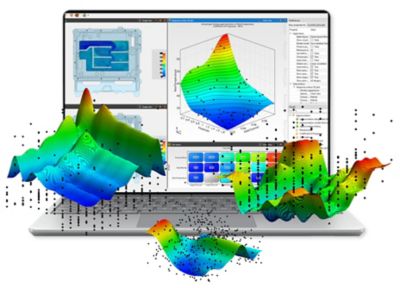
Ansys optiSLang 2025 R2 offers powerful advancements to benefit your workflows.
Now optiSLang software delivers the following improvements:
- The base update enables engineers to perform direct optimization within their solvers. It supports up to 10 parameters and leverages the Ansys Workbench platform with basic optimizers and metamodeling, streamlining early-stage design exploration.
- In the connectors and workflows domain, optiSLang 2025 R2 continues to support and expand interoperability through new project export options and connectors, enabling seamless integration by adding new tools, such as Ansys ConceptEV software, Ansys Thermal Desktop software, and the Ansys SimAI platform.
- With the integration of the optiSLang AI+ add-on, users can now perform advanced MOP (Metamodel of Optimal Prognosis) signal competition, which enables the automatic selection of signal results. This update is particularly relevant to crash tests and antenna designs.
- Finally, the interfaces and algorithms update introduces PyoptiSLang v1.0, which consolidates all connectors into a unified environment and enhances algorithmic capabilities. It also incorporates the Ansys Engineering Copilot assistant directly into the optiSLang UI.
One of the biggest changes that will benefit Ansys customers is that we now have a clear path from basic to advanced functionalities within Ansys solvers and optiSLang software. Indeed, customers can now run basic design studies as part of their flagship license. Engineers, especially fluid, electronic, and structural engineers, can now use optiSLang Base in Workbench to perform design of experiments (DOEs), metamodeling, and optimization embedded in Ansys solvers with up to 10 parameters and two objectives. This was previously achieved in Ansys DesignXplorer systems and is now unified into a single suite of products that starts with the base freemium and can be upgraded to more advanced products like Pro, Premium, or Enterprise to access the power of optimization, master the workflow, and scale parametric design studies. The Ansys optiSLang AI+ optional add-on can also be used to perform advanced AI/ML methods for greater efficiency.
The industry is already using Ansys optiSLang software in combination with Ansys solvers for increased performance and gains when it comes to designing products faster and better. For example, Vertiv recently delivered a keynote explaining the benefits of Ansys optiSLang at our latest event, Ansys Simulation World 2025. You can watch the replay of the "AI/ML – Future of Optimization for Cost Effective Design" session on demand.
This evolution reflects our commitment to making simulation-driven design more accessible, scalable, and intelligent for every engineer. With optiSLang software, users can unlock new levels of productivity and innovation across industries.
These updates collectively benefit optimization engineers, Ansys end users, and analysts across industries, offering a more cohesive and scalable simulation optimization ecosystem.


The Advantage Blog
The Ansys Advantage blog, featuring contributions from Ansys and other technology experts, keeps you updated on how Ansys simulation is powering innovation that drives human advancement.