
As electronic complexity grows, vehicles are becoming “noisier.” Learn how simulation optimizes electromagnetics to enable clearer signals and greater reliability.
Today’s vehicle builds are defined by a growing collection of electronic components, from control units to antennas and radios. While these electronics deliver important benefits, including increased communication and safety, they also present significant engineering challenges. Whether it’s the interior of a passenger car or the tighter confines of an agricultural tractor, vehicle cabins (or cabs) are getting “noisier” as more electronics are placed in closer proximity to one another.
This electromagnetic (EM) interference or “noise” can come from internal sources, like control units and cabling, but also from the external world. Wherever it originates, the impact of interference is clear: It keeps essential systems such as antennas, radios, and control units from performing as expected in day-to-day operation.
Small design choices, such as the positioning of an antenna or the routing of a cable, can significantly alter EM interference patterns, but often in unpredictable ways that are only revealed through trial and error. Similarly, the material properties of structural components can amplify or suppress noise in ways that are not always intuitive.
Even as modern vehicle designs evolve, the rigorous and unyielding safety standards of the automotive industry remain constant. There are no shortcuts for automotive engineers as they navigate the complexity of EM optimization, while simultaneously facing pressure to launch new designs as quickly and cost-effectively as possible.
Quieting EM Noise: Simulation Sends a Clear Signal
Fortunately, EM simulation provides a clear solution. Electrical engineering teams in the global automotive industry are applying Ansys, part of Synopsys, software to study system interactions, EM noise levels, and potential sources of interference. Using advanced simulation solutions from Ansys, engineers can model an entire vehicle cab in 3D with all its complex electronics. They can then analyze the behavior of electromagnetic fields around both noise-generating components and receptors, like antennas, that require a clear, noise-free signal.
By simulating complex EM behavior at the earliest stages of design, engineers can propose and test design modifications, whether by repositioning elements, adjusting material properties, or refining component configurations, long before production begins. This process not only ensures compliance with stringent automotive safety standards — such as those related to ISO 11452 which focus on the electromagnetic compatibility (EMC) of automotive components — but also facilitates design speed, cost control, and innovation.
Ansys solutions for electromagnetic interference and compatibility (EMI/EMC) apply the principles of finite element analysis (FEA) to help engineers break down intricate geometries into smaller, more manageable elements. FEA enables more accurate modeling of all EM fields, ensuring that even the most minute interferences can be detected and analyzed. FEA is particularly critical in vehicle cab simulations, where the interplay between many components and diverse materials squeezed into a tight physical space can lead to unanticipated interference patterns.
As they model components like antennas, cables, and electronic control units (ECUs), engineers can use Ansys software to visualize and predict how EM fields will behave around these elements. They can identify hotspots of interference, assess the impact of conducted and radiated emissions, and explore how material properties influence EM behavior. And they can quickly see the results as they reposition components or modify structural materials to minimize EMI.
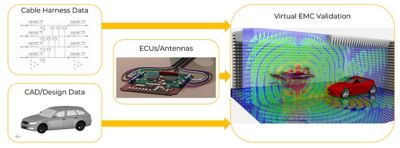
Ansys workflow for system electromagnetic compatibility (EMC) validation
Robust post-processing capabilities play a vital role in converting raw simulation data into actionable insights. Ansys software outputs visual and numerical data that can guide iterative design improvements, ultimately leading to enhanced compliance with regulatory standards and improved system performance.
Particularly beneficial for large structure validation, Ansys HFSS Mesh Fusion technology provides the ability to mesh intricate geometries separately and solve an entire assembly without compromising accuracy.
Driving Improved Tractor Performance
One Ansys customer, a world leader in designing and manufacturing tractors for agricultural and construction applications, wanted to address a significant problem that had been identified by its customers. Specifically, an ECU positioned near an antenna was degrading the receptor’s performance in the DAB band (specific frequency ranges allocated for Digital Audio Broadcasting), particularly impacting the 10C channel (10-inch steel section of the cab). Conducted EM emissions also radiated through a connected cable.
Using advanced Ansys simulation tools, it was possible to model the tractor cab, focusing on key components like the antenna, ECU, and noise-conducting cable. Ansys HFSS high-frequency electromagnetic simulation software and Ansys 3D product simulation software enabled engineers to accurately replicate the EM environment within the cab.
The team carefully modeled the antenna’s internal and external structures, assigning precise material properties to all components. From this activity a simplified circuit model was created to input noise into the simulation, allowing for correlation with physical test data.
Further, running repeated simulations enabled the team to test various antenna placements on the cab roof to minimize noise levels. By increasing the distance between the antenna and ECU, for example, it was determined that some positions amplified interference due to coupling effects at critical frequencies. And simulation was also essential to understanding and addressing unexpected electromagnetic effects of a new cab design.
Ultimately, these efforts resulted in an 8% overall noise reduction through one new cab design. Based on their initial success, the team will continue to pursue its goal of a 25% noise reduction for the foreseeable future. These ongoing efforts include the use of Ansys software to explore larger antenna plates, alternative cable routing, and shielding strategies for further noise mitigation.
A Design Revolution Is Already Underway
Ansys simulation solutions are fueling similar EM design innovations across the automotive industry. For example, our customers are applying new approaches like increasing the size of antenna ground plates to improve shielding effectiveness. Here, larger plates act as barriers, minimizing noise transmission from nearby electronic components and creating a more isolated environment for the antenna to operate.
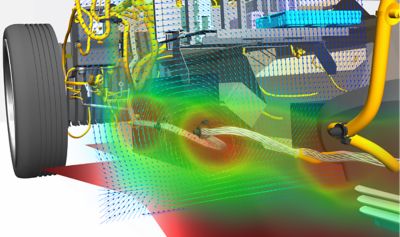
Avoid late-stage surprises by simulating electromagnetic effects in complex cable harnesses early in the design cycle.
Customers are also using Ansys software to adjust the routing and length of cables that carry noise, which can significantly impact EM performance. By avoiding resonance at critical frequencies, engineers can reduce the amplitude of conducted emissions that radiate toward sensitive receptors. The integration of shielding into the design of noise-carrying cables delivers additional protection, as shielding materials absorb or reflect EM energy.
Employing materials with low EM permeability in key areas and relocating noise-generating components to areas with natural shielding properties, or placing them farther from sensitive electronics, are other promising strategies Ansys customers are using to minimize field interactions.
Start Cutting Through the Noise
In today’s world of increasing electronics complexity, EM simulation is no longer optional. It’s become an accepted best practice used by global leaders to simultaneously achieve optimal signal quality, reliable system performance in the field, rapid and continuous product innovation, and cost-effective design and testing.
As vehicle designs include more advanced electronic technologies, including high-frequency communication systems, electrical engineering challenges are growing exponentially in the automotive sector.
Ansys provides precise solutions to create optimal designs, shrink design cycles, and cost and increase value delivered to customers. Contact us to learn more about how Ansys can help signal a new era of vehicle electronics design for your team.

Just for you. We have some additional resources you may enjoy.




The Advantage Blog
The Ansys Advantage blog, featuring contributions from Ansys and other technology experts, keeps you updated on how Ansys simulation is powering innovation that drives human advancement.