Synopsys and Ansys power the future of innovation—connecting silicon to systems.
-
-
학생용 무료 소프트웨어에 액세스하기
차세대 엔지니어에게 힘을 실어주는 Ansys
학생들은 세계적 수준의 시뮬레이션 소프트웨어를 무료로 이용할 수 있습니다.
-
지금 바로 Ansys에 연결하십시오!
미래를 설계하기
시뮬레이션이 다음 혁신을 어떻게 지원할 수 있는지 알아보려면 Ansys와 연결하십시오.
무료 트라이얼
제품 및 서비스
학습하기
회사 정보
Back
제품 및 서비스

According to the Federal Aviation Administration (FAA), more than 3 million people fly via U.S. airports every day. Ensuring that these flights are safe involves abiding by many regulations and standards, including those that relate to the software components — from execution and control programs to connectivity and communication software — that airplanes rely upon.
As time goes on, software certification will only become more critical in the aviation industry. Modern aircraft are increasingly reliant on software to perform critical functions, and this software is only becoming more complex with the increased adoption of autonomous technology. Simultaneously, the aviation industry faces rising pressure to reduce costs and development times, which makes increasing overall efficiency in the design, development, and certification processes a necessity. However, achieving such efficiency without sacrificing accuracy is no easy task for regulatory bodies.

One path to overcoming these hurdles and ensuring that critical software is safe and efficient begins at the global level with the International Civil Aviation Organization (ICAO), which is affiliated with the United Nations. ICAO’s regulations are used around the world and refined by each country to create national regulations. All new and modified aircraft need to be certified under these national standards and must fulfill reciprocal agreements from other nations when crossing international borders.
One way aviation authorities achieve this reciprocity is by using an acceptable means of compliance (AMC), which is a “nonbinding standard that illustrates a way to establish compliance with regulation,” says Amina Mekki-Mokhtar, a safety manager at Ansys. An AMC can help ensure uniform regulation implementation.
This brings us back to developing software, with the DO-178C Software Considerations in Airborne Systems and Equipment Certification standard serving as a critical AMC for those developing software in the aviation industry. This standard guides the development of safety-critical software for commercial aircraft. And, because multiple aviation authorities recognize DO-178C as AMC, developers can confirm compliance with all involved countries simultaneously.
The DO-178C standard “allows applicants to obey the law and, most importantly, allows applicants to develop critical software that is free from unacceptable risks,” says Mekki-Mokhtar. For instance, Mekki-Mokhtar shares that the standard provides objectives that aim to:
- Prevent the introduction of faults (such as design faults)
- Remove faults that may have been introduced
- Ensure fault tolerance and system performance even when faults are present
The DO-178C standard is also continuously evolving along with the software and methodologies used in the aerospace industry. For instance, the latest edition addresses the use of model-based development, object-oriented technologies, and tool qualification considerations.
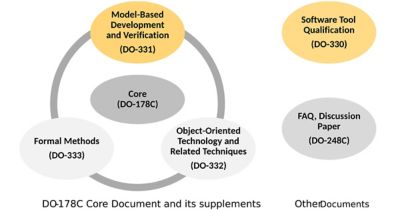
Graphic representation of the structure of the DO-178C documents
However, knowing what is included in the DO-178C standard is just the first step. Effectively using this standard to regulate software and achieve compliance is easier said than done.
The Path Toward Widespread DO-178C Compliance
“DO-178C is an objectives-oriented standard, which means that the standard defines what needs to be achieved and not how it can be achieved,” says Mekki-Mokhtar. As a result, complying with DO-178C is a huge lift that involves defining and documenting methods and workflows.
“There's a ton of documentation involved — you must document pretty much everything throughout the whole development process,” says Rachel Knutson, senior manager application engineer at Ansys. “Keeping track of every single step and how it relates back to the initial requirements — that traceability piece — can be tough.”

Additional challenges come along with mastering the verification and validation efforts for critical embedded software. “It's not just about testing the final product. It includes things like thorough design reviews, code reviews, making sure all the requirements are covered, and even checking the structure of the software itself, especially if they're using model-based techniques,” says Knutson.
Then, if automated tools are used to save time, engineers need to take additional steps to ensure that these tools are sufficiently reliable for safety-critical development.
To tackle all these challenges in a rigorous and accurate way, those in the aviation industry can turn to Ansys simulation software and model-based design (MBD).
How To Implement DO-178C in the Development of Airborne Systems
MBD enables engineers and developers to “improve productivity in the development and verification of safety-critical software, especially when the modeling language is formally defined and the code generator qualified,” says Mekki-Mokhtar.
One specific MBD solution is the Ansys SCADE embedded software product collection, which supports design, verification, and code generation, including formal properties definitions, and formal verification.
The advantages of using the SCADE suite to implement the DO-178C standard include:
- Addressing potential problems early in the design and development process. This is “like making a mistake in a blueprint instead of when you're already building the house,” says Knutson. “This early feedback loop (has) saved (engineers) a ton of time and expensive rework down the line.”
- Automating tedious and error-prone tasks. This includes manually writing code, creating documentation, and recording all links between requirements and code.
- Fostering a deep focus and foundational knowledge of safety-critical software. Knutson shares that the SCADE suite contains prequalified pieces that are already aligned with DO-178C standard requirements. “It's like having a head start because the tools themselves have already gone through some of the rigorous checks outlined in the standard,” she says.
- Using a formal synchronous language foundation. “It's designed to guarantee that things happen in a predictable and reliable way,” says Knutson, “which is super important for safety-critical software development.”
- Providing an all-in-one platform that integrates model-based development with verification, validation, and traceability tools. The combination of these tailored solutions helps engineers efficiently get their safety-critical software systems certified.
Thanks to these many benefits, the SCADE suite helps engineers save time and increase efficiency during the DO-178C standard certification process. “This frees up development teams to really focus on the core design of the software instead of getting bogged down in some of the certification paperwork,” says Knutson.
As an example, consider how the SCADE suite and the Ansys SCADE Display model-based human-machine interface (HMI) design tool are qualified to the highest safety levels of the DO-178C standard and thus can automatically create reliable, trustworthy code that is qualifiable for safety standards.
“This means we don’t have to spend any time on those really detailed, manual code reviews and the back-to-back testing between the model and the actual code,” says Knutson. “That alone saves a massive amount of time and reduces the chance of human error in the verification phase.”
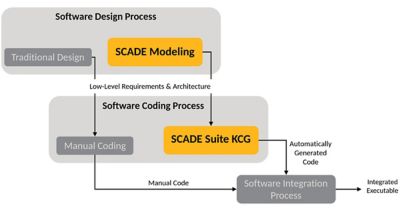
Graphic representation of the software coding process with the Ansys SCADE suite
Already, Ansys customers have found great success using the SCADE suite to achieve certification for the DO-178C standard. And for customers who are facing this standard for the first time, the Ansys team provides a step-by-step manual with planning templates to make the process of using the SCADE suite easy. These resources “give you a solid foundation and ensure you're covering all the necessary bases,” says Knutson.
The Evolution of the SCADE Suite and the DO-178C Standard
As the aviation industry matures, the DO-178C standard advances alongside it. For instance, Mekki-Mokhtar says that the standardization committee is focused on both clarifying existing texts and tackling new and emerging technologies, like artificial intelligence (AI). This work could translate into new or modified standards in the future.
Such progress can also be found in the SCADE suite, which maintains a focus on continuous improvement. The developers working on the SCADE suite account for industry trends, implement customer feedback, and collaborate with standardization bodies in different sectors.
A few specific examples of this growth are:
- The Ansys Scade One model-based embedded software development solution, which is “designed to be more user-friendly and integrated for model-based development,” says Knutson
- The Model Coverage Assistant feature, which helps automate test case generation to make the DO-178C certification process more efficient
- The SCADE DO-178C verification workflow, which can improve productivity with increased reduction, automation, or removal of many verification and validation (V&V) activities
Learn more about how the SCADE suite can help you implement DO-178C by checking out these resources:
- Register for the upcoming webinar “How To Implement DO-178C Using Model-Based Design and Verification”
- Watch the on-demand webinar “Improved Productivity With DO-178C Verification Workflow”
- Learn more about DO-178C in this guide: “What Is DO-178C?”
- Check out the white paper “Develop Safe Avionics Software With DO-178C Objectives Using Ansys SCADE Suite”
- Enroll in the Ansys Learning Hub Course “Introduction to Ansys SCADE Tools and Solutions for DO-178C Standard”

“We don’t have to spend any time on those really detailed, manual code reviews and the back-to-back testing between the model and the actual code.”
— Rachel Knutson, senior manager application engineer, Ansys



The Advantage Blog
The Ansys Advantage blog, featuring contributions from Ansys and other technology experts, keeps you updated on how Ansys simulation is powering innovation that drives human advancement.