-
-
학생용 무료 소프트웨어에 액세스하기
차세대 엔지니어에게 힘을 실어주는 Ansys
학생들은 세계적 수준의 시뮬레이션 소프트웨어를 무료로 이용할 수 있습니다.
-
지금 바로 Ansys에 연결하십시오!
미래를 설계하기
시뮬레이션이 다음 혁신을 어떻게 지원할 수 있는지 알아보려면 Ansys와 연결하십시오.
국가
무료 트라이얼
제품 및 서비스
학습하기
회사 정보
Back
제품 및 서비스
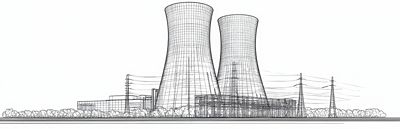
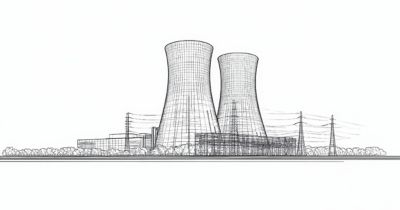
Today’s engineering environment demands higher accuracy and efficiency, particularly in the nuclear sector, where safety, performance, and cost control are critical. Advanced simulation plays a central role in meeting these expectations by reducing physical testing, improving design insight, and supporting regulatory approval.
High‑fidelity thermal and fluid analysis is essential for both new reactor concepts and the life extension of existing systems. Because thermal‑hydraulic behavior often dictates safe, efficient operation, engineers require precise models of coolant flow, heat transfer, and two‑phase dynamics across steady‑state and transient scenarios.
Ansys Thermal Desktop thermal-centric modeling software is designed to address these needs. The software provides rapid, reliable thermal management capabilities and unifies thermal, fluid, and control modeling in a single environment. Its multiphysics approach enables early‑stage evaluation, faster iterations, and more informed design decisions, reducing development risks.
Key capabilities include:
- Integrated thermal, fluid, and radiation modeling in one interface.
- Thermal‑centric modeling, combining system‑level flow simulations with 3D geometry.
- Mixed‑fidelity support (0D/1D/2D/3D) for reviewing problems from multiple perspectives.
- Rapid design changes and what‑if simulations enabled by built‑in meshing and material property tools.
- Thermal radiation modeling between surfaces and from the environment.
- 0D-1D fluid network modeling, including phase‑change behavior with built‑in or user‑defined correlations.
- Compatibility with other products from Ansys, part of Synopsys, such as Ansys Fluent fluid simulation software and Ansys Mechanical structural finite element analysis software, improving workflow efficiency and reducing simulation time.
Advanced Two‑Phase Modeling
Thermal Desktop solutions offer extensive two‑phase modeling features critical for nuclear applications:
- Automatic phase appearance/disappearance based on thermodynamic conditions, eliminating manual toggling.
- Built‑in, customizable pressure‑drop correlations for piping, heat exchangers, and auxiliary systems.
- Dynamic flow‑ and boiling‑regime mapping, improving accuracy in transients and off‑nominal conditions.
- Optional slip‑flow modeling, using separate momentum equations for vapor and liquid phases.
- Flat‑front modeling to minimize phase mixing, valuable in purging or priming analyses.
- Separate energy and mass equations for each phase to capture stratification and nonequilibrium effects.
- Liquid‑surface tracking in complex tanks for accurate orientation and level‑change predictions.
Workflow and Application Examples
Engineers can begin with conceptual designs using predefined shapes or import detailed models from Ansys Discovery 3D product simulation software or Ansys SpaceClaim 3D computer-aided design (CAD) modeling software. Thermal Desktop software rapidly solves heat-transfer and fluid‑flow problems, supports parametric studies, and incorporates user‑defined logic and correlations.
Common nuclear applications include:
- Heat‑exchanger analysis, especially where evaporation, condensation, or purging/filling processes drive performance.
- Component‑level two‑phase studies using rapid 1D frameworks.
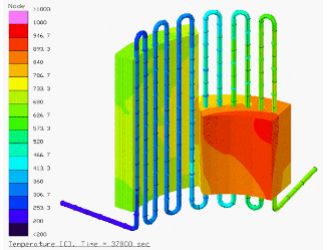
Ansys Thermal Desktop thermal-centric modeling software handles complex two phase phenomena, which are particularly important in nuclear thermal hydraulic scenarios.
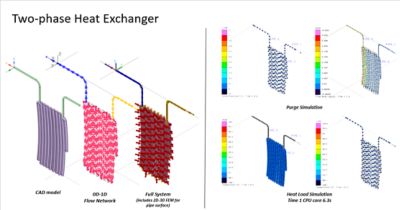
An example of a simulation workflow with Thermal Desktop software for two-phase interaction (water and nitrogen) fluid flow using a 1D framework
- Cryogenic storage modeling includes tank structures, internal components, piping, filling, draining, and long‑duration storage.
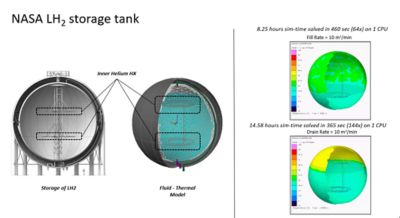
An example of a NASA LH2 storage tank for launch site fueling. The case explores the filling, draining, and long-duration storage of cryogen.
Advanced Thermal Simulation Benefits
Thermal Desktop simulation provides a comprehensive, efficient approach for modeling real-world systems. By leveraging fast, network‑based simulations and combining 1D system models with detailed 2D and 3D representations, it enables engineers to analyze conduction, convection, radiation, and complex two‑phase fluid behaviors with greater speed and accuracy. Its seamless integration with complementary Ansys tools further enhances workflow efficiency, making it a powerful solution for advanced thermal‑management and multiphysics engineering challenges.
Together, these capabilities empower teams to make smarter decisions earlier, minimize development risks, and accelerate innovation — establishing Thermal Desktop software as an indispensable platform for advanced thermal management and multiphysics challenges.
To learn more about Thermal Desktop software, request a free trial or contact us.

Just for you. We have some additional resources you may enjoy.
Learn More
Request a free trial of Ansys Thermal Desktop software or contact us for more information.

The Advantage Blog
The Ansys Advantage blog, featuring contributions from Ansys and other technology experts, keeps you updated on how Ansys simulation is powering innovation that drives human advancement.