Synopsys and Ansys power the future of innovation—connecting silicon to systems.
-
-
학생용 무료 소프트웨어에 액세스하기
차세대 엔지니어에게 힘을 실어주는 Ansys
학생들은 세계적 수준의 시뮬레이션 소프트웨어를 무료로 이용할 수 있습니다.
-
지금 바로 Ansys에 연결하십시오!
미래를 설계하기
시뮬레이션이 다음 혁신을 어떻게 지원할 수 있는지 알아보려면 Ansys와 연결하십시오.
무료 트라이얼
제품 및 서비스
학습하기
회사 정보
Back
제품 및 서비스
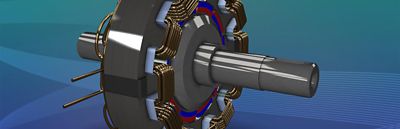
An early-stage startup develops an innovative gapless rolling electric motor using multiphysics simulation.
Ask someone about Leonardo da Vinci and you’ll probably hear about the “Mona Lisa,” “The Last Supper,” or other great works of art. Ask an engineer, and you might be surprised. At least, if you ask Alex Dobjanski of Orhont Magnetics, a Pittsburgh startup now based in Ohio that provides fabrication services for electric machine prototypes, you might be surprised. He considers the renowned “Renaissance man” to be his biggest engineering inspiration for da Vinci’s influence on ball bearing design and friction reduction.
With years of experience teaching engineering globally, Dobjanski launched Orhont to help students, academia, and small businesses build cost-effective prototypes. But after successfully helping others validate their ideas, he focused on his own. Inspired by da Vinci, Dobjanski imagined a new motor concept that eliminates ball bearings yet maintains their function. This led to the startup’s signature technology, the gapless rolling electric motor.
To refine his design and prototype, Dobjanski uses multiphysics simulation tools from Ansys, part of Synopsys, with access to the software through the Ansys Startup Program and support from the SimuTech Group, an Ansys Apex Channel Partner. Orhont gains additional support from funding awarded by the Department of the Navy’s Small Business Innovation Research (SBIR) program.
With the combined support, Dobjanski integrates Ansys electromagnetic (EM) and mechanical simulation to ensure the motor’s efficiency, power, and performance while reducing operational time and costs.
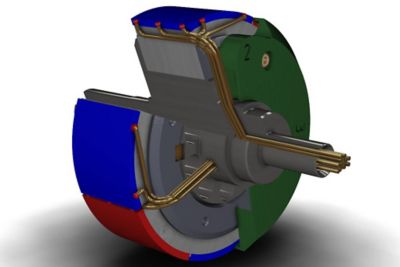
3D model of Orhont Magnetics’ motor rotor with permanent magnets
Revolutionize Motor Design
To multiply torque in motor design, you typically need to attach heavy gearboxes, which make the system bulky and costly. Dobjanski says his motor achieves this within one device that acts as a motor and gearbox hybrid.
“We tried to combine everything in one space, in one geometry, and make it as small as possible,” he says. “We combined two things together and eliminated the problem of weight, extra dimensions, and so on. This is how our motor works. It magnetically drives the planetary gears of the gearbox, so you don’t need actual mechanical gears in the motor, but you have the effect of (torque) multiplication.”
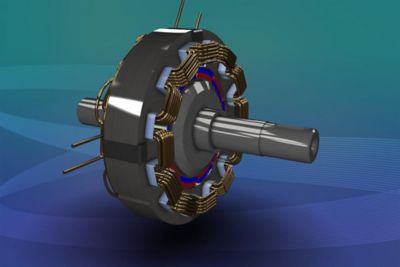
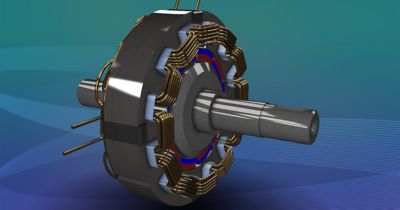
Orhont Magnetics’ motor stator with concentrated winding
By eliminating ball bearings and gearboxes, Orhont’s gapless rolling motor reduces friction and related wear and tear. It earned its namesake from its ability to use magnetic rollers to remove the usual air gap between the stator and rotor. In this design, the rotor can roll directly on the stator’s surface without causing damage by using static friction instead of dynamic friction. Dobjanski says this results in higher durability, less required maintenance, and quieter operation. In connection, its lightweight, compact design supports energy efficiency.
The sleek design secured Navy SBIR funding for Phase I in 2024 and Phase II in 2026 — a combined total of more than $1.3 million, which Orhont applies to research and development (R&D), including simulation analyses.
Although the SBIR project is centered around defense applications, such as torpedo propulsion, Dobjanski says the motor has a wide range of uses, highlighting its suitability for low-speed, high-torque applications. Examples include electric helicopters, vertical takeoff and landing (VTOL) vehicles, drones, aerial systems, ship propulsion, and industrial machinery, such as computer numerical control (CNC) machines.
Orhont’s gapless rotating motor can also be integrated into other motor systems, including stepper motors, which require precise rotation.
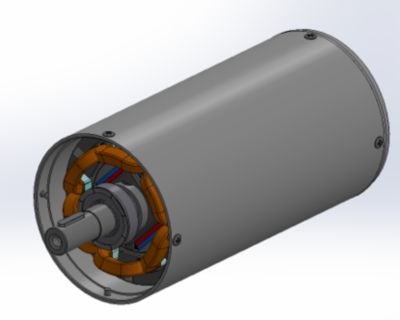
Model of the brushless direct current (BLDC) motor in the housing
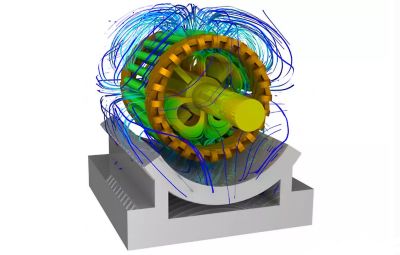
The Ansys Maxwell advanced electromagnetic (EM) field solver supports the design and analysis of electric motors, actuators, sensors, transformers, and other EM and electromechanical devices.
Simulate Success
Orhont’s connection with the Ansys Startup Program is somewhat kismet. While pursuing his Ph.D. in electrical engineering, Dobjanski taught a fellow student how to use Ansys software. She applied it to her dissertation and later worked for Ansys. Wanting to expand Orhont’s simulation integration, Dobjanski contacted her to purchase software. She connected him to SimuTech, who helped Orhont join the Ansys Startup Program and gain access to tools like the Ansys Maxwell advanced EM field solver and Ansys Mechanical structural finite element analysis (FEA) software.
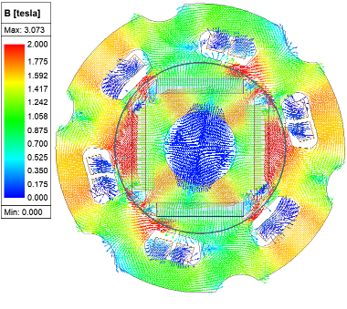
Magnetic flux distribution in the BLDC motor illustrated using Ansys Maxwell software
“We use Ansys Maxwell software because you can create your own topology,” he says. “Some software gives you a template of the existing motor, and you cannot change it. But our motor is very different and unique. It had to be built from scratch, and Ansys Maxwell software allows you to build whatever topology you like.”
Modeling multiple rotational frames in one simulation streamlined calculating the motor’s EM parameters, but Dobjanski also had to consider motor cooling. By integrating Mechanical software, he performed thermal analyses and assigned boundary conditions to create a real-life environment.
“We also used Ansys EM and mechanical tools because they can communicate to each other,” he says. “For example, if the losses are calculated using the EM solver, then the heat resulting from those losses can be calculated using the mechanical solver. Both of them work together to give you a real picture of what is going on in the machine.”
Increase Efficiency Gains
Thermal analysis also improves noise, vibration, and harshness (NVH) by helping design engineers understand how temperature affects different parts of the motor.
“The combination of Ansys EM and mechanical analyses — this link between them can predict thermal behavior,” Dobjanski says. “This is what is usually missed by designers. They are missing the thermal impact on the motor, and it can degrade performance. We gained a lot from getting the EM results and then using the mechanical solver to get the real picture. It helped us fix many, many problems — how to design the housing, how to make the heat transfer better through different geometry of the stator, and so on.”
Improved thermal behavior leads to greater efficiency, but that’s not the only area where Orhont’s motor shines. Ansys FEA simulation results confirmed a 25% increase in power-to-volume ratio compared with conventional motors, Dobjanski says. Multiphysics simulation also supports design accuracy and pre-production validation.
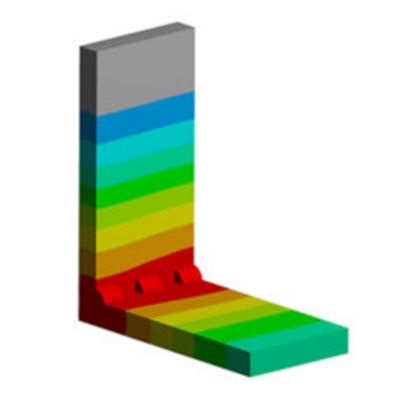
Ansys Mechanical structural finite element analysis (FEA) software supports thermal analysis, a range of materials models, and structural optimization.
“We can build a pretty accurate prototype from the first shot using Ansys simulations,” he says. “Before using Ansys software, I remember in the old days we would do analytical calculations, and there are so many equations, you would get lost and something is missed. Then you build the prototype and have to go back because something’s not working.”
In addition, virtual testing and prototyping saves the startup time and costs.
“Ansys tools give me credibility,” he says. “I've been using Ansys software for maybe 15 years, and I know what it is, and I know how to handle it. So, Ansys simulation saves us a lot of material cost for sure — and time, which is most important.”
Over the next two years, Orhont will continue to refine its prototype during Phase II of the Navy’s SBIR program, aiming for Phase III to bring the technology to government or private use.
Expand Your Motor Designs Today
Ansys is dedicated to advancing industrial processes and equipment with innovative solutions. To learn how Ansys can support your early-to-mid-stage business, visit the Ansys Startup Program.

Just for you. We have some additional resources you may enjoy.
“Ansys tools give me credibility. I’ve been using Ansys software for maybe 15 years, and I know what it is, and I know how to handle it. So, Ansys simulation saves us a lot of material cost for sure — and time, which is most important.”
— Alex Dobjanski, founder, Orhont Magnetics

The Advantage Blog
The Ansys Advantage blog, featuring contributions from Ansys and other technology experts, keeps you updated on how Ansys simulation is powering innovation that drives human advancement.