Synopsys and Ansys power the future of innovation—connecting silicon to systems.
-
-
학생용 무료 소프트웨어에 액세스하기
차세대 엔지니어에게 힘을 실어주는 Ansys
학생들은 세계적 수준의 시뮬레이션 소프트웨어를 무료로 이용할 수 있습니다.
-
지금 바로 Ansys에 연결하십시오!
미래를 설계하기
시뮬레이션이 다음 혁신을 어떻게 지원할 수 있는지 알아보려면 Ansys와 연결하십시오.
무료 트라이얼
제품 및 서비스
학습하기
회사 정보
Back
제품 및 서비스

Combine multiphysics solvers, optimization, and artificial intelligence (AI) to level up your simulation workflow and support data center cooling infrastructure.
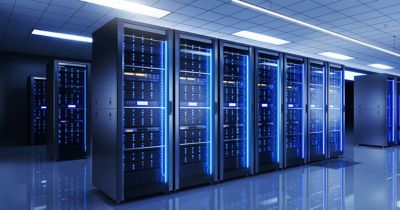
If you’ve ever worked in an office that has a server room, you’re probably familiar with the warmer temperatures felt just beyond its door. Considering that a midsize company’s server room could be around 500 square feet, multiply that by 200 to get an idea of the warmth radiating from an average large-scale data center, which sits at around 100,000 square feet. Now, multiply it by 2,000 to get a sense of the size — and consequential heat generation — of hyperscale data centers, which can take up 1 million square feet or more.
The larger the data center, the more heat it generates, and advanced technologies like artificial intelligence (AI) and high-density computing compound the problem by increasing power demands, heat loads, and other operational strains across commercial and industrial environments. Popular cooling methods include traditional air systems and newer liquid, immersion, and hybrid configurations.
Ansys, part of Synopsys, delivers end‑to‑end simulation solutions to support all cooling methods, enabling data centers to optimize efficiency and thermal chain coverage from chip-level to full facility, validate cooling technologies, and support high‑density AI workloads.
Let’s explore how high‑fidelity multiphysics solutions, including optimization software and AI-accelerated simulation, can enhance your simulation workflow, advance thermal intelligence, and support data center cooling infrastructure.
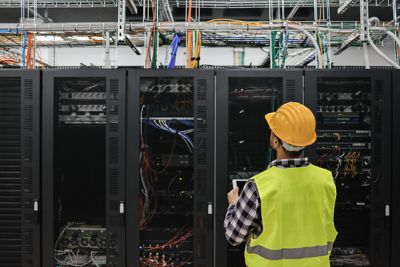
Cooling systems are essential industrial equipment to ensure uptime, optimize efficiency, and support high-density performance in modern data centers.
Optimize Data Center Cooling Systems
Data centers are brimming with racks of computer hardware from servers and routers to printed circuit boards (PCBs) and power distribution units (PDUs). Cooling systems are essential industrial equipment to ensure uptime, optimize efficiency, and support high-density performance.
High-fidelity multiphysics simulation solutions, including structural, fluid, and thermal analyses, provide critical insights to determine the best cooling method and design across air, liquid, immersion, and hybrid options.
Traditional air systems usually require large fans, such as turbines. Liquid cooling systems usually engage large, water-filled pipes to create a cooling effect.
Larger industrial water-based cooling equipment includes chillers, cooling towers, and computer room air handler (CRAH) units. Computer room air conditioner (CRAC) units are another popular choice but use refrigerants. Other equipment can be air- or liquid-driven, such as dry coolers, fluid coolers, or heat exchangers. Also, larger industrial cooling infrastructure and systems usually include pumps.
Additional techniques exist, including immersion cooling, which submerges racks and electronic equipment in a specialized, thermally conductive yet electrically nonconductive dielectric liquid, and hybrid cooling systems, which combine air and liquid methods, such as evaporative cooling.
And with data center growth and rising power demands, further research and new ideas are needed to integrate existing technologies and techniques with emerging technologies while keeping in mind tomorrow’s efficiency, sustainability, and innovation. This is where Ansys solutions lend significant value.
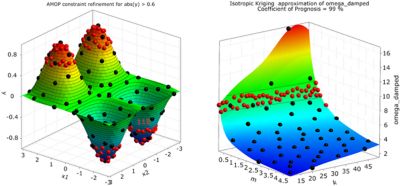
The adaptive metamodel of optimal prognosis (AMOP) algorithm in Ansys optiSLang process integration and design optimization software automatically searches for the most relevant parameters and runs new simulations for future iterations, accelerating simulation time and increasing efficiency.
Engineers can integrate Ansys or non-Ansys simulation with Ansys optiSLang process integration and design optimization software to optimize cooling system designs for efficiency. This includes computational fluid dynamics (CFD) or finite element analysis (FEA) solvers, such as Ansys Fluent fluid simulation software and Ansys Mechanical structural FEA software, respectively.
For example, Vertiv, a global leader in critical digital infrastructure, supports data centers and communication networks with advanced power, cooling, and information technology (IT) solutions. Vertiv integrates Ansys solutions to optimize their designs and products, accelerate time to market, and cut costs.
Built-in automatic machine learning (AutoML) algorithms in optiSLang software, such as the metamodel of optimal prognosis (MOP) and adaptive metamodel of optimal prognosis (AMOP), make metamodel creation easy. In simple terms, a metamodel is a model of a model. Ansys optiSLang software builds metamodels for rapid feedback and robust design analysis in a fraction of the time it takes to run a full simulation.
As its name suggests, AMOP is adaptive. After the initial design of experiments (DOE), AMOP automatically creates MOP for the outputs. It finds regions where the metamodeling is favorable and regions where new observations could improve quality. Based on this insight, AMOP automatically runs new simulations for future iterations. In this way, AMOP redefines the DOE where needed to achieve the best metamodel quality, requiring less manual input and simulations. Essentially, optiSLang software helps determine which data you need and how much of it, increasing efficiency and speeding up your simulation workflow.
After constructing a design database, this training data can be used in the Ansys SimAI cloud-enabled AI platform to build a physics-based generative model, enabling the creation of designs more quickly in three simple steps: upload data, train model, and predict.
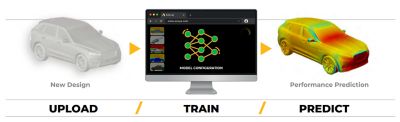
The workflow in the Ansys SimAI cloud-enabled artificial intelligence (AI) platform is engaged in three simple steps: upload data, train model, and predict.
This accelerates simulation and decision-making. For example, if you want to explore a new design for a specific cooling system setup, the SimAI platform can give you an answer in 3D in seconds because it’s equipped with your design database and training data, which includes trusted simulation models that have been trained by experts. In this way, the platform democratizes simulation for nonexperts as they can test new designs in the SimAI platform without firsthand simulation, optimization, or AI/ML expertise.
Advance Thermal Intelligence
As AI and other Industry 5.0 technologies continue to boom, data centers are basically working in overdrive, creating more issues around heat and power density. This makes data center cooling infrastructure more crucial than ever. Three fundamental benefits are ensuring uptime and reliability, optimizing efficiency and resources, and enabling scalable high-density performance.
By preventing thermal and hardware-related failures that could lead to downtime, cooling systems help maintain continuous data center operations efficiently, which reduces energy use and operating expenses.
Cooling system management is also essential to scale high-density performance, which is becoming standard with AI. By incorporating an end-to-end simulation workflow with thermal intelligence, data centers can support the safe, reliable operation of cooling systems by identifying and mitigating hot spots to maintain stability at higher power densities.
Let’s look at a simple, real-world example to assess an air or liquid cooling system. If one physical rack is positioned in front of your cooling source, the cooling flow can be interrupted or blocked, creating a hot spot. CFD analyses can help you detect and dispel those hot spots.
By using a CFD solver, such as Fluent software, engineers can determine the most optimal speed, flow, and position of the cooling source while testing different geometries to visualize and predict the best physical layout for the racks.
Upgrade Your Cooling System Design Today
Ansys delivers end-to-end thermal and cooling simulation for the entire thermal chain from silicon heat to full data center operation. High-fidelity multiphysics simulation enables thermal intelligence and reveals dynamics at every level for air, liquid, immersion, or hybrid cooling methods.
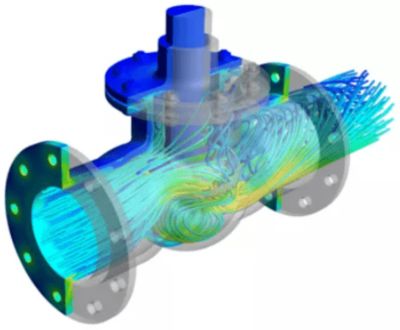
Computational fluid dynamics (CFD) solvers, such as Ansys Fluent fluid simulation software, boost thermal intelligence for data center cooling systems.
Simulation helps engineers understand infrastructure positioning and see hot spots in 3D to develop the best cooling approach. Additionally, AI-accelerated simulation enables faster design cycles, predictive insights, and optimized cooling for high-density AI data centers.
Discover more cooling solutions for data centers at Industrial Processes and Equipment Simulation Software Solutions from Ansys.
To try optiSLang optimization software firsthand, request a free trial. To explore the SimAI platform, request a live demonstration.

Just for you. We have some additional resources you may enjoy.
Learn More
- Discover cooling solutions for data centers at Industrial Processes and Equipment Simulation Software Solutions from Ansys.
- To try optiSLang optimization software firsthand, request a free trial.
- To explore the SimAI platform, request a live demonstration.


The Advantage Blog
The Ansys Advantage blog, featuring contributions from Ansys and other technology experts, keeps you updated on how Ansys simulation is powering innovation that drives human advancement.
시작하기
엔지니어링 과제에 직면하고 있다면우리 팀이 도와드리겠습니다. 풍부한 경험과 혁신에 대한 헌신을 가지고 있는 우리에게 연락해 주십시오. 협력을 통해 엔지니어링 문제를 성장과 성공의 기회로 바꾸십시오. 지금 문의하기