Synopsys and Ansys power the future of innovation—connecting silicon to systems.
-
-
학생용 무료 소프트웨어에 액세스하기
차세대 엔지니어에게 힘을 실어주는 Ansys
학생들은 세계적 수준의 시뮬레이션 소프트웨어를 무료로 이용할 수 있습니다.
-
지금 바로 Ansys에 연결하십시오!
미래를 설계하기
시뮬레이션이 다음 혁신을 어떻게 지원할 수 있는지 알아보려면 Ansys와 연결하십시오.
무료 트라이얼
제품 및 서비스
학습하기
회사 정보
Back
제품 및 서비스

Throughout our Autonomy in Aerospace and Defense (A&D) series, we’ve seen how the integration of autonomous technology has affected the different systems we rely upon.
From advancing hardware and software to mission engineering, testing, and validation, autonomous technologies are transforming A&D. This evolution also holds true for operations, in which the introduction of autonomous technology has the potential to boost operational efficiency, safety, and reliability.
By adopting autonomous technologies, the industry is modernizing its operational tools and redefining the roles of human operators. This shift is essential for maintaining a competitive edge and ensuring successful outcomes in high-stakes environments.
Operators can now rely on autonomous systems to handle routine tasks, enabling them to focus on more complex and demanding responsibilities while driving continuous improvement and innovation. The result is an operational environment that is more efficient and responsive to the industry's dynamic needs.
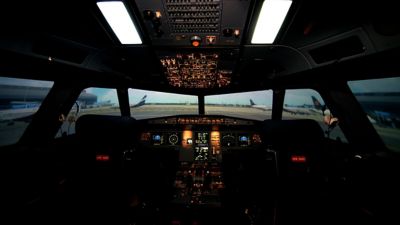
Exploring Essential Operational Systems and the Role of Autonomous Technology
At its simplest, a human-machine interface (HMI) is the hardware and software that humans use to interact and communicate with a computer. HMIs have two main goals:
- Enhance operator awareness
- Enable interactions between the operator and the system
There are many types of HMIs, from buttons on an airplane's control panel and voice controls to situational awareness displays. Heads-up displays (HUDs) are a particularly essential HMI, which provide operators with rapid decision support without having to take their eyes away from the world around them, thereby improving operational safety.
No matter the specific application, HMI technologies are an essential part of furthering autonomy. HMIs will be used as components in autonomous designs and can use autonomous technology themselves. To achieve these new applications, engineers need to focus on challenges, including:
- Following existing safety standards for HMI design and certification, such as the DO-178C standard for commercial aircraft and the ARINC 661 standard for cockpit display systems
- Intuitively presenting complex information at a wide range of familiarity levels
- Ensuring real-time data accuracy and relevance
- Designing interfaces that are both powerful and easy to use
- Sharing mission-critical information while avoiding information overload
- Ensuring seamless integration with existing systems
- Rigorously meeting the safety, usability, accessibility, certification, and reliability standards required for mission- and life-critical applications
- Building training and flight simulator controls that match real-world vehicles to increase training effectiveness
In addition to HMIs, efficient diagnostics, maintenance, and data tools are crucial for operational safety and reliability. This includes everything from flight logging and remaining useful life analyses to sensor contamination diagnostics and emergency response systems.
Engineers can also use autonomous technology to increase the accuracy and efficiency of these systems. For example, autonomous diagnostic tools can continuously analyze A&D vehicles to rapidly identify areas that may need maintenance, determine the cause(s) of potential issues, and alert operators.
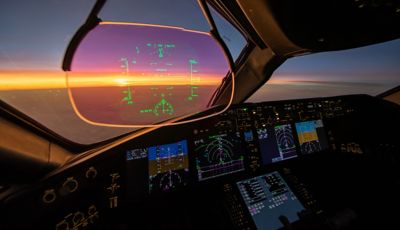
The Future of Operations and Autonomy in A&D
The A&D industry is on the cusp of significant transformation that is driven by autonomous technology. As the adoption of these technologies continues, engineers must remain focused on enhancing and ensuring the safety, accuracy, and efficiency of operational systems in a way that complements operator performance.
This will only become more critical as operators' roles transition from hands-on control to supervisory oversight as autonomy levels increase. This shift requires the development of highly reliable system operations technology that upholds safety standards. These will also change and evolve along with technological advancements.
Using simulation is pivotal in this transformation, as it enables virtual testing and optimization of both software and hardware before deployment. With simulation software, engineers can reduce the risks and costs associated with real-world testing and develop more reliable autonomous systems.
By prioritizing innovation and focusing on the development of robust operational and autonomous systems, the A&D industry can look forward to a future in which operations are not only more effective but significantly safer.
To learn more about how autonomy is accelerating system operations growth in A&D, download the "Advancing System Operations in Aerospace and Defense" e-book.

Just for you. We have some additional resources you may enjoy.
Learn More
To learn more about how autonomy is accelerating system operations growth in A&D, download the "Advancing System Operations in Aerospace and Defense" e-book.


The Advantage Blog
The Ansys Advantage blog, featuring contributions from Ansys and other technology experts, keeps you updated on how Ansys simulation is powering innovation that drives human advancement.