-
-
학생용 무료 소프트웨어에 액세스하기
차세대 엔지니어에게 힘을 실어주는 Ansys
학생들은 세계적 수준의 시뮬레이션 소프트웨어를 무료로 이용할 수 있습니다.
-
지금 바로 Ansys에 연결하십시오!
미래를 설계하기
시뮬레이션이 다음 혁신을 어떻게 지원할 수 있는지 알아보려면 Ansys와 연결하십시오.
국가
무료 트라이얼
제품 및 서비스
학습하기
회사 정보
Back
제품 및 서비스

The latest advancements and applications in quantum computing depend on innovative minds around the globe working together to realize the capabilities of this cutting-edge science. Quantum computing is emerging as an integral part of modern technology that is used in fields such as artificial intelligence (AI), cybersecurity, and financial modeling, to name a few.
Quantum computers themselves are advanced machines inspired by quantum physics — a study of the behavior of atoms and particles. In short, a quantum computer is an upgraded, more powerful version of a regular computer that has the ability to generate and manipulate quantum bits, or qubits.
A traditional computer uses binary bits to create content that we are familiar with, such as online videos or our favorite songs. A quantum computer uses qubits, which are the basic units of information in quantum computing. Essentially, qubits are the building blocks of quantum computing. The quantum state of qubits is very fragile, requiring extra care and time to avoid decoherence, or decay, from outside “noise.” Due to this fragility, qubits are best protected in supercooled and vacuum-sealed chambers.
In 2020, Dr. Raphaël Lescanne and Dr. Théau Peronnin came together to take “cat qubits” from the lab to the industry, thus founding Alice & Bob, a startup hardware developer out of Paris. In 2021, they joined the Ansys Startup Program with a goal for quantum computing: Accomplish the first universal, fault-tolerant quantum computer.
Alice & Bob has taken the design of quantum computers even further through the advanced use of cat qubits. Based on Schrödinger’s thought experiment, cat qubits can exist in two different quantum states simultaneously, providing a balance of quantum error rates. An integral part of the research and development of the qubits needed for a fault-tolerant computer was ultimately simulation. The Ansys Startup Program offered Alice & Bob experts access to Ansys products and support that otherwise may not have been available to them. The program focuses on supporting and fostering early-stage and midstage startups, such as former member Alice & Bob, by removing cost barriers.
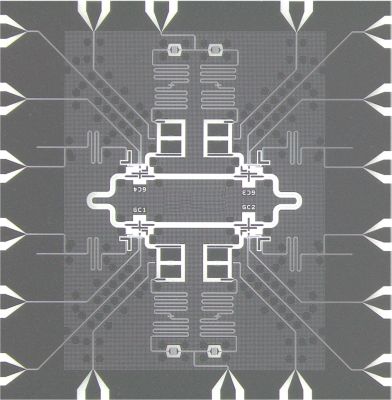
An image of a chip
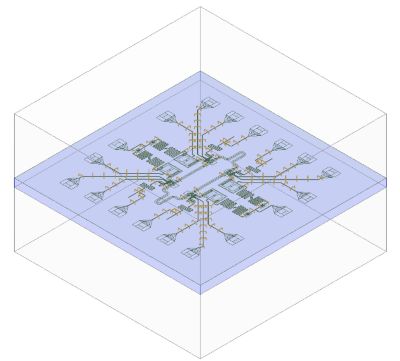
The same chip in Ansys HFSS high-frequency electromagnetic simulation software
Simulation Meets Quantum Computing
“The Ansys Startup Program was a great opportunity for us to save money, have easy access to the whole multiphysics package, and avoid running into license problems. I had unlimited access to Ansys HFSS software,” says Dr. Felix Rautschke, QPU design lead at Alice & Bob. “As a business startup, we need to go fast, and HFSS software enables us to go fast with all the improvements and efficiency developments that have been done over the past 30 years.”
Rautschke explained that when he started at Alice & Bob in 2020, characterizations of cat qubits required weeks of work. With support from 4CAD Group, a French-based Ansys Elite Channel Partner, that time was reduced to a day or less.
“Simulation provides enormous gains in that they can now quickly and accurately simulate all qubits,” Rautschke says. “For example, if there are five samples ready but (there is) only room for three samples in the fridge, the team can carefully select which chips to put in the fridge — based on simulation.”
Ansys software has helped Alice & Bob overcome several complex challenges. “Ansys has developed quite a good solution when it comes to problems,” he says. “They combine small features in a large environment. Our chips are 10 mm by 10 mm, and the smallest component that we need to mesh is only 5-by-10 micrometers. That is a huge gap that we need to bridge in terms of physical dimensions and in terms of meshing. But the tool just does it.”
This level of time reduction in development of the first fault-tolerant quantum computer is undeniably giving Alice & Bob the upper hand in speed and accuracy. “The circuit simulator is an important tool used for quickly building a circuit if you want to try something new, such as a new filter, or combiner, or a multiplexer,” Rautschke says. “You can easily build it up on lumped elements or a provided Ansys model. It is fast and easy. They can simulate the full circuit within seconds, giving them the flexibility to replace and improve elements here and there to optimize geometry.”
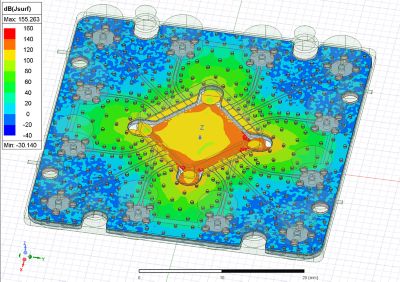
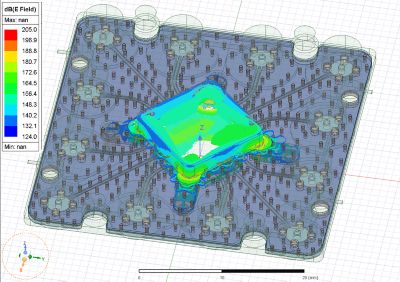
A simulation that includes fields for Alice & Bob’s packaging without a chip. The image on the left shows surface current, and the image on the right shows the magnitude of the E field.
Aerospace, World Records, and More: What’s Next for Alice & Bob?
Within months of joining the Ansys Startup Program, Alice & Bob grew to 10 researchers, and it continues to grow, with more than 100 employees out of its offices in Paris and Boston. Rautschke explains that to this day, “the simulations and the designs are a critical part of what we do.”
In 2022, Alice & Bob accomplished a world-record goal with a chip that could go 100 seconds without a bit-flip error. Most recently, Alice & Bob showed that it could reduce hardware requirements by up to 200 times to build a large-scale useful quantum computer, compared with competing approaches. Now, the company is venturing into the aerospace industry to supply quantum algorithms for next-generation aerospace equipment.
Thanks to help from the Ansys Startup Program and support from 4CAD Group, Alice & Bob continues to innovate and advance the world of quantum computing.
Learn more about the Ansys Startup Program.

Just for you. We have some additional resources you may enjoy.
“The Ansys Startup Program was a great opportunity for us to save money, have easy access to the whole multiphysics package, and avoid running into license problems.”
— Dr. Felix Rautschke, QPU design lead, Alice & Bob


The Advantage Blog
The Ansys Advantage blog, featuring contributions from Ansys and other technology experts, keeps you updated on how Ansys simulation is powering innovation that drives human advancement.