Case Study
-
-
학생용 무료 소프트웨어에 액세스하기
차세대 엔지니어에게 힘을 실어주는 Ansys
학생들은 세계적 수준의 시뮬레이션 소프트웨어를 무료로 이용할 수 있습니다.
-
지금 바로 Ansys에 연결하십시오!
미래를 설계하기
시뮬레이션이 다음 혁신을 어떻게 지원할 수 있는지 알아보려면 Ansys와 연결하십시오.
무료 트라이얼
제품 및 서비스
학습하기
회사 정보
Back
제품 및 서비스
“By integrating Ansys Fluent-based CFD digital twins into Unit Operations Laboratories, we have the potential to transform how students engage with core chemical engineering concepts. Tools such as SpaceClaim, Fluent, and EnSight allow students to simulate and visualize flow fields, temperature distributions, and reaction behavior that are impossible to measure experimentally. This integration not only strengthens conceptual understanding but also prepares students with industry-relevant simulation skills. My experience with Ansys has been exceptionally positive due to its accuracy, robustness, and seamless transition from classroom learning to real-world engineering practice.”
— Dr. Yu Feng
Associate Professor, School of Chemical Engineering, Oklahoma State University
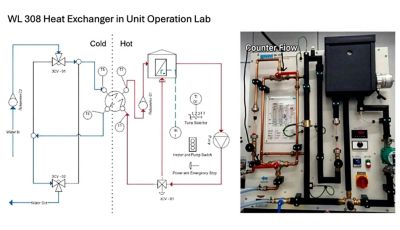
Engineering simulation was incorporated into Unit Operations Laboratories to address long-standing limitations of traditional experiments in conveying transport phenomena and process mechanisms. By integrating CFD-based digital twins alongside physical experiments, students gain access to spatiotemporal flow, temperature, and species data that are otherwise unmeasurable. This approach strengthens conceptual understanding, enhances hands-on learning, and equips students with industry-relevant simulation skills.
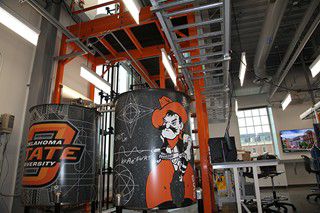
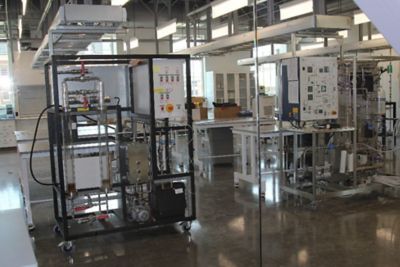
The two-phase flow (left) and the adsorber + distillation equipment (right) in the unit operation lab at Oklahoma State University.
Challenges
Traditional Unit Operations Laboratories provide limited visibility into internal flow, heat, and mass transfer mechanisms, making it difficult for students to connect theory with observations. The primary challenge was identifying a simulation platform capable of producing high-fidelity, physics-based digital twins that integrate seamlessly with laboratory hardware. The software needed to be accurate, intuitive for undergraduates, compatible with student licenses, and aligned with industrial workflows.
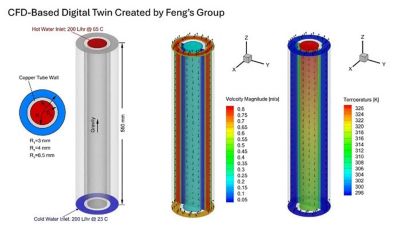
CFD-based digital twin of a shell-and-tube heat exchanger (developed by Dr. Yu Feng) providing “x-ray” vision for revealing the spatiotemporal distributions of the temperature and flow velocities inside.
Course Department
- School of Chemical Engineering
Courses Being Taught
- Unit Operations Laboratory I
- Unit Operations Laboratory II
Engineering Solutions
CFD-based digital twins were developed and embedded into Unit Operation Laboratory modules using Ansys, part of Synopsys tools. Students used SpaceClaim software to understand and modify lab geometries, Ansys Fluent software to simulate flow, heat transfer, and reaction kinetics, and EnSight/CFD-Post capabilities for advanced visualization and analysis. Simulations were conducted before, during, and after experiments, enabling direct comparison between predicted and measured data. This workflow enabled students to explore operating conditions, visualize internal transport phenomena, and validate experimental results through first-principles modeling.
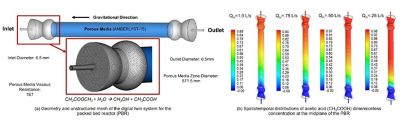
CFD-based digital twin of a packed bed reactor (developed by Connor Westcott) reveals temperature and flow-rate effects on methyl acetate hydrolysis, enabling high-resolution optimization of reaction performance.
Benefits
- Improved student understanding of fluid dynamics, heat and mass transfer, and reaction kinetics through visualization of spatiotemporal data
- Enhanced ability to interpret and validate experimental measurements using simulation results
- Increased student engagement and confidence through hands-on exposure to industry-standard CFD tools
- Alignment of laboratory instruction with modern digital engineering practices
- Development of transferable computational and analytical skills relevant to graduate study and industrial careers
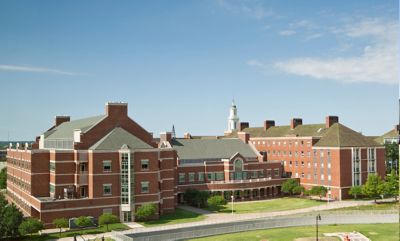
Engineering North Building of Oklahoma State University
시작하기
엔지니어링 과제에 직면하고 있다면우리 팀이 도와드리겠습니다. 풍부한 경험과 혁신에 대한 헌신을 가지고 있는 우리에게 연락해 주십시오. 협력을 통해 엔지니어링 문제를 성장과 성공의 기회로 바꾸십시오. 지금 문의하기