Synopsys and Ansys power the future of innovation—connecting silicon to systems.
-
-
Kostenlose Software für Studierende
Ansys unterstützt die nächste Generation von Ingenieur*innen
Studenten erhalten kostenlosen Zugang zu erstklassiger Simulationssoftware.
-
Verbinden Sie sich jetzt mit Ansys!
Gestalten Sie Ihre Zukunft
Stellen Sie eine Verbindung mit Ansys her, um zu erfahren, wie Simulation Ihren nächsten Durchbruch vorantreiben kann.
Kostenlose Demoversionen
Produkte & Dienstleistungen
Lernportal
Über das Unternehmen
Back
Produkte & Dienstleistungen
Back
Lernportal
Ansys unterstützt die nächste Generation von Ingenieur*innen
Studenten erhalten kostenlosen Zugang zu erstklassiger Simulationssoftware.
Back
Über das Unternehmen
Gestalten Sie Ihre Zukunft
Stellen Sie eine Verbindung mit Ansys her, um zu erfahren, wie Simulation Ihren nächsten Durchbruch vorantreiben kann.
Kostenlose Demoversionen
TOPIC DETAILS
What are Data Center Cooling Systems?
Data center cooling is the combined strategies, methods, and hardware used to control the heat generated by chips, servers, storage, networking, and power infrastructure equipment in data centers. Modern electronic devices, especially servers, storage systems, and networking equipment, all convert the electrical energy they consume into heat.
The performance of those devices decreases as their operating temperatures increase. If internal temperatures remain too high for long enough, the electronics can fail. To avoid this, monitoring software will shut down the equipment, taking parts of the data center offline.
The goal of data center cooling is to move heat out of the electronic components and systems/equipment using a simple heat transfer process that minimizes the amount of heat generated, collects and exchanges it efficiently, and then rejects it to the environment.
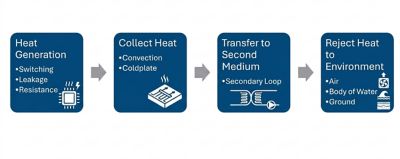
Engineers break down the most common data center cooling process into four steps.
Measuring Data Center Cooling System Efficiency and Power Usage Effectiveness
Cooling systems are mandatory in data centers due to the impact of high temperatures on performance and reliability. The efficiency and reliability of a data center’s cooling system are driven by the cooling technologies used. Power is one of the highest operating costs for any data center, and cooling accounts for a considerable portion of those costs. A typical data center spends 40% of its annual operating budget on power. So engineers must balance cost, reliability, and energy efficiency to provide an optimal solution.
To measure a data center's energy efficiency, the industry uses the power usage effectiveness (PUE) metric. It indicates the ratio of all the power used in a data center to the power used for computing.
PUE = Total Facility Power Consumption / Power Consumed by Servers and Compute Hardware
A PUE of 1 means that the data center is using all its power for computations, networking, and storage. Hyperscalers like Google and Meta invest in systems that achieve an “excellent” PUE of 1.1-1.2. The industry average is 1.4-1.5, and poorly performing data centers have a PUE of 2.0 or higher. Because cooling is typically the largest non‑IT energy consumer, a high PUE often indicates opportunities to improve cooling and overall infrastructure efficiency.
Types of Data Center Cooling Systems
The traditional technology for cooling a data center is air cooling, and it has served the industry for decades. However, high-density server racks with ever-increasing heat output from each component have made air cooling expensive, increasing the use of alternative cooling methods. Here are the most common data center cooling technologies:
Air Cooling
Air-cooled data centers use air to transport heat away from components. Large computer room air conditioners (CRACs) move chilled air throughout the facility, typically via raised floors beneath equipment or overhead ducts. The cool air travels down a cold aisle into the equipment inlets. Fans pull the air through the equipment, extracting heat, and expelling it into a hot aisle. The hot air is either fed back into the air conditioning system or exhausted outside the building. This segregation of a row of racks into a hot and a cold side is called cold aisle containment. Although chilled airflow is well understood and easy to manage, air is not an efficient heat-transfer medium compared with liquids. However, some smaller server rooms do use industrial heating, venting, and air conditioning (HVAC) systems for cooling.
An important factor for the energy consumption and sustainability of air cooling is the refrigeration technology the system uses to cool the air. Air conditioning systems can use heat pumps, evaporation cooling, chilled water cooling, or a combination of all three. One variation of air cooling systems places a computer room air handler (CRAH) in the cold aisle and delivers chilled water to a heat exchanger that cools the air locally. This is more efficient than moving air long distances through ducts.
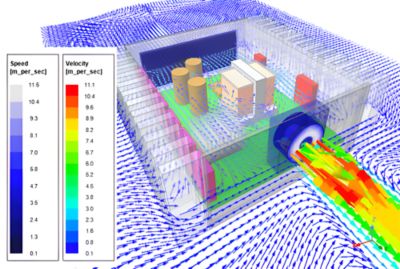
The first step in air cooling is managing the airflow through the electronics enclosure. This is a fluid flow analysis used to optimize heat sync and fan placement.
Free Cooling
In some locations, cooling systems pull cold air or water directly into a data center. The outside air temperature, a nearby large body of water, or the ground absorbs the heat created by the servers and compute hardware. For an air-cooled data center, outside air can be used directly. Alternatively, ambient air, the ground, or water from a lake, river, or ocean can chill a liquid cooling loop.
Liquid Cooling
Liquid cooling refers to a wide variety of technologies that remove heat from equipment using a liquid as the heat transfer medium rather than air. Most systems use water or a water-glycol mixture as the coolant. Liquid cooling technologies use less rack space and are therefore ideal for high-density systems. Liquid cooling systems also have a smaller infrastructure footprint.
The most common implementations of liquid cooling systems vary based on how the solution transfers heat to the liquid:
Direct liquid cooling (DLC): A DLC system delivers chilled water to a cold plate attached directly to the heat-generating processor, usually the central processing unit (CPU) or graphics processing unit (GPU). Most implementations use a heat-conducting metal, such as copper or aluminum. This approach provides efficient cooling for high-temperature and high-density applications. It is sometimes called direct-to-chip cooling.
Rear door heat exchangers (RDHX): Instead of bringing chilled water directly to the heat-generating component, an RDHX system supplements traditional air cooling by replacing a standard server rack rear door with a liquid-cooled heat exchanger panel. The heat exchanger extracts the heat rather than letting it flow into the hot aisle. Data center operators use this approach as a cost-effective way to improve the PUE in older data centers. They do not need to replace the servers and compute hardware, only the server rack door. The result is cooler air in the hot aisle, reducing the cost of air cooling.
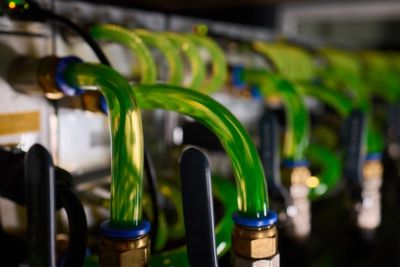
A water-glycol cooling loop for a direct liquid cooling (DLC) system showing the incoming and outgoing fluid tubes
Immersion Cooling
For the most efficient cooling currently available, engineers submerge servers and compute hardware directly in an electrically nonconductive but thermally conductive dielectric fluid. Heat from the components transfers directly to the surrounding fluid, causing the warmed liquid to rise to the top of the enclosure, where a heat exchanger removes the thermal energy. In most current applications, this heat extraction is performed using a liquid‑to‑liquid heat exchanger.
There are two types of immersion cooling systems. The first, single-phase, uses convection to pull the heat up and away from the components. In a two-phase system, the immersion liquid boils near the component operating temperatures, vaporizing and taking advantage of the additional heat absorbed during phase change — the gas bubbles to the top, where it condenses back to a liquid. Two-phase systems can achieve PUEs in the 1.02-1.03 range.
Hybrid Cooling
Data center cooling engineers usually combine multiple approaches to create a hybrid cooling solution. It is common in newer data centers for operators to use direct liquid cooling for CPUs and GPUs and RDHX with air cooling for the other components in the rack.
The Role of Cooling in Data Center Sustainability
Beyond reducing downtime and costs, data center operators factor sustainability into their cooling systems. Unless they can rely on a renewable energy source, every kilowatt of cooling used increases the facility's carbon footprint. Most sustainability efforts revolve around power source, efficiency, and water usage.
Power Source
Using sustainable or zero-carbon power sources is the most visible sustainability effort in data centers, including the power required for cooling. This may even include on-site power generation or buying specific allotments of sustainable power. To increase the use of renewable energy, many data center cooling systems include energy storage solutions to capture energy when renewable power is available and use it at night or when wind power is less available.
Efficiency
For data center cooling, design teams focus heavily on efficiency in every aspect of the cooling system. The primary goal is to minimize energy use when removing heat from the electronic equipment. Moving from air-chilled to water-chilled is one of the more cost-effective ways to increase efficiency. Many of the tactics discussed above reduce power consumption while delivering effective cooling.
In addition, smart management systems that use monitoring, digital twins, and artificial intelligence-driven dynamic tuning avoid waste and deliver cooling when and where it is needed, based on real-time workload measurements.
Another widely used sustainability measure is to harvest the waste heat from the cooling system. Data center sites in colder climates can, for example, provide heat to local homes and offices or keep greenhouses and fish farms warm. New applications are looking at using waste heat to power carbon capture systems and water filtration devices.
Minimizing heat generation and raising the operating temperature of electronic devices improves data center cooling sustainability by reducing the energy required to cool the equipment.
Water Usage
Because water plays an important role in almost every form of cooling, sustainable water use is a major focus for design teams. Most modern designs aim to use closed-loop systems and avoid evaporative cooling towers. They also work to ensure that any water that leaves the data center cooling system is usable downstream. Newer data centers are using modern, high-performance water chillers that require less water, reduce consumption, and keep water in the facility. Systems may also include filtration or separate primary cooling loops that use lake, river, or ocean water.
Data Center Cooling Design and Optimization
Data center cooling design is like most engineering efforts — a balance among cost, schedule, and performance. In addition, because of the size and rapid growth of data centers, engineers must consider scalability in their designs. The performance side of the design equation is the most important because data centers that don’t provide adequate cooling can lead to overheating, resulting in reduced performance, system shutdown, or even damaged hardware.
Some suggestions for cooling system design and optimization include:
- Integrate cooling systems into the overall building design rather than trying to fit into a set structure.
- Take a system-level approach that includes thermodynamics, fluid dynamics, power networks, and geometric considerations.
- Implement industry-standard solutions, such as:
- Hot aisle and cold aisle containment
- Humidity control systems
- Airflow management across the facility
- Industrial Internet of Things (IoT) to monitor systems in real time
- Solutions that match the local climate, water availability, and power landscape
- Leverage simulation during design and digital twins during operation.
Improving Data Center Cooling Solutions With Simulation
Engineers use simulation tools throughout a data center’s life cycle to optimize design and operations. They do this by creating virtual representations of components, assemblies, and systems that accurately model heat transfer, thermodynamics, fluid dynamics, and power consumption.
The simulation process begins with an understanding of the heat generated by the electronic components. Electrical engineers use simulation toolsets like Ansys SIwave printed circuit board and package electromagnetics simulation software and Synopsys Redhawk-SC for power integrity simulations, resulting in more efficient systems that require less cooling.
The next step is for thermal engineers to model the cooling solutions for the electronic devices. They use a combination of computational fluid dynamics (CFD) and thermal simulation tools designed specifically for electronics cooling, like Ansys Icepak electronics cooling simulation software in the Ansys Electronics Desktop (AEDT) electronics systems design platform. If needed, they can use a more advanced CFD tool, such as Ansys Fluent fluid simulation software, to model airflow at the rack, aisle, or server room level, as well as specific cooling systems and strategies that require advanced physics, such as two-phase cooling, turbulence, and multispecies flow.
At the next level, thermal engineers may also take a system-level approach to cooling and model the design of a cooling system using a 1D fluid-thermal platform like Ansys Thermal Desktop thermal-centric modeling software. This enables faster interactions and gives engineers a way to quickly and efficiently look at the entire data center cooling solution. To model the operations of the cooling system once implemented, teams will deploy a platform like the Ansys Twin Builder simulation-based digital twin platform to build, validate, deploy, and scale hybrid digital twins of the system. The digital twin is then used for predictive maintenance and intelligent system monitoring.
The mechanical, electrical, and plumbing (MEP) engineers who design cooling devices, heat pumps, chillers, heat exchangers, and related hardware use a combination of simulation tools to meet specifications. They leverage a general-purpose finite element tool, such as Ansys Mechanical structural finite element analysis software, to evaluate the structural and thermal performance of the cooling systems.
Related Resources
Los geht's
Wenn Sie mit technischen Herausforderungen konfrontiert sind, ist unser Team für Sie da. Mit unserer langjährigen Erfahrung und unserem Engagement für Innovation laden wir Sie ein, sich an uns zu wenden. Lassen Sie uns zusammenarbeiten, um Ihre technischen Hindernisse in Chancen für Wachstum und Erfolg zu verwandeln. Kontaktieren Sie uns noch heute, um das Gespräch zu beginnen.