Synopsys and Ansys power the future of innovation—connecting silicon to systems.
-
-
Kostenlose Software für Studierende
Ansys unterstützt die nächste Generation von Ingenieur*innen
Studenten erhalten kostenlosen Zugang zu erstklassiger Simulationssoftware.
-
Verbinden Sie sich jetzt mit Ansys!
Gestalten Sie Ihre Zukunft
Stellen Sie eine Verbindung mit Ansys her, um zu erfahren, wie Simulation Ihren nächsten Durchbruch vorantreiben kann.
Kostenlose Demoversionen
Produkte & Dienstleistungen
Lernportal
Über das Unternehmen
Back
Produkte & Dienstleistungen
Back
Lernportal
Ansys unterstützt die nächste Generation von Ingenieur*innen
Studenten erhalten kostenlosen Zugang zu erstklassiger Simulationssoftware.
Back
Über das Unternehmen
Gestalten Sie Ihre Zukunft
Stellen Sie eine Verbindung mit Ansys her, um zu erfahren, wie Simulation Ihren nächsten Durchbruch vorantreiben kann.
Kostenlose Demoversionen

No matter your industry, it doesn’t take a crystal ball to predict some of the core challenges ahead.
Every sector faces an imperative to reduce costs, increase efficiency, and shorten time to market. Simultaneously, technology is rapidly advancing, especially in the age of artificial intelligence (AI), and systems are becoming increasingly complex. Traditional document-centric engineering methodologies and tools are just not enough to keep up in this quickly advancing environment.
You’ve likely already heard about a couple of the possible solutions to these challenges: digital engineering (DE) and model-based systems engineering (MBSE). At its simplest, DE relies on the combination of modeling, simulation, and data analytics throughout a product’s life cycle as the main method for communication, collaboration, and decision-making. DE combines every part of the development process via a digital thread that connects authoritative data and digital models, enabling traceability and consistency.
MBSE, meanwhile, is a methodology that is a subset of DE. According to INCOSE's definition, MBSE is the formalized application of modeling that extends from design through development and beyond. When using MBSE, feedback from collaborators and critical information such as goals, requirements, and constraints are exchanged via a digital system and engineering domain models, which are used in coordination with one another and maintained during the entire system life cycle. MBSE has many benefits, with INCOSE listing a reduction in design time, quality improvement, and more affordable complex systems as a few.

Due to the many advantages of DE and MBSE, organizations across the engineering landscape are being pushed to change their existing processes. For example, the DoDI 5000.97 directive focuses on incorporating DE into defense programs. This shift involves moving from a primarily document-based design process to one that utilizes models and simulations throughout. DE and MBSE have the potential to revolutionize engineers' work. Even better, engineers can implement these solutions using many of the tools and software solutions they already have at their disposal.
“This is about taking your existing assets and repurposing them in a way that you get reuse and a lot of savings from them,” says Tony Davenport, regional sales director at Ansys, part of Synopsys.
While implementing these solutions has the potential to yield great results, it will take organization-wide changes in mindset and methodologies.
Four Advantages of Making a DE and MBSE Mindset Change
Here are four key ways that implementing DE and MBSE at your organization can provide solutions to your most pressing challenges.
1. Reducing Workloads and Freeing Up Engineers
These solutions enable engineers to reuse existing work instead of spending time redesigning models, thereby saving time and money.
"None of this is about taking the engineer out of the engineering process,” says Davenport. “It's about getting the engineer to a spot where they can make more decisions and better decisions earlier in the process ... so they become more and more valuable to their organization.”
This benefit is extended to customers, since getting products to market sooner results in reduced development costs and a product that they can reliably use sooner.
2. Opening Communication Between Siloed Teams
DE and MBSE enable better multidisciplinary communication, enabling different teams and organizations to easily and safely learn from one another by sharing validated, important information — all while keeping sensitive information secure.
For instance, Davenport shares that engineers from different disciplines who may have traditionally been separated can now use MBSE to explore models created by one another and gain a deeper understanding of their combined work.
3. More Rapidly Upskilling Engineers
DE and MBSE can help train engineers, aiding them in their growth while also supporting wider organizational goals.
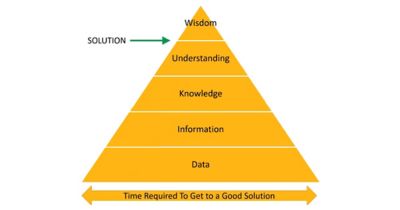
Model-based systems engineering (MBSE) can help junior engineers to more quickly and confidently “climb” the wisdom pyramid.
For example, more senior engineers can build AI-powered solutions for their team based on their previous work. Such solutions can answer questions such as “Am I using the best practices to design my radar systems?” and “Which design variables have more impact on performance?”
In this way, organizations can enable more junior engineers to self-learn, accelerating their path up the thought pyramid.
4. Minimizing Overall Costs
When considering DE and MBSE, you may wonder if adding more processes to the mix will result in cost increases. Due to the advantages discussed here, efficiency increases from DE and MBSE can yield cost savings across an organization.
As Davenport puts it, “Ultimately, making the right decisions faster means the engineer becomes more valuable to their organization.” Simultaneously, this helps organizations avoid the costs and schedule delays caused by making poor decisions, enabling them to further reduce costs and get to market more quickly.
Defining the Path Toward DE and MBSE
What if you’re interested in DE and MBSE but aren’t sure what steps to take? First, let’s define what a good solution to implementing DE and MBSE in your organization entails. An ideal solution must:
- Empower engineers to be able to make better decisions every day, becoming more valuable to the organization
- Be tool agnostic to enable integrated workflows
- Complement existing enterprise, IT, and cybersecurity tools and methods
- Engage all aspects of the organization, including every subject matter expert (SME)
- Provide clear advantages to the organization, such as driving profit and increasing efficiency
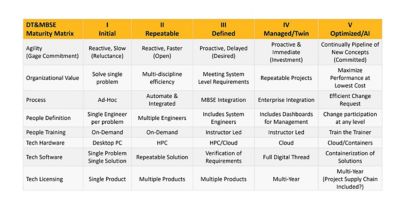
An MBSE maturity matrix created by Tony Davenport and based on the Carnegie Mellon Maturity Matrix
This matrix increases in maturity as you move from left to right, with most organizations falling within stages I and II.
- Stage I typically involves solving single problems on an ad hoc basis with a single product.
- Stage II focuses on creating repeatable work and automated workflows that increase efficiency, possibly with the help of multiple products and high-performance computing (HPC).
- Stage III is where MBSE comes into play, with engineers focusing on what they want to build and why via a disciplined systems engineering approach. In this stage, engineers can study how a system holistically plays within its environment.
- Stage IV involves capturing and managing data, models, and workflows within authoritative sources of truth (ASoTs) for search and reuse by others within an organization. In addition, this stage involves using digital twins to create reduced-order models (ROMs) for fast-running and transportable analytical solutions.
- Stage V widens the lens further to bring in new possibilities for engineers, such as using AI trained on previous work to ask questions and find answers quickly, which can help train younger engineers quickly. This has an additional benefit of efficient training and engaging the engineering workforce.
Successfully progressing through these stages will require performing multiple tasks simultaneously to create simulation workflows, establish MBSE practices, and create a DE infrastructure across all stakeholders. “All these work in parallel, and they can merge as they progress in maturity,” says Davenport.
The underlying requirement here is an understanding of the goals and benefits at each progressive stage, which helps organizations both identify their path forward and establish more realistic expectations as they transform their organizations.
Of course, this matrix is just one method of progressing forward with DE and MBSE. No matter your chosen path, organizations can implement DE and MBSE using products and software solutions they already have, such as Ansys simulation solutions.
Key Ansys Software Solutions for Implementing DE and MBSE at Your Organization
Simulation solutions from Ansys, part of Synopsys, are open and flexible, making them easy to integrate into your existing setups and processes. Ansys software also provides a multidisciplinary approach that combines cost considerations, system engineering, and multiphysics engineering.
An animation showing how a phased array antenna’s maximum gain dynamically points at a ground station while it orbits the area
For example, consider an engineer working on a phased array antenna for use on a weather-monitoring drone. This engineer may be using only Ansys HFSS high-frequency electromagnetic simulation software to analyze their designs, but in the future, they could expand to using:
- HFSS software, along with Ansys Mechanical structural finite element analysis software, to take a multiphysics approach. A benefit of Ansys simulation solutions is the ability to seamlessly perform multiphysics simulations, gaining more detailed and accurate results all within one product ecosystem.
- The Ansys System Architecture Modeler (SAM) capability to manage complex products by implementing MBSE alongside engineering solutions, as well as Ansys ModelCenter model-based systems engineering software to create and automate multitool workflows, optimize product designs, and connect requirements to engineering. With these solutions, the engineer can better collaborate on their phased array antenna design by easily sharing only the relevant information with internal and external partners, creating multidisciplinary workflows, building models that show all the requirements of their antenna (e.g., antenna gain and transmit power), and more
- Ansys Systems Tool Kit (STK) digital mission engineering software to expand their analysis by providing a physics-based solution for studying complex systems in their operational environments. By using STK software, our engineer can study how their new radar system functions in a variety of environmental conditions and mission scenarios, confirming reliability, performance, and certification compliance throughout all tests.
- Ansys Minerva simulation process and data management software to enable DE by serving as an ASOT for simulation data and connecting to the digital thread. With Minerva software, the engineer can build a workflow that enables multiple engineers to analyze aircraft radar performance as well as define a place to store this data, enabling the sharing of models and processes, which increases the team’s ability to collaborate.
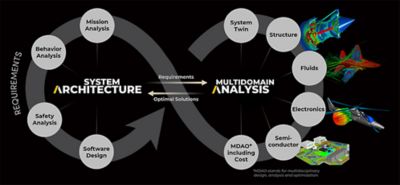
An example of how MBSE enables digital engineering
At the end of the day, implementing DE and MBSE at your organization isn’t about the technology or products used. It’s a change in mindset and procedure — a transformation in how you design, build, and produce systems. Making this change will involve moving through different maturity levels to reach your goals, all while increasing precision, accuracy, and profits.
Head here to learn more about the benefits and applications of MBSE, or download this e-book to learn why digital engineering is critical to future-proofing your business.




The Advantage Blog
The Ansys Advantage blog, featuring contributions from Ansys and other technology experts, keeps you updated on how Ansys simulation is powering innovation that drives human advancement.