-
-
Kostenlose Software für Studierende
Ansys unterstützt die nächste Generation von Ingenieur*innen
Studenten erhalten kostenlosen Zugang zu erstklassiger Simulationssoftware.
-
Verbinden Sie sich jetzt mit Ansys!
Gestalten Sie Ihre Zukunft
Stellen Sie eine Verbindung mit Ansys her, um zu erfahren, wie Simulation Ihren nächsten Durchbruch vorantreiben kann.
Länder und Regionen
Kostenlose Demoversionen
Produkte & Dienstleistungen
Lernportal
Über das Unternehmen
Back
Produkte & Dienstleistungen
Back
Lernportal
Ansys unterstützt die nächste Generation von Ingenieur*innen
Studenten erhalten kostenlosen Zugang zu erstklassiger Simulationssoftware.
Back
Über das Unternehmen
Gestalten Sie Ihre Zukunft
Stellen Sie eine Verbindung mit Ansys her, um zu erfahren, wie Simulation Ihren nächsten Durchbruch vorantreiben kann.
Kostenlose Demoversionen

As the energy industry searches for sustainable energy sources, nuclear fusion remains a long-term goal. It has the potential to solve the energy trilemma, but achieving this requires sophisticated engineering solutions.
Nuclear fusion differs from nuclear fission in that it doesn’t split atoms to release energy. Instead, fusion combines light atomic nuclei to release enormous amounts of energy, the same process that powers the Sun. Fusion promises a virtually limitless, low-carbon power source, yet recreating it remains one of the most formidable engineering challenges of our time.
Fusion energy creates extreme conditions and needs complex physics and unprecedented engineering demands to be achieved. Plasma that is hundreds of millions of degrees Kelvin must be confined and maintain structural integrity under intense thermal and magnetic stresses. These advanced designs incorporate cutting-edge materials, digital engineering, and novel safety systems, introducing first-of-a-kind (FOAK) challenges. To overcome these challenges, simulation is essential for researchers and engineers to explore, design, and optimize reactors that would be impossible through experimentation alone.
By simulating the entire reactor system, engineers can evaluate efficiency, cost trade-offs, and safety requirements. Virtually testing cooling systems, magnetic confinement strategies, and structural materials enables rapid design iterations that would otherwise take years to physically prototype. This accelerates innovation, helps to de-risk projects, and speeds technology transfer to scale.
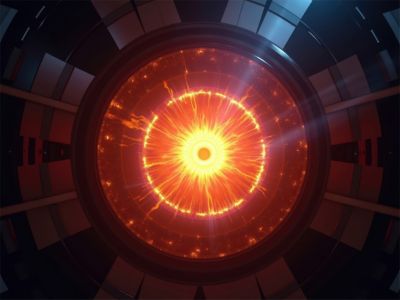
Inside a tokamak reactor, witnessing nuclear fusion processes creating controlled plasma energy
Multi-Domain Digital Engineering Environment for Fusion Reactor Design
Simulation has become central to the design, testing, and optimization of fusion energy systems. This is an extremely complex multiphysics, multiscale, multidomain undertaking, often with many partners, teams, and collaborators.
Establishing a digital engineering environment (DEE) is essential for organizations to address the challenges posed by complexity, interdependencies, requirements, and multiple simulation tools. The DEE includes a dedicated engineering simulation authoritative source of truth (ASOT) in the form of a simulation process and data management (SPDM) system to effectively manage engineering groups and preserve and manage simulation data and models in a structured, traceable, and reusable manner. The SPDM system also enables users to work effectively as a team using the available collaboration tools, even when they’re not geographically together.
Extensions to the DEE enable a tight connection with systems engineering efforts by linking model-based systems engineering (MBSE) authoring tools to the simulation tools. This enables automated, traceable processes for requirements verification, as well as easy architectural trade-offs through analysis-of-alternatives exercises validated via simulation. Specialized simulation codes developed by the national agencies and researchers to address complex fusion-related physics, like plasma dynamics, can be integrated with a commercial, reliable, and tool-agnostic multidomain simulation environment which includes highly accurate commercial codes for a wide range of physics that are also important to fusion development. Engineers iterate on designs virtually, accounting for multiple types of physics occurring at multiple scales before committing to costly physical prototypes. The DEE can also be connected to high-performance computing (HPC) capabilities to speed up simulation evaluation time and enable large trade studies. The data generated by simulation models can be used to create digital prototypes that can later be converted and calibrated into digital twins. This environment can also be linked to a more extensive product development ecosystem with other ASOTs, such as product life cycle management (PLM) systems.
A DEE enables organizations and their engineers to harness the benefits of digital simulation tools and take advantage of the synergies that come with a virtual connected system. Such a system, coupled with appropriate methodologies and processes, enables engineering programs to achieve fine-grained traceability, easy access to tools, managed data and models, and effective information management.
Ansys, part of Synopsys, delivers solutions that tackle system complexity through market-leading, high-fidelity simulation tools, enabling faster development while enhancing the efficiency, safety, and performance of fusion reactors. Ansys is the only platform offering a fully integrated, multi-domain simulation environment powered by digital technologies such as MBSE, automation, intelligent software, and data analytics, which are vital to competitiveness and long-term viability. Our deep simulation capabilities span the physics of structures, fluid dynamics, electromagnetics, and multiscale modeling, as well as semiconductors, optics, embedded software, and materials. Unlike tools focused on isolated domains, we deliver modern, multiphysics integration, eliminating manual testing and siloed workflows. This streamlines processes, improves accuracy, and accelerates project delivery, all while ensuring compliance and operational excellence. The Ansys suite of tools and methodologies is also agnostic, enabling our customers to integrate and optimize with industry-standard tools or their own algorithms. This is important, as many nuclear engineering companies use customized or niche tools with long-standing legacy use cases.
An enterprise-wide DEE includes:
- Enterprise-wide digital thread complete with simulation, material, and data from other ASOTs. This eliminates any guesswork and drastically minimizes the manual back-and-forth effort required between teams to communicate information, locate correct model versions, and address design changes.
- Purpose-built ASOT that is dedicated to enterprise-wide simulation process and data management (eSPDM). Since a DEE must support a diverse set of tools, the eSPDM ASOT offers configuration management and vendor-neutral architecture.
- Purpose-built ASOT dedicated to enterprise-wide material data (eMAT) that contains an exhaustive library of materials, which can be augmented with the inclusion of proprietary and classified material data, making the needed material data available quickly and also ensuring that the correct data is used.
- Collaborative process workflows, which are single or multidisciplinary workflows with process management capabilities. They enable control over simulation data, including backup and archiving, traceability and audit trail, process automation, people collaboration, and capture of engineering expertise and IP protection. An eSPDM solution is a key enabler.
- Process integration and workflow automation connect multiple disciplines at each phase of the program life cycle to explore the sensitivities of components influencing the complex design space. This enables optimization of the designs at the conceptual, preliminary, and detailed phases. This process is primarily enabled by multidisciplinary design analysis and optimization (MDAO), which integrates disciplines to conduct trade studies without a human-in-the-loop, enabling automated, knowledge-based, fast exploration of the design space using reduced-order models (ROM). The MDAO process strives to produce a more robust design. The two main types of automated workflows are:
- Solver workflows are verticalized workflows typically associated with a specific physics domain.
- Tool-chaining workflows for process integration and multidisciplinary design optimization.
- Continuous verification and validation against requirements are necessary as the designs mature from early concepts of operations (CONOPS) and analysis of alternatives, system, and subsystem conceptual studies to detailed design and software development. Modeling, simulation, and analysis (MS&A) processes are deployed throughout the development practices for system-, subsystem-, and component-level verification. Before transitioning to physical prototyping and testing, a mature design can be virtually tested against performance, reliability, logic, and life requirements using model-in-the-loop and software-in-the-loop processes.
- Technologies for digital verification and virtual validation. Model-based, digital-process-driven testing and evaluation should be part of a comprehensive shift toward their adoption. In fact, model-based test and evaluation (MBT&E) solutions already exist in ways that can be adopted with or without transforming the design and analysis processes.
- Open ecosystems enable automation across and within domains. This conceptual approach ensures that an organization can enable solutions for usability, interoperability, traceability, scalability, maintainability, extensibility, availability, security, and more.
- Facilitation of multidomain, distributed, collaborative execution of digital engineering activities in a safe and secure environment, while ensuring all domains, states, phases, and tasks are supported with mature modeling, simulation, and analysis.
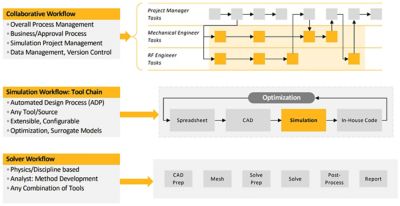
Hierarchical process illustration within the modeling, simulation, and analysis domain
Ansys Provides Key MBSE Technologies Needed for Success
Ansys provides key MBSE technologies, including Ansys System Architecture Modeling software, which is a collaborative platform and ASOT for system requirements, components, and their attributes. Bidirectional connection of any engineering analysis to the system architecture model is essential when performing trade studies and verifying requirements throughout the entire design process, the design and generation of embedded software, safety and cybersecurity analysis, digital twins, simulation data management, and engineering simulation.
In addition to these key products, Ansys has an open architecture philosophy and mindset, that enables Ansys to integrate its key technologies with whatever third-party products our customers are using, for example requirements management and PLM. Ansys’s MBSE solution includes a comprehensive and flexible methodology that customers can use to implement MBSE and achieve the promised cost and efficiency benefits. The combination of key technology, open infrastructure mindset, and MBSE methodology make Ansys the best partner for MBSE.
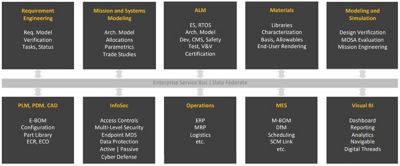
Ansys interoperable MBSE building blocks
Advantages of Coupling Ansys’ SPDM Solutions with PLM Systems
While the complexity of designing and building nuclear fusion power plants threatens to extend timelines and delay schedules, time waits for no one. PLM is not enough, even though PLM tools are prevalent, because they were developed with a focus on computer-aided design (CAD), not simulation. Enterprises that recognize the power of simulation are not maximizing their potential because they rely on legacy PLM systems. That’s why the fundamental need to stay ahead now requires a fundamental change in how engineered systems are designed, developed, tested, and maintained. It is undesirable for an enterprise to find itself in a position where its success may be impaired, cost overruns are commonplace, and the performance of the system is less than what it should be.
AI Advances Fusion Innovation
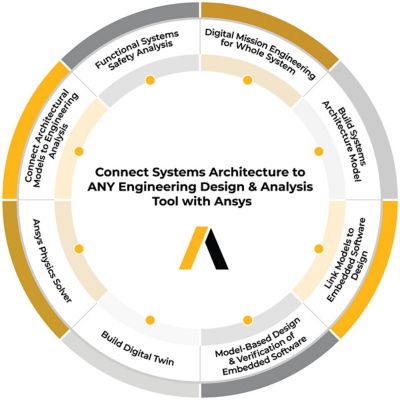
Digital engineering ecosystem
Integrating comprehensive tool suites with artificial intelligence and machine learning (AI/ML) and digital twins makes innovation more accessible, enabling optimized design throughout the plant life cycle. Combining physics-based simulation with AI-driven analytics and generative design empowers researchers to explore more design possibilities smarter and faster than ever. In addition, Ansys AI tools were designed for ease of use, no coding or data science expertise required. Users simply upload their data, select desired outputs, and use generative AI models to improve the design. This empowers plant designers to explore complex design spaces intelligently, efficiently, and quickly, even without having deep AI experience.
System Safety, Reliability, and Software Development
Ansys enables model-based safety and reliability analysis capabilities to various safety domains with Ansys medini analyze system-oriented safety analysis software. Ansys also supports model-based development of embedded safety-critical software applications, with consideration for efficiency and qualification standards across different domains, including nuclear instrumentation and controls.
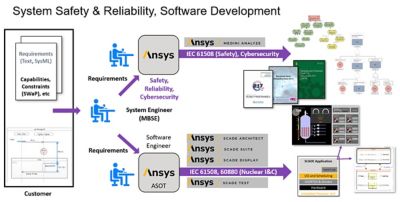
System safety and reliability software development
Investing in the Future of Fusion
Public and private companies around the world have invested in fusion research and are demonstrating that fusion is increasingly within reach. Collaboration across academia, national laboratories, and private industry accelerates progress and reduces duplication of effort. In this context, simulation serves as a bridge between theory, experimentation, and practical engineering solutions.
Despite significant advances, engineering hurdles, material limitations, and the need for integrated system testing, fusion remains a long-term endeavor. However, simulation helps overcome these obstacles efficiently. Virtual prototyping, risk assessment, and system optimization enable engineers to make informed decisions, prioritize experimental validation, and focus resources on the most promising approaches.
The race toward establishing nuclear fusion power plants to be practical and commercially viable is as much an engineering challenge as it is a scientific one. While plasma physics and reactor concepts capture headlines, real progress often comes from the meticulous work of modeling, simulation, and design refinement. Simulation enables engineers to explore extreme conditions safely, optimize complex systems, and accelerate innovation in ways that were previously unimaginable. Ansys digital engineering solutions enable seamless workflows, driving operational excellence, reducing uncertainty and cost, and ensuring compliance with stringent safety standards. We help de-risk complex projects and fast-track the development of advanced technologies, empowering customers to scale confidently in safety-critical environments.
Learn more about how Ansys, part of Synopsys can help with nuclear power generation.


The Advantage Blog
The Ansys Advantage blog, featuring contributions from Ansys and other technology experts, keeps you updated on how Ansys simulation is powering innovation that drives human advancement.