Skip to Main Content

Teaching Optics & Photonics with Ansys

By blending theory with the visualization of optical and photonic phenomena, incorporating Ansys software into your optics and photonics curriculum provides students with hands-on experience using industry-leading tools, significantly enhancing learning outcomes, student retention, and career preparedness.
Speak with an expert
Teaching Optics & Photonics with Ansys

Why Teach Using Ansys?

Empower the next generation of optical and photonics engineers by integrating Ansys software into your curriculum. With Ansys, students can increase their optical intuition, mastering fundamentals such as light-matter interaction, wave propagation and beam optics, photonic device design, and the role of optical systems in modern technology. Teaching with Ansys bridges the gap between theoretical principles and hands-on application, giving students the tools to design, analyze, and optimize optical and photonic systems.

By using the same simulation software trusted by leading companies worldwide, you'll equip your students with in-demand skills and a competitive edge in their careers, improving placement rates. Bring innovation into your classroom and prepare your students to tackle the toughest optics and photonics challenges with confidence—teach with Ansys.

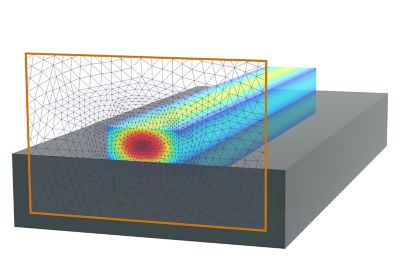
Waveguide Simulation

Resources for Optics & Photonics Engineering Courses

Explore how Ansys software, paired with Education Resources, makes teaching optics and photonics practical and engaging. From ray tracing and lens optimization in Zemax OpticStudio to waveguide design, interference modeling, and integrated photonics circuits in Lumerical, these resources combine theory with hands-on simulation, helping students visualize Gaussian imaging, analyze diffraction and polarization, design optical instruments, and build photonic components like couplers, resonators, and interferometers.

Using simulation in courses that explore geometrical optics enables students to visualize underlying theory and apply it to real-world optical systems. With tools like Zemax OpticStudio, students can design and optimize lenses, telescopes, and imaging systems using ray tracing techniques, reinforcing concepts such as focal length, aberrations, and system performance.

Designing the James Webb Space Telescope using Ansys Zemax OpticStudio   

Design Your First Lens: Intro to Imaging Systems Using Ansys Zemax OpticStudio

Cookes Lens Design in Ansys Zemax OpticStudio

Simulation in wave optics and photonics courses allows students to move beyond ray approximations and understand light as an electromagnetic wave. Using Lumerical tools, they can model interference, diffraction, guided-wave propagation, and integrated photonic devices, providing a deeper understanding of mode theory, coupling, and resonance effects critical for modern photonics applications.

Waveguide and Coupler Design with Ansys Lumerical Software

Ring Resonator Design with Ansys Lumerical Software

Mach-Zehnder Interferometer with Ansys Lumerical Software

Directional Waveguide Coupler Design in Ansys Lumerical Software

Introducing simulation early in a student’s degree helps bridge theory and practice from the start. Foundational resources combine basic ray and wave concepts, enabling students to explore optical behavior interactively and build confidence before tackling advanced design and analysis tasks.

Introduction to Optics Concepts with Ansys Tools Lecture Unit 

Basic Lens Design in Zemax OpticStudio | Education Resource

Los geht's

Wenn Sie mit technischen Herausforderungen konfrontiert sind, ist unser Team für Sie da. Mit unserer langjährigen Erfahrung und unserem Engagement für Innovation laden wir Sie ein, sich an uns zu wenden. Lassen Sie uns zusammenarbeiten, um Ihre technischen Hindernisse in Chancen für Wachstum und Erfolg zu verwandeln. Kontaktieren Sie uns noch heute, um das Gespräch zu beginnen.