Synopsys and Ansys power the future of innovation—connecting silicon to systems.
-
-
Kostenlose Software für Studierende
Ansys unterstützt die nächste Generation von Ingenieur*innen
Studenten erhalten kostenlosen Zugang zu erstklassiger Simulationssoftware.
-
Verbinden Sie sich jetzt mit Ansys!
Gestalten Sie Ihre Zukunft
Stellen Sie eine Verbindung mit Ansys her, um zu erfahren, wie Simulation Ihren nächsten Durchbruch vorantreiben kann.
Kostenlose Demoversionen
Produkte & Dienstleistungen
Lernportal
Über das Unternehmen
Back
Produkte & Dienstleistungen
Back
Lernportal
Ansys unterstützt die nächste Generation von Ingenieur*innen
Studenten erhalten kostenlosen Zugang zu erstklassiger Simulationssoftware.
Back
Über das Unternehmen
Gestalten Sie Ihre Zukunft
Stellen Sie eine Verbindung mit Ansys her, um zu erfahren, wie Simulation Ihren nächsten Durchbruch vorantreiben kann.
Kostenlose Demoversionen
THEMENDETAILS
Was ist Beamforming?
Beamforming ist der Prozess der Bildung und Ausrichtung eines elektromagnetischen Strahls – als drahtloses Signal –, um räumliche Vielfalt für eine Antenne zu schaffen. Beim Beamforming geht es darum, einen Strahl in einem Antennenempfänger-System zu erzeugen und zu kontrollieren und die Energie in eine bestimmte Richtung zu den Empfängern zu leiten, während gleichzeitig verhindert wird, dass Energie woanders hin entweicht.
Ohne Beamforming würden sich elektromagnetische Signale, wie Hochfrequenzwellen, ohne jegliche Kontrolle vom Sender in alle Richtungen ausbreiten. Dies führt zu einer geringeren Genauigkeit und einem niedrigen Signal-Rausch-Verhältnis am vorgesehenen Empfänger.
Beamforming ist Strahllenkung sehr ähnlich. Die beiden Begriffe werden zwar oft austauschbar verwendet, aber Beamforming bildet einen Bleistift-ähnlichen Strahl und drückt den Strahl in eine bestimmte Richtung, wohingegen Strahllenkung die Strahleigenschaften kontinuierlich aktualisiert, um einem Empfangsgerät zu folgen und auf Umgebungsänderungen zu reagieren.
Wie funktioniert Beamforming?
Beamforming steuert die Phase und Amplitude mehrerer Signalquellen über ein Antennenarray, um einen einzelnen konzentrierten Strahl oder mehrere gleichzeitige Strahlen zu erzeugen.
Die Phase und Amplitude werden auf der Ebene jedes Signalstroms angelegt, was an der jeweiligen Antenne oder an der Stelle sein kann, an der mehrere Antennen zu Subarrays zusammenfasst sind.
Um die Strahlen zu leiten, werden die Signale, die von den unabhängigen Signalquellen (Antennen) ausstrahlen, so eingestellt, dass sie ihre abgestrahlte Energie in eine gewünschte Richtung überlagern, wodurch auch Nullen in andere Richtungen erzeugt werden. Nullen entwickeln sich in Richtungen, in denen sehr wenig Energie abgestrahlt wird, und stellen Richtungen dar, in denen empfangende Arrays eine Empfindlichkeit nahe Null haben.
Es gibt drei Hauptelemente für die Konstruktion und Ausrichtung eines Strahls:
- Räumliche Signalverarbeitung: Analysiert die räumlichen Eigenschaften und relativen Phasen eines Anfangssignals.
- Anpassen des Signals: Passt Verstärkung und Phase jeder Antenne dynamisch auf Grundlage der Anfangsanalyse an.
- Signalkombination: Die Signale der einzelnen Antennenelemente werden kombiniert, um einen fokussierten Strahl zu erzeugen, der auf den Empfänger gerichtet ist. Interferenzen in andere Richtungen können ebenfalls in diesem Stadium genullt werden.
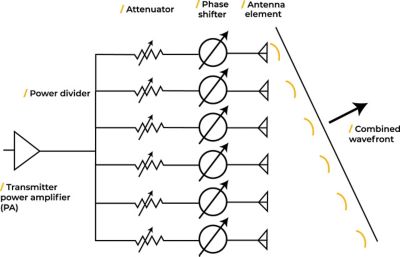
Schaltplan eines Phased Array
Da Sender und Empfänger zusammenarbeiten, spielen die Empfänger auch eine Rolle beim Empfang der Signale. Die Empfänger können zur Steuerung des Empfindlichkeitsmusters des Antennensystems verwendet werden, indem die einzelnen Signale, die an jeder Antenne im Array ankommen, verzögert werden. Die Steuerung der Zeitverzögerung des Signals ist das gleiche wie die Steuerung seiner Phase, da die Phase im Frequenzbereich der Zeitverzögerung im Zeitbereich entspricht. Durch die Steuerung von Zeitverzögerung/Phase können die Wellenfronten in die gewünschte Richtung geändert und ihre Kombination maximiert werden.
Außerdem ermöglicht die Manipulation der Amplitude des empfangenen Signals jedes Antennenelement individuell zu steuern (stärker oder schwächer zu machen), um in den gewünschten Richtungen das maximale Signal zu erhalten. Dazu werden die Nebenkeulen des Antennenarrays unterdrückt, um die Abstrahlung von Energie in unerwünschte Richtungen zu verringern. Dies verbessert Signalstärke und Signalqualität in die gewünschten Richtung, und das Signal in Richtungen, die nicht von Interesse sind, wird reduziert. Dadurch wird die Wahrscheinlichkeit verringert, dass ein Array andere HF-Systeme im Sendemodus stört, und die Empfindlichkeit gegenüber anderen potenziellen Störquellen in anderen Richtungen als der beabsichtigten Signalquelle wird verringert. Dies ist sehr wichtig bei großen Phased Array-Konfigurationen mit einer großen Anzahl von Antennen, bei denen mehrere Strahlen zur Verfolgung und zum Umgang mit mehreren Drahtlosnetzwerk-Benutzenden und -Kommunikationssystemen verwendet werden.
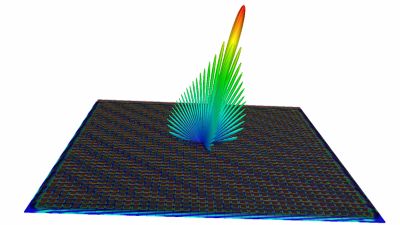
Große Phased Array-Antenne mit einer grafischen Darstellung des Strahlungsmusters der Antenne gemäß der Berechnung der elektromagnetischen Hochfrequenz-Simulationssoftware Ansys HFSS. Farbcodierung und Beamforminghöhe über der Antennenebene zeigen die Signalstärke als Richtungsfunktion an. Die Richtung des Spitzensignals sowie Sekundärstrahlungs-Nebenkeulen sind deutlich sichtbar.
Beamforming-Technologien
Viele Beamforming-Technologien werden verwendet, um einen fokussierten Energiestrahl zu erzeugen, zu steuern und zu lenken.
Schmalband-Beamforming
Schmalband-Beamforming ist eine der einfacheren Technologien. Es verwendet eine sehr spezifische, einzelne Frequenz, die einen klar definierten Strahl liefert, der bei allen Antennenelementen auf der zentralen Frequenz als gleich angenommen wird. Es wird häufig in Sonartechnologie und Schmalband-Kommunikationssystemen verwendet.
Breitband-Beamforming
Breitband-Beamforming ist schwieriger zu steuern, da die Frequenz über ein viel breiteres Band verläuft, in dem ein Einphasenverschiebungswert den Signalstrahl effektiv unscharf machen würde. Das in die Antenne eingespeiste Signal muss durch Ändern der Phase oder Frequenz an seine Bandbreite angepasst werden. Wenn keine Anpassungen vorgenommen werden, kann dies den effektiven Abstand der Elemente in einem Phased Array beeinträchtigen und zu Beam Squint führen (ein Phänomen, das dazu führen kann, dass der Strahl unbeabsichtigt die Richtung ändert). Wenn die Bandbreite auf der Senderseite nicht gesteuert werden kann, wird ein Breitbandsignal gesendet (während die zentrale Frequenz angestrebt wird), und die nachgeschaltete Signalverarbeitung auf der Empfängerseite muss die breiten Frequenzbänder kompensieren. Breitband-Beamforming wird häufig in Radarsystemen und MU-MIMO-Beamforming-Kommunikationssystemen verwendet.
Nullsteuerndes Beamforming
Bei Nullsteuerung werden andere Signale ausgelöscht, um Störungen zu reduzieren. Die Nullstelle wird als Beschränkung auf die Beamformingbedingungen angewendet, die zur Bestimmung der entsprechenden Phasen der Beamforming-Kanäle verwendet werden. Dadurch entsteht bei der Kombination der Signale eine Gesamtsignaldämpfung (bzw. -auslöschung) in der Nullrichtung. Die Nullstelle wird in allen Phasenzuständen kombiniert, die auf jedes Element im Array angewendet werden. Es wird häufig verwendet, um Menschen daran zu hindern, Signale globaler Positionierungssysteme zu stören, insbesondere im Militär- und Verteidigungssektor.
Adaptives Beamforming
Adaptives Beamforming verbessert die Übertragung eines Signals durch dynamische Anpassung des Richtungsmusters des Phased Array. Es minimiert Rauschen und maximiert das fragliche Signal. Diese Beamforming-Technologie wird häufig in 5G-Netzen eingesetzt. Bei Kommunikationsformen mit adaptivem Beamforming wird ein Standardsignal vereinbart und Pilotsignale werden in regelmäßigen Abständen (z. B. jede Millisekunde) über eine Breitbandfrequenz gesendet, während die Empfänger schätzen, wie der Kanal im gesamten Band aussieht.
Hybrides Beamforming
Hybrides Beamforming ist eine Kombination aus analogem und digitalem Beamforming. Hybrides Beamforming verwendet sowohl analoge als auch digitale Komponenten als Teil eines großen Arrays. Es wird auch weitgehend in 5G- und Millimeterwellen-Kommunikationssystemen verwendet, bei denen analoge Sender ein Signal senden, digitale Empfänger das empfangene Signal jedoch als digitales Signal verarbeiten. Hybrides Beamforming kann die Komplexität der digitalen Verarbeitung verringern, indem analoges Beamforming auf Subarrays angewendet wird, die an konstanten, aber unterschiedlichen Orten "suchen" und die Signale zu einer kleineren Anzahl von digitalen Empfängern kombinieren. So hat das System einen digitalen Empfänger, der sich auf einen bestimmten räumlichen Bereich konzentriert. Methoden für hybrides Beamforming können im Vergleich zu vollständig digitalen Beamforming-Systemen hohe Datenraten zu niedrigen Kosten und bei geringer Komplexität erzielen.
Vorteile und Einschränkungen von Beamforming
Obwohl Beamforming in vielen Kommunikations- und sensorbasierten Anwendungen von entscheidender Bedeutung ist, gibt es wie bei jeder Technologie Vor- und Nachteile.
Vorteile von Beamforming
- Hohe räumliche Steuerung, um die Energie eines Strahls gezielt zu lenken, ohne Energie zu verschwenden (d. h. Energie, die an Orten ohne Empfänger verloren ginge).
- In Phased Arrays können mehrere Strahlen kontrolliert werden.
- Präzises Formen und Leiten von Funksignalen (Hochfrequenzwellen), um Konnektivität mit hoher Geschwindigkeit und niedriger Latenz für verschiedene Kommunikationssysteme zu ermöglichen.
- Sendern eine Möglichkeit bieten, Strahlen auf eine Vielzahl von Geräten zu fokussieren, darunter das Internet der Dinge (IoT), Mobilgeräte und Fahrzeuge.
- Bietet geringe Erkennbarkeit und Störfestigkeit für militärische Anwendungen.
- Ermöglicht, dass das Frequenzspektrum wiederverwendet wird, um mehrere Strahlen zu bilden.
- Bietet Sicherheit bei Ausfall einzelner Sender oder Empfänger mit Multisource-Array-Systemen.
Einschränkungen von Beamforming
- Komplexe Systeme erfordern eine Vielzahl von Hardwarekomponenten, darunter Verstärker, Phasenverschieber, Wandler und Digitalsignal-Verarbeitungseinheiten.
- Beamforming-Technologien (insbesondere digitale Beamforming-Technologien) sind nicht günstig, aber die Kosten sinken, da die Hardware günstiger wird.
- Anpassungseinschränkungen können in sich wandelnden Umgebungen problematisch sein.
- Fortschrittliche Beamforming-Algorithmen beim digitalen Beamforming können rechenintensiv sein.
- Beam-Squinting und Self-Nulling können während des Betriebs auftreten.
Beamforming-Anwendungen
Da heutzutage verschiedene Strahlarten verwendet werden, von Licht über Hochfrequenz bis hin zu anderen elektromagnetischen Wellen, gibt es viele Branchen und Anwendungen, in denen Beamforming eingesetzt werden kann.
Medizinische Anwendungen
Das bei der Magnetresonanztomographie (MRT) verwendete Beamforming erzeugt Bilder mit höherem Kontrast und größerer Schärfe aufgrund des geringeren Rauschens. Bei einem MRT sind einzelne Transducer (Wandler) radial um den Patienten angeordnet. Die Beamforming-Technologie kombiniert die Signale der Transducer (Wandler), um ein hochauflösendes Bild zu erzeugen. Durch die Kenntnis der Platzierung aller Transducer (Wandler) kann das System selektiv mit der Bildgebungsumgebung interagieren, um zu bestimmen, welche Elemente in das endgültige Bild aufgenommen werden sollen.
Neben der medizinischen Bildgebung wird Beamforming zur Behandlung von Krebspatienten eingesetzt. Viele Krebsbehandlungen verwenden Strahlung (Strahlentherapie), die durch Phased Arrays erzeugt werden. Bei diesen Therapien können mehrere Strahlenquellen in diesen Arrays verwendet werden und die Teilchenstrahlen am Tumor aufeinandertreffen lassen. So kann der schmale, fokussierte Strahl Krebszellen töten, während die umliegenden gesunden Zellen unberührt bleiben.
5G und NextG
Beamforming wird in der 5G-Kommunikation verwendet, um Hochfrequenzwellen zwischen einer Basisstation und einem Mobilgerät zu fokussieren. In städtischen Umgebungen besteht die Gefahr von Echos und Rauschen, die durch Signale entstehen, die vom Boden und von Gebäuden reflektieren, wodurch die Signale beeinträchtigt werden, die der Empfänger interpretieren muss. Beamforming hilft dabei, diese Strahlen unabhängig von der Umgebung auf den vorgesehenen Empfänger zu fokussieren und die Signale nicht in jede Richtung zu senden. Dies ermöglicht auch die Wiederverwendung des Frequenzspektrums für mehrere Benutzende und gewährleistet hohe Datenraten und eine gute Netzabdeckung für Benutzender.
Phased Array-Antennen sind in viele Plattformen und Pakete integriert und können verwendet werden, um die in eine bestimmte Richtung gerichtete Energie zu maximieren. Die obige Animation zeigt eine HFSS-Software-Animation zur dynamischen Strahllenkung und zeigt auch elektrische Ströme, die die Antenne auf andere Teile des Host-Pakets induziert.
Optisches Beamforming
Optisches Beamforming wird in Multiplexern verwendet, bei denen Strahlen in bestimmte Richtungen gebildet werden, um Signalübertragung zu ermöglichen und bei hohen Datenraten in mehrere Richtungen zu wechseln. Es wird auch in der optischen Satellitenkommunikation eingesetzt, bei der die sehr präzise Steuerung optischer Strahlen von einem Satelliten auf niedriger Erdumlaufbahn zu einer Basisstation am Boden übertragen wird.
Phased Array-Antennen werden zunehmend bei Satellitenkommunikation und Radaranwendungen eingesetzt, um den Bedarf an mechanischer Lenkung zu reduzieren und gleichzeitig die Agilität des Antennensystems zu gewährleisten. Diese Simulation aus der Software HFSS zeigt das Strahlungsmuster, das die elektromagnetische Interaktion mit dem Host-Satellitenfahrzeug umfasst.
Radar
Bei Radaranwendungen konzentriert sich Beamforming auf ein bewegliches Ziel und passt sich an Änderungen an, indem die verschiedenen Antennen in einem Antennenarray verwendet werden. Radar kann oft vorhersagen, wo sich das Ziel befindet, sodass der Strahl auf verschiedene Punkte umgestellt werden kann, um die Energie auf dem Ziel zu halten. Algorithmen und Rückkopplungsschleifen verfolgen das Ziel selbst anhand von Vergangenheitsdaten auf der wahrscheinlichen Bahn des Ziels.
Antennen-Strahllenkung kann in praktischen Anwendungen eingesetzt werden, um die Richtung der Signalverstärkung zu aktualisieren, um die Bewegung des Host-Fahrzeugs auszugleichen. Diese Animation der Software HFSS zeigt die elektromagnetische Kopplung mit dem Beamforming der Antenne sowie die Funktion zur Kompensation der Fahrzeugbewegung.
Simulation von Beamforming mit Ansys
In einer idealen Welt würden Ingenieur*innen so wenig physikalische Tests wie möglich durchführen, bevor das Endprodukt realisiert wird. Simulation kann dazu beitragen, die erforderlichen physikalischen Iterationen der Entwicklungszyklen zu reduzieren, indem die Antennen und die Betriebsumgebung, in der sie verwendet werden, virtuell simuliert werden. So können Antennen so genau konstruiert werden, dass Sie nur einen Prototypen bauen müssen und damit Zeit und Geld durch fehlgeschlagene Prototypen sparen. Zudem liefert die Simulation mehr Erkenntnisse über die Konstruktion, als es mit rein physischen Tests möglich wäre.
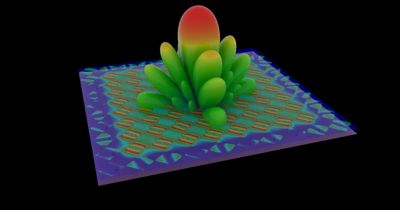
Die Strahlung einer Phased-Array-Antenne entsteht durch die Bewegung elektrischer und magnetischer Ströme auf den einzelnen Antennenelementen, die mit einer vorgegebenen Zeit- bzw. Phasenverzögerung angesteuert werden. Die Farben auf den Antennen auf der Ebene der Antenne in diesem Simulationsmodell aus der Software HFSS zeigen die relative Bewegung der Oberflächenströme auf den Antennen an, und die 3D-Oberflächendarstellung zeigt die Antennenstrahlung in Bezug auf die Ausrichtung.
Simulation kann Folgendes unterstützen:
- Testen der Antennenkonstruktion mit der vorgesehenen Prozesstechnologie.
- Testen potenzieller Fertigungsfehler.
- Analysieren der Leistung der Antennen in realen Szenarien, einschließlich extremer Umgebungen (wie im Death Valley oder im Weltraum) und Anwendungsszenarien (z. B. Montage der Antenne an einem Militärflugzeug zur Überwachung der Leistung oder in einer Stadt, um die Abdeckung von Drahtlosnetzwerken an verschiedenen Standorten zu testen).
- Testen von Physik und Eigenschaften der Grundmaterialien unter verschiedenen Bedingungen.
- Prüfen des Antennensystems auf eine gravierende Leistungsminderung bei Ausfall eines einzelnen Kanals. Das hilft beim Entwickeln von Strategien und der Planung von Reparaturen, um die Auswirkungen auf die Betriebssysteme zu minimieren.
Zur Beantwortung dieser Fragen können verschiedene Ansys-Tools verwendet werden:
- Ansys HFSS – elektromagnetische Hochfrequenz-Simulationssoftware: Wird verwendet, um Hochfrequenztechnologien auf der Geräte- und Integrationsebene sowie Phased Arrays zu entwerfen, bei denen alle erforderlichen Gewichte berechnet werden, um einen Strahl in eine bestimmte Richtung zu fokussieren.
- Die Simulationssoftware Ansys Icepak für Elektronikkühlung: Entwickelt zur Messung der Wärmekonvektion um Antennensysteme herum und zur Entwicklung von Kühlsystemen für die Anwendung.
- Ansys Fluent –Software zur Strömungssimulation: Wird zur Modellierung von fluid-, luft- und wassergekühlten Systemen verwendet, um einen optimalen Betrieb zu ermöglichen und ein Durchbrennen von Transistoren und Chips zu verhindern.
- Ansys RF Channel Modeler – Software zur Modellierung drahtloser Kanäle mit hoher Wiedergabetreue: Entwickelt, um digitale Zwillinge von Antennensystemen mit digitalen Zwillingen von großen Umgebungen zu kombinieren, um zu sehen, wie HF-Arrays in realen Szenarien funktionieren.
Die Zukunft des Beamforming
Während die Beamforming-Technologie heute eine Vielzahl von Antennensystemen in die Lage versetzt, auf einem viel höheren Niveau zu arbeiten, nehmen Fortschritte im digitalen Beamforming die Vorreiterrolle der nächsten Generation der Kommunikationstechnologie ein.
Dies liegt daran, dass das Signal so schnell wie möglich in ein digitales Format umgewandelt wird und anschließend Hochgeschwindigkeits-Digitalprozessoren mehrere Strahlen erzeugen, um in jede gewünschte Richtung zu senden oder zu empfangen. Mit ausreichender Basisbandverarbeitung können Phase und Amplitude für alle Nutzer individuell angepasst werden, sodass jeder seinen eigenen, einzigartigen Strahl erhält.
Während 5G derzeit von Beamforming profitiert, wird das digitale Beamforming dazu beitragen, 6G-Technologie, fortschrittlichere Radarsysteme, Multiple-User-Multiple-Input-Multiple-Output-Beamforming (MU-MIMO) und holographisches Beamforming einzuführen.
Wenn Sie herausfinden möchten, wie man fortschrittlichere Antennenarrays und Kommunikationssysteme mit verschiedenen Beamforming-Ansätzen entwickelt, wenden Sie sich noch heute an unser technisches Team.
Zugehörige Ressourcen
Los geht's
Wenn Sie mit technischen Herausforderungen konfrontiert sind, ist unser Team für Sie da. Mit unserer langjährigen Erfahrung und unserem Engagement für Innovation laden wir Sie ein, sich an uns zu wenden. Lassen Sie uns zusammenarbeiten, um Ihre technischen Hindernisse in Chancen für Wachstum und Erfolg zu verwandeln. Kontaktieren Sie uns noch heute, um das Gespräch zu beginnen.