Synopsys and Ansys power the future of innovation—connecting silicon to systems.
-
-
Kostenlose Software für Studierende
Ansys unterstützt die nächste Generation von Ingenieur*innen
Studenten erhalten kostenlosen Zugang zu erstklassiger Simulationssoftware.
-
Verbinden Sie sich jetzt mit Ansys!
Gestalten Sie Ihre Zukunft
Stellen Sie eine Verbindung mit Ansys her, um zu erfahren, wie Simulation Ihren nächsten Durchbruch vorantreiben kann.
Kostenlose Demoversionen
Produkte & Dienstleistungen
Lernportal
Über das Unternehmen
Back
Produkte & Dienstleistungen
Back
Lernportal
Ansys unterstützt die nächste Generation von Ingenieur*innen
Studenten erhalten kostenlosen Zugang zu erstklassiger Simulationssoftware.
Back
Über das Unternehmen
Gestalten Sie Ihre Zukunft
Stellen Sie eine Verbindung mit Ansys her, um zu erfahren, wie Simulation Ihren nächsten Durchbruch vorantreiben kann.
Kostenlose Demoversionen
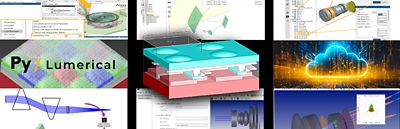
Accelerating confident engineering decisions from concept to system validation
Optical product development continues to evolve rapidly as systems grow more integrated, multiphysics in nature, and tightly constrained by mechanical and manufacturing realities. Whether designing automotive perception systems, augmented/mixed reality modules, photonic integrated circuits (PICs), or advanced illumination systems, today’s engineers must deliver higher accuracy faster and across more disciplines than ever.
Yet the largest bottleneck is no longer physics accuracy but workflow continuity and trust across tools.
Ansys Optics 2026 R1 addresses this challenge head-on. The latest release strengthens workflow continuity by focusing on modeling fidelity. It helps preserve design intent and physical meaning throughout the entire design chain — from optical concept to system validation.
The Industry Challenge: Fragmented Optical Design Chains
Optical development typically progresses through a maze of different environments — sequential imaging, nonsequential analysis, mechanical computer-aided design (MCAD), photonic simulation, and system-level validation.
Each transition introduces risk:
- Geometry reinterpretation
- Material reassignment
- Coordinate mistakes
- Stop placement mismatches
- Ambiguities in physical assumptions
These disruptions cost time, invite errors, and erode confidence.
Optics 2026 R1 reduces this “translation tax” by preserving design intent and physical consistency across the entire workflow.
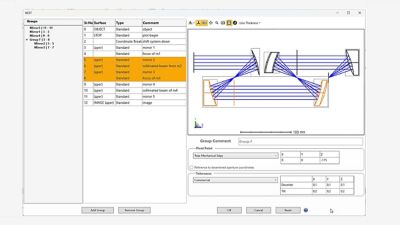
Ansys Zemax OpticStudio optical system design and analysis software Nested Elements and System Tolerancing (NEST) capability
Ansys Zemax OpticStudio 2026 R1: Designing With System Reality in Mind
Opto-Mechanical Tolerancing With Mechanical Hierarchy
Traditional tolerancing treats optical elements as independent perturbations, but in real systems, lenses are mounted assemblies with defined pivot points.
The new Nested Elements and System Tolerancing (NEST) capability in OpticStudio software captures this reality by:
- Organizing elements into mechanically meaningful groups
- Automatically inserting coordinate breaks and tolerance operands
- Determining correct tilt and decenter pivots using smart presets
- Updating layouts in real time to visualize true motion
This dramatically improves sensitivity analysis accuracy, especially for off-axis and folded systems, where manual pivot definitions often introduce errors.
Coming Soon: Requirements Editor — Turning Specs Into Executable Constraints
Today, specifications often live in PDFs or spreadsheets, disconnected from the optimization process. The upcoming Requirements Editor is designed to close this gap, giving designers a direct way to translate system requirements into optimization‑ready constraints.
When released, the Requirements Editor will enable teams to define:
- Modulation transfer function (MTF) targets and wavefront error limits
- First-order system requirements
- Pupil parameters and spot size constraints
By converting these parameters into actionable constraints within the optimization loop, the Requirements Editor will help ensure that system performance stays tightly aligned with design intent.
The expected engineering impact:
- Reduced transcription errors
- Faster validation
- Clear traceability between the requirement and the performance
Non-Sequential Workflow Enhancements for Complex Architectures
As optical systems become more folded and integrated, non-sequential modeling becomes essential.
OpticStudio 2026 R1 introduces several structural improvements:
- Dedicated NSC stop objects. Explicit aperture geometry ensures physically accurate stop behavior in non-sequential propagation, eliminating ambiguity in pupil formation and flux clipping.
- NSC quick focus. Automatic detector alignment based on selected ray sequences ensures correct focus, centering, and orientation, particularly in folded and diffractive systems.
- Sequence grouping. Ray paths can be grouped automatically by ghost order, diffraction interaction, TIR behavior, or source-detector contribution. This enables causal analysis of stray light contributors instead of inspecting only aggregate irradiance.
- NSC imaging tools. NSC spot diagram and direct RMS spot optimization in non-sequential mode enables imaging performance evaluation under realistic system conditions.
These features shift NSC analysis from a verification tool to an imaging design environment.
Unified Diffractive and Meta-Optics Data Formats
To further improve efficiencies, Ansys Zemax OpticStudio 2026 R1 also unifies diffractive and meta-optics data formats via:
- Simplified edition selection
- Messages window
- Ansys Engineering Copilot
- MTF analysis performance improvements
These enhancements enable engineers to access the information they need more quickly and seamlessly from within Ansys Zemax software.
Ansys Lumerical 2026 R1: Connecting Nanophotonics to System Design
At the photonic device scale, simulation accuracy depends heavily on geometric fidelity and multiphysics coupling. Lumerical 2026 R1 strengthens the connections among fabrication, optics, and system-level performance through new workflows and graphics processing unit (GPU) acceleration.
Fabrication-Aware CMOS Image Sensor Workflow
- The Sentaurus TCAD-to-Lumerical FDTD workflow for CMOS Image Sensor (CIS) enables consistent propagation of geometry and material information between tools. This workflow uses the manual exchange of TDR files to transfer Sentaurus TCAD Mesh and Structure data into FDTD software for optical simulation.
- Optical generation rate (OGR) data produced by the FDTD simulation can then be exported back into the Sentaurus S-device for electro-thermal simulations, closing the loop among fabrication, optics, and electronics.
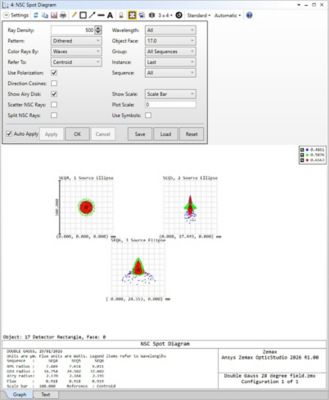
An NSC spot diagram
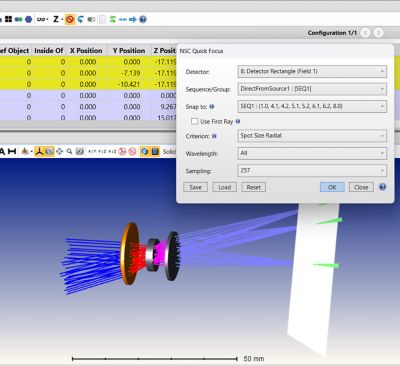
NSC quick focus
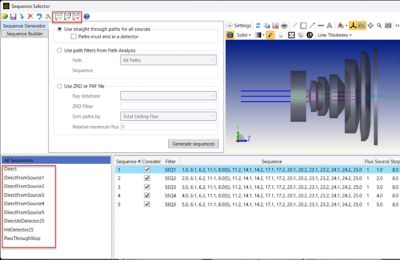
NSC sequence grouping
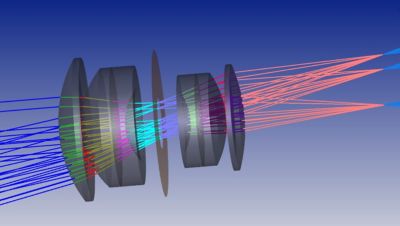
NSC imaging design
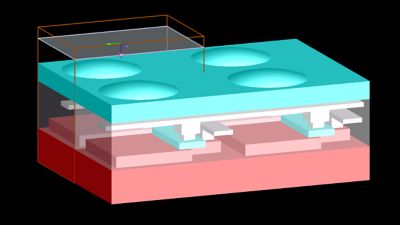
A Sentaurus TCAD-to-Lumerical FDTD workflow
Direct Meshing to GPU, Broadband, and Volumetric Current Sources on GPUs
- Direct meshing to GPUs reduces host memory constraints and improves overall wall time (meshing, simulation, and data saving times), especially for large 3D structures with smooth, curved surfaces.
- Broadband sources now work with GPUs, and GPU support for volumetric current sources was also added. Both are key requirements for inverse design optimizations using LumOpt. It works by recording the data using a 3D Field Region as a monitor, with a first simulation and then playing it back, as a source for GPU-based LumOpt optimization tasks, such as CIS design.
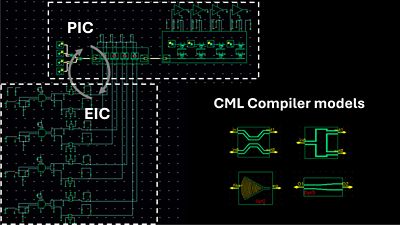
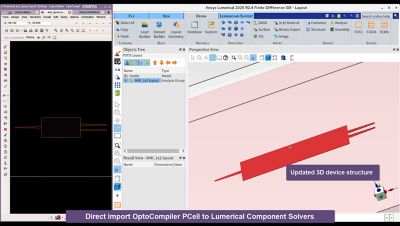
An Ansys Lumerical INTERCONNECT photonic integrated circuit simulation software and Synopsys OptoCompiler direct bridge
Compact Models for PIC Design
- Ansys Lumerical CML Compiler photonic compact model libraries development software can now generate photonic Verilog-A compact models compatible with PrimeSim HSPICE and PrimeSim SPICE circuit simulators. Using Sparameters from Ansys Lumerical FDTD advanced 3D electromagnetic FDTD simulation software, the Ansys Lumerical MODE optical waveguide design tool, and Ansys Lumerical Multiphysics opto-electronics component simulation software, users can design custom components and perform full electro-optical co-simulations in Synopsys OptoCompiler.
- Ansys Lumerical INTERCONNECT photonic integrated circuit simulation software is now integrated into OptoCompiler. PIC designers can now use INTERCONNECT software directly from OptoCompiler via PrimeWave and perform transient photonic circuit simulations with INTERCONNECT compact models and analyze results in WaveView, without leaving the OptoCompiler environment.
- INTERCONNECT software now integrates the nonlinear ring modulator element that accounts for temperature variations caused by self-heating.
By connecting device physics to system architecture, Ansys, part of Synopsys, software reduces abstraction gaps between different scales.
Ansys Speos 2026 R1: Bringing Optical Fidelity Into Mechanical Packaging
Optical Design Exchange
Optical design exchange (ODX) enables the direct transfer of lens geometry, stops, coatings, and source definitions into CAD environments, such as NX, via Ansys Speos CAD integrated optical and lighting simulation software. Each optical element is preserved as a structured component, maintaining its optical properties.
This eliminates the need for geometry reconstruction and ensures that the stray light simulation accurately reflects the original optical design.
Optical Part Design Under Manufacturing Constraints
New optical part design enhancements are:
- Multiparameter editing
- Prism height limits in light guides
- Freeform sharp cut-off lenses
- Tilted optical axis definition for TIR lenses
These features ensure that optimization remains within realistic manufacturing boundaries.
Enhanced Visualization and GPU Improvements
Improved ray animation, transparency control on result maps, and 3D irradiance results enhance physical intuition in system simulation. GPU reports provide peak VRAM use and error diagnostics for greater simulation analysis. A new navigation mode in Live Preview delivers higher interactivity for precise displacement in 3D scenes, even for the most demanding simulations.
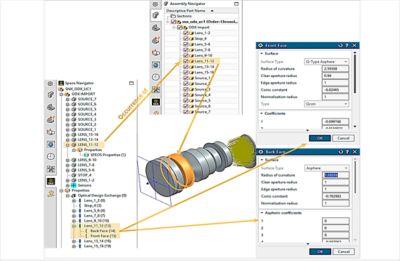
Ansys Speos CAD integrated optical and lighting simulation software optical design exchange for Siemens NX
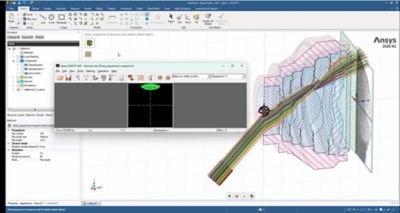
The Speos software ray animation tool
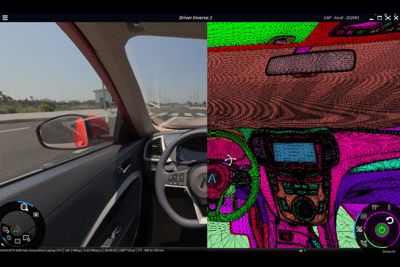
Speos software live preview enhancements
A Continuous Optical Engineering Workflow
With Optics 2026 R1, the value isn’t just in new features — it’s in the continuity they create through:
- Structured tolerancing in OpticStudio software
- Unified diffractive data across tools
- Fabrication-consistent photonic simulation in Lumerical software
- CAD-integrated stray light validation in geometry, materials, and physical assumptions, maintained across domains
Simulation becomes continuous, and continuity builds something that’s increasingly rare in complex product development: engineering trust. In an environment where development cycles are accelerating and integration density is increasing, that trust becomes a competitive advantage.

Just for you. We have some additional resources you may enjoy.
Learn More



The Advantage Blog
The Ansys Advantage blog, featuring contributions from Ansys and other technology experts, keeps you updated on how Ansys simulation is powering innovation that drives human advancement.