Synopsys and Ansys power the future of innovation—connecting silicon to systems.
-
-
Kostenlose Software für Studierende
Ansys unterstützt die nächste Generation von Ingenieur*innen
Studenten erhalten kostenlosen Zugang zu erstklassiger Simulationssoftware.
-
Verbinden Sie sich jetzt mit Ansys!
Gestalten Sie Ihre Zukunft
Stellen Sie eine Verbindung mit Ansys her, um zu erfahren, wie Simulation Ihren nächsten Durchbruch vorantreiben kann.
Kostenlose Demoversionen
Produkte & Dienstleistungen
Lernportal
Über das Unternehmen
Back
Produkte & Dienstleistungen
Back
Lernportal
Ansys unterstützt die nächste Generation von Ingenieur*innen
Studenten erhalten kostenlosen Zugang zu erstklassiger Simulationssoftware.
Back
Über das Unternehmen
Gestalten Sie Ihre Zukunft
Stellen Sie eine Verbindung mit Ansys her, um zu erfahren, wie Simulation Ihren nächsten Durchbruch vorantreiben kann.
Kostenlose Demoversionen
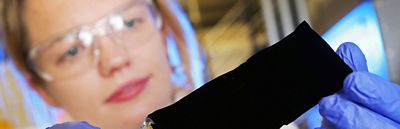
If you’ve ever looked up at the sky at night only to be unable to see the stars above, you’ve experienced light pollution firsthand. Light pollution, or unwanted and excessive artificial light, is one of the fastest-growing pollutants on Earth.
The effects of this pollution range from harming animals, such as bats and migrating birds, to affecting the cultural significance of dark skies for Indigenous people and impeding astronomers’ work. And light pollution doesn’t appear to be going away anytime soon.
According to a paper by Kyba et al., “The average night sky got brighter by 9.6% per year from 2011 to 2022, which is equivalent to doubling the sky brightness every eight years.” As for what causes light pollution, there are quite a few different sources, including the growth of cities, streetlights, factories, and satellites.
In regard to satellites, NASA researchers have determined that light from the thousands of satellites orbiting Earth could contaminate around 40% of the images taken by NASA’s Hubble Space Telescope and about 96% taken by the SPHEREx observatory.
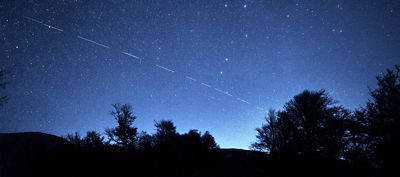
Satellite light pollution. Image courtesy of Surrey NanoSystems
This satellite-caused light pollution affects space telescopes by distorting images, producing artifacts, increasing contamination, and possibly reflecting infrared, which adds interference for other instruments. This causes serious consequences for astronomy and scientific observations, says James Whitfield, an applications scientist with expertise in optics and his colleague Lisa Pickering, the head of product marketing at Surrey NanoSystems.
But how can we address the issues of light pollution, especially when this type of pollution isn’t regulated? That’s where Vantablack, an ultrablack coating technology developed by Surrey NanoSystems, comes onto the scene.
Peering Into the Darkest Dark: What Makes Vantablack Special
In 2012, Surrey NanoSystems created Vantablack, a coating that absorbs 99.965% of light, making it the world’s darkest material.
With its exceptional light absorption properties and advancements in stray light suppression, Vantablack has a wealth of potential applications. In fact, the “company aims to provide market-leading stray light solutions that aid all the way from space applications for imaging to safety in the automotive industry in camera and image recognition systems to amazing art pieces that play on the depthless effect of Vantablack coatings,” says Whitfield. Speaking of art, Vantablack has even been used in the Olympics and Coachella, says Pickering.
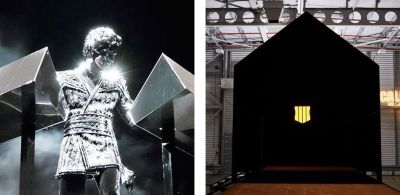
Vantablack used at Coachella (left) and to construct the darkest room ever made (right). Images courtesy of Surrey NanoSystems
As for the aerospace applications of Vantablack, here customers can rely on the Vantablack® 310 series to help take on the challenge of light pollution. While the Vantablack® 100 series is the most light-absorbing, it has a non-touch coating and can’t be sprayed in-house or used for stray light suppression in optical baffles and imaging systems where performance is the utmost priority.
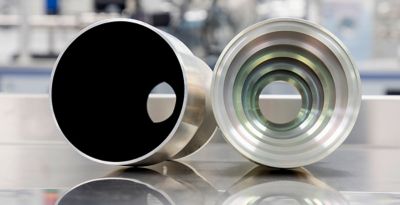
Baffles with and without Vantablak. Image courtesy of Surrey NanoSystems
Vantablack® 310, however, is “handleable and can be customer-applied,” says Pickering. And that’s not all. Vantablack® 310 is a nanoscale-engineered paint with an AB Magnitude of 6.6 that meets the IAU-CPS brightness limit. This series is also formulated to be easily cleaned and, like the Vantablack® 100 series, survive the challenging environment of low Earth orbit (LEO) — plus the Surrey NanoSystems team just revealed that it can be applied as an aerosol. This will help in “removing barriers to entry,” says Whitfield, since customers “can test out prototypes quite easily in-house” with this aerosol version.
Due to these benefits, Vantablack® 310 has many key applications. It can be applied to satellite bus structures and as a chassis-blackening coating to make satellites effectively invisible to the naked eye.
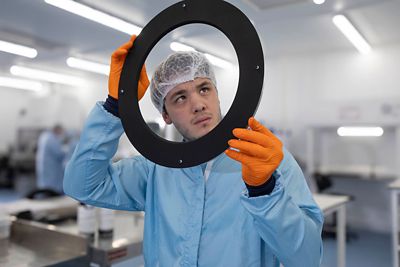
Vantablack® 310 substrate. Image courtesy of Surrey NanoSystems
To help ensure that Vantablack® 310 is ready to launch and to help innovators better visualize the effectiveness of this solution, the Surrey NanoSystems team is turning to simulation solutions from Ansys, part of Synopsys.
Using Stray Light Simulations To Showcase Vantablack’s Strength
When determining how to best highlight the impressive capabilities of Vantablack, the Surrey NanoSystems team met with Ansys parter, CADFEM. CADFEM simulation experts provided Surrey NanoSystems with a glare shield proof of concept that showcased the reliability of Ansys Speos CAD integrated optical and lighting simulation software. This example highlighted the ability to use Speos software to study and compare different coatings — including Vantablack.
This CADFEM proof of concept gave the Surrey NanoSystems team the confidence they needed to rely on Ansys simulation solutions in a critical role: showcasing Vantablack’s performance to customers. “We understand that our coatings are the darkest material in the world,” says Whitfield. “However, quantifying this past simple reflectance measurements was often a barrier when engaging in detailed discussions with optical engineers.”
To address this challenge, the Surrey NanoSystems team is in the early stages of using Speos software to:
- Generate tailored data-driven insights
Speos software enables the Surrey NanoSystems team to “support our customers by leveraging our expertise in stray light suppression through computer modeling, along with our reflective data for our coatings,” says Whitfield. In this way, the team can create detailed stray light simulation images and heat maps that engineers and even the general public can use to quantify Vantablack’s effectiveness at mitigating stray light. - Optimize design processes
With simulation, customers can better qualify and evaluate the coating’s performance and make critical adjustments before production begins. This enables customers to minimize costs while accelerating prototyping.
For example, consider a customer seeking to optimize a satellite’s optical baffle, which is a complex, expensive component. To aid this goal, the Surrey NanoSystems team could import a model of the customer’s exact optical baffle into Speos software, apply Vantablack® 100 properties, and simulate stray light suppression and how the part would perform with the coating.
“Based on the results, we can then propose design changes that simplify the component without compromising performance … or explicitly provide a data-driven argument as to why our coating is essential to their design and performs better against customer coatings,” says Whitfield. “These simplifications can help reduce costs across the entire supply chain from manufacturing through to launch or be the extra push needed to drive the use case of our coatings.”
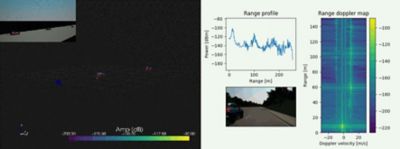
Examples of using Ansys simulation solutions to analyze Vantablack performance for automotive applications. Images courtesy of Surrey NanoSystems
Such data-driven suggestions for design simplifications would not only minimize a customer’s lead time and manufacturing complexity but “help us make the part easier to apply our coating as well,” says Whitfield. “If we can provide different options, we can break down those barriers to entry.”
In this way, simulation software can help Surrey NanoSystems expand its role from a coating company to a consulting partner, says Whitfield. In this expanded role, the Surrey NanoSystems team would like to help customers earlier in the design process — during the initial design and development phase, “when optical designers are using (Ansys Zemax OpticStudio optical system design and analysis software) or Speos software to simulate their system,” says Whitfield. This will enable the team to propose potential changes even earlier in the process, saving customers additional time and money.
Things Are Looking Up for a Future Full of Darker Skies
Already, Vantablack is showing its power to work well in space. In the decade-plus that’s passed since Vantablack was launched into LEO, it has proven its ability to perform flawlessly on a functioning satellite. These coatings have achieved unrivaled light absorption on the International Space Station (ISS), spectrometers, and more. Vantablack® 310 will soon also be used to address light pollution challenges on the Jovian 1, a small satellite with an expected 2026 launch date.
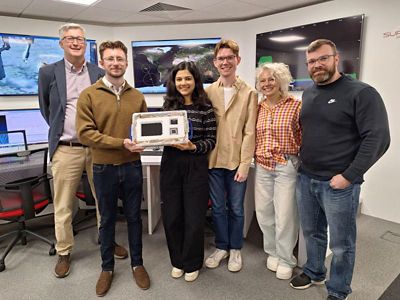
The Jovian 1 satellite. Image courtesy of Surrey NanoSystems
Looking further into the future, the potential for Vantablack to shape space exploration is vast — expanding from LEO to beyond. “Stray light reflectance is an issue from satellite to ground observation to deep space imaging,” says Whitfield. “Ultrablack coatings have a place all across space, from geostationary orbit (GEO) to mapping the lunar landscape.”
For example, “maybe we can start sending satellites to orbit the Moon and to orbit Mars to take images for potential landing spots for lunar landers and Mars landers,” says Whitfield. “We would welcome the opportunity to have our coatings incorporated into those systems.”
The collaboration between Surrey NanoSystems and Ansys can help make this future a reality. Want to learn more about how Speos software enables innovation that’s redefining even the skies around us?

Just for you. We have some additional resources you may enjoy.
“Stray light reflectance is an issue from satellite to ground observation to deep space imaging. Ultrablack coatings have a place all across space, from geostationary orbit (GEO) to mapping the lunar landscape.”
— James Whitfield, Applications Scientist, Surrey NanoSystems

The Advantage Blog
The Ansys Advantage blog, featuring contributions from Ansys and other technology experts, keeps you updated on how Ansys simulation is powering innovation that drives human advancement.