Synopsys and Ansys power the future of innovation—connecting silicon to systems.
-
-
Kostenlose Software für Studierende
Ansys unterstützt die nächste Generation von Ingenieur*innen
Studenten erhalten kostenlosen Zugang zu erstklassiger Simulationssoftware.
-
Verbinden Sie sich jetzt mit Ansys!
Gestalten Sie Ihre Zukunft
Stellen Sie eine Verbindung mit Ansys her, um zu erfahren, wie Simulation Ihren nächsten Durchbruch vorantreiben kann.
Kostenlose Demoversionen
Produkte & Dienstleistungen
Lernportal
Über das Unternehmen
Back
Produkte & Dienstleistungen
Back
Lernportal
Ansys unterstützt die nächste Generation von Ingenieur*innen
Studenten erhalten kostenlosen Zugang zu erstklassiger Simulationssoftware.
Back
Über das Unternehmen
Gestalten Sie Ihre Zukunft
Stellen Sie eine Verbindung mit Ansys her, um zu erfahren, wie Simulation Ihren nächsten Durchbruch vorantreiben kann.
Kostenlose Demoversionen

Ansys, part of Synopsys, and NVIDIA advance 6G, ISAC, and AI-RAN with high-fidelity digital twins.
The path to 6G is transforming wireless connectivity into an intelligent fabric that can both communicate and sense. Future radio access networks (RANs) will not only deliver data but also detect motion, identify objects, and interpret surroundings through tightly integrated sensing and communication (ISAC) capabilities. These advances will enable networks that understand spatial context as well as signal conditions — essential for autonomous systems, precise localization, and environment-aware connectivity.
Explore how Synopsys’ broad portfolio of silicon design, verification, and simulation and analysis solutions enable faster development cycles for advanced wireless systems in this interview with Fierce Network TV.
NVIDIA Aerial Omniverse Digital Twin (AODT) provides a complete, GPU-accelerated digital-twin platform for modeling every layer of the RAN — from radio propagation and user-equipment (UE) mobility to physical-layer dynamics and full network stack logic. With its integrated ray-tracing–based electromagnetic (EM) solver and end-to-end RAN emulation, AODT delivers a proven foundation for researching next-generation wireless systems at large scale.
Now, through collaboration with Ansys, part of Synopsys, that platform gains even deeper realism and design connectivity. AODT can now directly incorporate detailed antenna models designed in Ansys HFSS high-frequency electromagnetic simulation software (accelerated with NVIDIA cuDSS, CUDA-X library for GPU-accelerating Direct Sparse Solver), enabling network simulations to reflect true, hardware‑accurate beam and radiation behavior. Complementing this, Ansys Perceive EM radio frequency channel and radar signature simulation software is introduced as an alternative modular EM propagation solver library that connects to AODT to deliver even higher‑fidelity channel modeling. Together, these additions enhance AODT’s fidelity and link network‑level simulation more tightly with real‑world antenna and channel physics.
NVIDIA AODT: An End-to-End Full-Stack Network Digital Twin
The NVIDIA AODT platform delivers a GPU-accelerated, high-fidelity simulation of RAN behavior that combines physical-world modeling, EM propagation, and full protocol network stack intelligence. It serves as a comprehensive development environment for operators, equipment vendors, and research teams defining the future of wireless communications.
In this latest collaboration, AODT strengthens its EM realism and design interoperability through two complementary connections with Ansys:
The ability to import accurate antenna models created by designers in Ansys HFSS, ensuring the system reflects the true performance of real antenna hardware
A new modular Perceive EM library that plugs directly into AODT as an alternative high-fidelity channel solver
HFSS Software: Delivering Antenna Accuracy From the Design Source
Every reliable wireless simulation begins with the antenna. Ansys HFSS is the trusted industry standard for creating and optimizing base-station (BS) and user-equipment (UE) antennas. Its full-wave solvers capture coupling, array behavior, near-field interactions, and structural effects that define real-world radiation performance.
High-fidelity antenna designs in HFSS can be exported into radiating system models and used directly by AODT in network digital-twin simulations. This enables the RAN community to evaluate antennas exactly as designed — beam patterns, polarization, and gain included — within realistic AODT scenarios.
Ansys has integrated NVIDIA’s cuDSS sparse direct solver library (part of CUDA‑X) into the HFSS FEM frequency‑domain direct matrix solver, yielding speedups of up to 11x for the matrix‑solve stage on suitable models.
That direct connection between antenna design and network-level modeling bridges a crucial gap: allowing accurate field behavior designed in HFSS to influence and inform network decisions studied in AODT — even before the antenna is built.
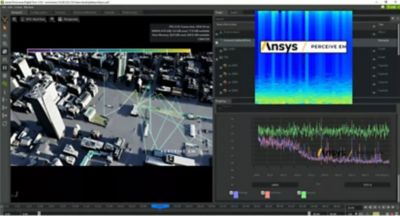
The Ansys Perceive EM solver integrated into the NVIDIA Aerial Omniverse Digital Twin (AODT) platform. The artificial intelligence (AI) radio access network (RAN) is trained on site-specific synthetic data generated by Perceive EM software to predict channel aging for high-speed subscribers of a base station in a bespoke location.
Perceive EM: A Modular Electromagnetic Library for Ultra-High-Fidelity Channel Modeling
While AODT includes a robust, GPU-accelerated EM propagation engine, Ansys Perceive EM enters as an alternative modular EM library that expands the simulation envelope for demanding EM and radar-centric use cases. Its complementary strengths are listed below.
- Extreme geometry detail: handles 3D environments with millions of facets using hybrid ray-tracing and physical-optics (PO) solvers.
- Radar-grade scattering capability: calculates radar cross-section (RCS)-like scattering from structurally accurate objects, supporting ISAC and radar-communication studies.
- High-density UE scalability: simulates large numbers of simultaneous user channels in motion-rich scenes while maintaining high accuracy.
- Radar-mode modeling: enables simulation of high-pulse reputation frequency (PRF) broadband near-field radar systems embedded within communication settings.
By leveraging NVIDIA Omniverse’s geometry and motion data, Perceive EM can compute time-varying channels with realistic Doppler and line-of-sight dynamics — capabilities that extend AODT’s existing EM and network modeling for advanced research in sensing-aware communication systems.
High-Fidelity Antennas in AODT Network Simulations
With antenna models designed in HFSS, AODT simulations reflect authentic hardware behavior throughout the network. These models bring verified beam patterns, side lobes, and radiation efficiencies into link and system studies, replacing idealized antenna approximations with manufacturer-validated designs.
Whether AODT runs its native EM solver or pairs with Perceive EM software, the use of HFSS-authored antennas ensures a consistent EM truth across all simulation variations — connecting hardware design teams with network planners in a unified workflow.
Advancing AI-RAN Research
A key frontier for AODT is its role in developing AI-RAN — intelligent RAN architectures that use AI to manage RAN functions like beamforming, interference, and spectrum allocation.
Training these AI models requires data grounded in accurate physics. The combination of HFSS-authored antenna designs and AODT provides that foundation.
- HFSS reveals real antenna responses — beam shapes, coupling, and polarization.
- AODT fuses these antenna system models into the RAN simulation, giving AI models physically meaningful data for training and inference.
Here, AI learns from physics, not from approximation, strengthening performance and transferability from digital twin to real deployment.
Accelerating ISAC and Advanced Wireless Research
Perceive EM’s capabilities in radar-grade scattering and large-channel scalability enable detailed study of ISAC — a defining 6G concept that merges environmental sensing with data exchange. Within AODT, researchers can explore how devices jointly communicate and sense, all within a single simulation ecosystem that combines Perceive EM’s EM fidelity, HFSS antenna accuracy, and AODT network digital twin platform.
Seeing the Wireless World in Motion
Inside NVIDIA Omniverse, electromagnetic effects come to life visually. Engineers can overlay power, delay, and Doppler maps directly on realistic 3D scenes. Watching an HFSS-designed antenna interact with an AODT-computed channel allows teams to view wireless propagation as a living part of the environment — turning complex EM data into actionable design insight.
Realism Fuels Intelligence
The collaboration between Ansys, part of Synopsys, and NVIDIA enhances a proven digital-twin platform with new layers of EM fidelity. Perceive EM extends AODT’s simulation envelope to ultra-detailed, radar-accurate environments, while HFSS supplies industry-trusted antenna designs for accurate hardware representation.
Together, they enable engineers and researchers to explore how next-generation wireless networks radiate, sense, and learn — transforming digital twins into the proving ground for 6G and AI-RAN innovation.
Realism fuels intelligence — and together, HFSS, Perceive EM, and AODT make it possible.




The Advantage Blog
The Ansys Advantage blog, featuring contributions from Ansys and other technology experts, keeps you updated on how Ansys simulation is powering innovation that drives human advancement.