Case Study
-
-
Kostenlose Software für Studierende
Ansys unterstützt die nächste Generation von Ingenieur*innen
Studenten erhalten kostenlosen Zugang zu erstklassiger Simulationssoftware.
-
Verbinden Sie sich jetzt mit Ansys!
Gestalten Sie Ihre Zukunft
Stellen Sie eine Verbindung mit Ansys her, um zu erfahren, wie Simulation Ihren nächsten Durchbruch vorantreiben kann.
Länder und Regionen
Kostenlose Demoversionen
Produkte & Dienstleistungen
Lernportal
Über das Unternehmen
Back
Produkte & Dienstleistungen
Back
Lernportal
Ansys unterstützt die nächste Generation von Ingenieur*innen
Studenten erhalten kostenlosen Zugang zu erstklassiger Simulationssoftware.
Back
Über das Unternehmen
Gestalten Sie Ihre Zukunft
Stellen Sie eine Verbindung mit Ansys her, um zu erfahren, wie Simulation Ihren nächsten Durchbruch vorantreiben kann.
Kostenlose Demoversionen
“Using Ansys simulation tools, we saved significant time and costs by addressing electromagnetic compatibility issues early in the design phase. This approach optimized performance and ensured compliance with industry standards.”
— Mauro Barbieri
Endurance Race Cars - Head of Performance, Ferrari
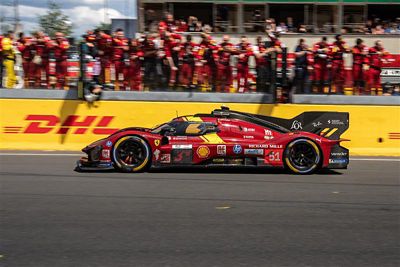
For the third year in a row, Ferrari’s 449P Hypercar triumphed at 24 Hours of Le Mans, placing first (#83), third (#51) and fourth (#50). Pictured above, no. 51 driven by A.Pier Guidi, J. Calado, A. Giovaniazzi
Challenges
To design an e-powertrain system for its 499P Hypercar, Ferrari must first overcome several electromagnetic interference (EMI) and electromagnetic compatibility (EMC) challenges. Specifically, as this technology transitions to wide-bandgap semiconductors, the higher switching frequencies and reduced component sizes result in increased conducted and radiated emissions. These emissions can disrupt the functional behavior of an electric powertrain’s components, compromising overall system performance. Resolving any related system challenges was previously done by the Ferrari engineering team via physical prototypes, which often increased development costs, delays, and risks.
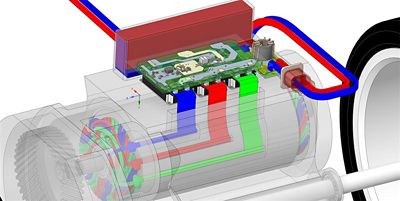
E-powertrain system geometry
Synopsys Solution
- Ansys SIwave™ printed circuit board (PCB) and package electromagnetics simulation
- Ansys HFSS™ high-frequency electromagnetic simulation software
- Ansys Q3D Extractor® parasitic extraction electromagnetic simulation software
- Ansys Icepak® electronics cooling simulation software
- Ansys Electronics Desktop (AEDT)™ electronics systems design platform
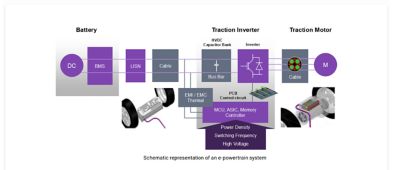
Schematic representation of an e-powertrain system
Benefits
- Optimized overall e-powertrain system performance by integrating Ansys tools for accurate modeling of power modules, PCBs, and EMI filters
- Ansys offers accurate solvers for numerous automotive electronics and EMC applications integrated in AEDT — a unique solution that’s easy to implement and automate
- Enhanced thermal management and energy flow in the powertrain system, which improves efficiency while increasing reliability and performance
- Reduced design time and costs by identifying and resolving EMI/EMC issues during the design phase, eliminating the need for extensive physical prototypes
- Regulatory compliance for conducted and radiated emissions, validated virtually before physical testing
- Significant reductions in physical prototypes and expedited automotive regulatory compliance, enabled by early-stage validation
Overview
Racing hybrid powertrains represent one of motorsport’s most sophisticated engineering achievements, as they combine traditional internal combustion engines with advanced electrical systems. To be effective in a competitive environment, they must deliver exceptional performance while managing multiple energy sources and complex power flows. Ferrari used advanced simulation tools to enable early-stage EMI/EMC optimization for the e-powertrain systems of its sports cars and race cars. These tools helped the original equipment manufacturer (OEM) reduce testing costs and compliance challenges while simultaneously ensuring the superior performance this iconic brand is known for.
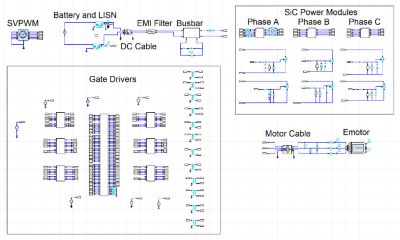
Complete inverter circuit with all the main components, including LISN and CISPR 25 EMI receiver
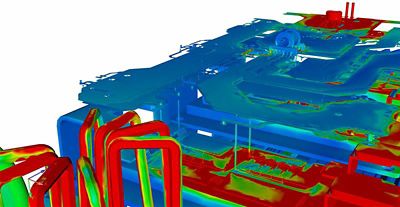
Radiated emissions of the inverter part. The electrical and magnetic field can be visualized at all frequencies.
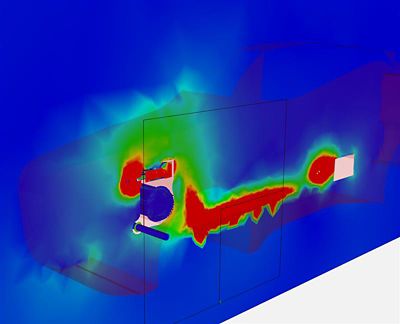
Radiated emissions of the e-powertrain with battery cables and complete car geometry
Comprehensive Simulation Workflow for EMI/EMC Design
To meet evolving regulatory standards and enhance system performance, Ferrari needed a reliable, simulation-driven approach that identified and resolved EMI/EMC challenges early in the design process. Ansys, part of Synopsys, provided a comprehensive virtual simulation workflow of integrated Ansys tools including Ansys SIwave software, Ansys HFSS software, and Ansys Q3D Extractor software to improve printed circuit board (PCB) layouts, model parasitics, and simulate thermal and electromagnetic behavior.
This success was enabled by:
- Simulations of PCBs, power modules, and EMI filters using SIwave software and HFSS software for better EMC and thermal performance
- Quasistatic solvers in Q3D Extractor software to analyze partial inductance and resistance in busbars and cables
- State-space modeling in the AEDT environment to evaluate time-domain behavior and validate EMI filters prior to production
- A unique electrothermal workflow for power losses in the power electronics thermal management with Q3D Extractor software and SIwave software coupled with Ansys Icepak
- As a result of the new workflow, Ferrari engineers can predict and manage EMI/EMC and thermal at both the component and system levels
“The integration of simulation up to the final phase of testing in a complete vehicle allows the development of a more efficient, safer and compliant hybrid powertrain, ensuring high-level performance in the most demanding competitions.”
— Mauro Barbieri
Endurance Race Cars - Head of Performance, Ferrari
Los geht's
Wenn Sie mit technischen Herausforderungen konfrontiert sind, ist unser Team für Sie da. Mit unserer langjährigen Erfahrung und unserem Engagement für Innovation laden wir Sie ein, sich an uns zu wenden. Lassen Sie uns zusammenarbeiten, um Ihre technischen Hindernisse in Chancen für Wachstum und Erfolg zu verwandeln. Kontaktieren Sie uns noch heute, um das Gespräch zu beginnen.