The semiconductor industry stands at a critical turning point. With global semiconductor sales exceeding $600 billion last year, the need for the industry to scale has never been more apparent. As AI applications drive unprecedented requirements for processing capabilities, chip designers are turning to advanced simulation technologies to enable the digital engineering workflows that will support the next generation of complex, heterogeneous multi-die systems.
Today’s chips increasingly integrate specialized processing elements and memory in sophisticated multi-die packages. Designing these systems requires understanding complex interactions across electrical, thermal, and mechanical domains that can only be predicted through comprehensive multiphysics simulation. As the industry embraces this multiphysics approach, simulation has evolved from a verification tool to a central enabler of innovation, enabling designers to explore novel architectures that would otherwise be too risky to attempt.
With AI chips expected to grow significantly in 2025, heterogeneous integration has emerged as the solution to ensure continued advancement. By combining multiple specialized dies — potentially manufactured on different process nodes — into a cohesive package, system architects can optimize each component for its specific function rather than compromise on a monolithic design. These purpose-built AI processors contain architectures optimized for tensor operations with specialized data paths, memory hierarchies, and computational elements that dramatically accelerate neural network workloads compared with general-purpose processors.
Multiphysics and Multiscale Challenges Come With Complexity
The design of heterogeneous multi-die systems introduces unprecedented complexity across multiple domains. Traditional simulation approaches that treat electrical, thermal, and mechanical phenomena separately simply won’t cut it for these highly integrated systems.
Power delivery networks and thermal management systems must be analyzed holistically, as electrical performance affects thermal profiles while heat dissipation impacts electrical performance in a continuous feedback loop. This interdependency is particularly critical for the neural processing units (NPUs) used in AI workloads, which can experience dramatic power fluctuations during different computational phases.
Similarly, high-bandwidth, low-power interfaces between dies demand detailed electromagnetic analyses to ensure signal integrity while operating within increasingly tight power constraints — a challenge that grows more complex as die-to-die communication speeds increase. The complexity extends to power integrity across multiple domains, as NPUs and other specialized processors typically operate with different voltage levels and power requirements.
Mechanical stress presents another challenge, as the complex structures in advanced packages experience thermal expansion and contraction during assembly and operation that can affect both reliability and electrical performance through stress-induced parameter shifts.
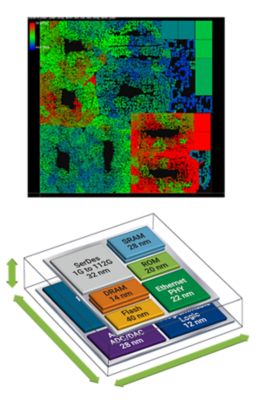
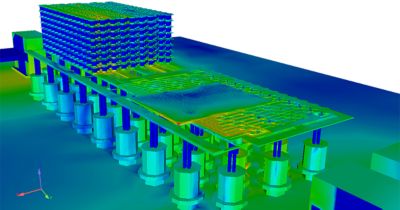
Ansys RedHawk-SC power integrity simulation software results can be used to verify single chips and multi-die 3D-IC systems.
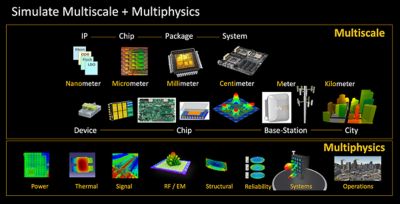
Multiscale physics challenges have also become increasingly important as system designs span from nanometer-scale transistors to centimeter-scale packages and beyond. This wide range of physical dimensions requires simulation tools capable of seamlessly transitioning between different scales while maintaining accuracy and computational efficiency. Beyond these component-level concerns, predicting overall system performance under realistic workloads is essential for optimizing heterogeneous architectures. These limitations have driven the semiconductor industry toward more sophisticated simulation approaches that can address the multifaceted nature of modern chip design.
Advanced Simulation Methodologies Accelerate Semiconductor Engineering
Modern simulation methodologies for heterogeneous systems are evolving toward unified, multiphysics approaches that capture the complex interactions between different physical domains. Co-simulation frameworks have emerged as particularly valuable tools, enabling simultaneous analysis of electrical, thermal, and mechanical phenomena with bidirectional coupling of results. In these environments, power distribution analysis feeds directly into thermal simulation, which in turn affects electrical performance through temperature-dependent parameters, creating a more realistic model of the system’s actual behavior under operating conditions.
To manage the computational complexity of these multiphysics problems, domain decomposition methods (DDMs) have become increasingly important. These techniques strategically divide complex problems into multiple smaller, manageable subdomains that can be solved independently and then combined, substantially improving the capability to solve multidomain, multiphysics, large-scale problems efficiently without sacrificing accuracy.
AI-based methods can also accelerate simulation by training models on existing results, allowing engineers to quickly explore design spaces without running full-scale simulations for every configuration.
These advances in simulation technology have enabled comprehensive package analysis for the complex 2.5D and 3D packaging configurations that are increasingly common. Modern tools can now model through-silicon vias, redistribution layers, and embedded cooling technologies with high fidelity, providing accurate predictions of system performance before physical prototyping.
Digital Engineering Transforms Workflows and Processes
However, the demands on engineering teams to solve increasingly complex engineering challenges are exacerbated by time-to-market pressures, particularly in competitive sectors like automotive, where manufacturers struggle to meet needs for sophisticated silicon components. Advanced system architecture modelers (SAMs) now enable engineering teams to validate system-level performance earlier and more often, which accelerates development cycles by identifying potential issues before committing to silicon implementation. These digital engineering tools support new ways of working that break down traditional silos among different engineering disciplines, fostering collaborative environments where thermal, mechanical, and electrical experts can work concurrently rather than sequentially.
Ansys RedHawk-SC power integrity simulation software results can be used to verify single chips and multi-die 3D-IC systems. As heterogeneous integration becomes the dominant paradigm, the industry is moving toward unified design methodologies that span multiple physical domains and packaging levels. Standardization of interface files represents a critical step toward a more open ecosystem, allowing different simulation tools to exchange information and enabling comprehensive cross-domain analysis.
Transforming Skills and the Workforce
The transformation of the semiconductor industry requires not just technological evolution but a parallel evolution in workforce capabilities. As designs become more complex and interdisciplinary, the industry faces a critical skills gap that threatens to impede progress. Tomorrow’s semiconductor professionals need to adopt broader thinking patterns that cross traditional domain boundaries, embracing both deep expertise and systems-level understanding. Companies must invest in upskilling and reskilling their workforces to meet these new demands, fostering environments where electrical engineers understand thermal implications and mechanical engineers appreciate signal integrity concerns. This workforce transformation is just as essential as technological advancement for addressing the semiconductor industry’s mounting challenges.
Equally important are secure methods for sharing geometric and physical data without exposing proprietary design details.
As heterogeneous systems increasingly incorporate components from multiple suppliers, the ability to exchange essential physical characteristics while protecting intellectual property becomes crucial for enabling better multicomponent analysis.
Standardized specification of compliance for interfaces between heterogeneous components will also streamline the integration process and reduce compatibility risks.
By embracing comprehensive multiphysics simulation in a model-based systems engineering workflow and leveraging AI to accelerate design processes, semiconductor companies can navigate the challenges of heterogeneous integration and deliver the computing platforms that will power the next wave of AI innovation. As these digital engineering capabilities continue to mature, they will enable increasingly sophisticated semiconductor architectures that deliver the computational power needed for next-generation applications while effectively managing system constraints.


The Advantage Blog
The Ansys Advantage blog, featuring contributions from Ansys and other technology experts, keeps you updated on how Ansys simulation is powering innovation that drives human advancement.