Synopsys and Ansys power the future of innovation—connecting silicon to systems.

Explore how simulation and semiconductors advance manufacturing from behind the scenes to the factory floor, transforming industries with intelligent workflows, equipment, and products.
What if manufacturing could operate faster, smarter, and with fewer disruptions? Imagine a world where factories adapt instantly to new demands, humans and robots collaborate effortlessly, and processes improve in real time.
This vision comes to life with semiconductors driving innovation through artificial intelligence (AI)-powered solutions; Industrial Internet of Things (IIoT) devices, such as sensors; and 5G connectivity.
Semiconductors transform how industries operate, serving as the invisible force behind automation, data-driven decisions, and real-time monitoring, all while supporting the human-centricity that defines Industry 5.0.
Combined with multiphysics simulation, these technologies enable more than smart manufacturing — they redefine what’s possible and pave new paths for innovation. Multiphysics simulation provides a virtual environment for testing and optimizing industrial processes, delivering critical insights, analytical models, and predictive accuracy that support IIoT devices and related data. It integrates AI and machine learning (ML) algorithms to optimize this insight and support advanced technologies, including digital twins, additive manufacturing, and automation.
Let’s explore how Synopsys’ engineering solutions optimize smart manufacturing from chip- to system-level, unlocking new possibilities for products and workflows.
Did You Know?
GETTING CLEAR ON SEMICONDUCTORS
✓ Conductors allow electricity to flow while insulators resist it, but semiconductors can do both. This makes them vital components for today’s technologies.
✓ Semiconductors like silicon are materials used to make integrated circuits, known as chips, which can process and store data.
✓ As a result, the terms “semiconductors” and “chips” are often used interchangeably, including in this article.
Understand What Makes Smart Manufacturing Smart
Traditional factories face challenges, including inaccuracies, delays, and unpredictable equipment problems. Smart manufacturing helps overcome these challenges by providing efficiency, speed, and foresight. What is smart manufacturing? CESMII, The Smart Manufacturing Institute, describes it as a streamlined, collaborative approach to coordinating business, digital, and physical systems at factories, at plants, and across the value chain.
With advanced sensors and data-driven processes, factories and plants are no longer reactive — they are informed, connected, and proactive with the ability to continuously improve. Automation manages everyday tasks while decision-making models address unique problems quickly. By adopting smart manufacturing, traditional factories evolve into smart factories, equipped to meet today’s evolving market demands.
Smart factories rely on interconnected machines, networks, and modern technologies. Examples include AI/ML, IIoT sensors, and cloud computing. These tools gather information, transfer data quickly, and improve workflows, often in tandem with automation or robotics.
Although additive manufacturing is not typically categorized as an automation technology, 3D printing plays a key role in many smart manufacturing settings. It streamlines design and fabrication, reducing production time and enabling rapid prototyping. It also helps create complex parts while lowering costs.
According to Deloitte’s 2025 Smart Manufacturing and Operations Survey, which included 600 respondents from large manufacturing companies, manufacturers are investing in technologies like sensors, automation, and AI to implement smart manufacturing processes. When asked about their top one or two goals for the next two years, 41% said they’re planning to invest in factory automation hardware, 34% in active sensors, and 28% in vision systems.
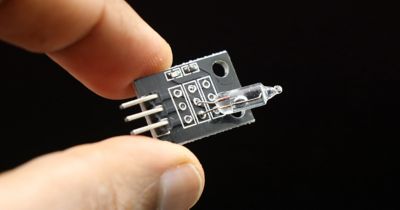
Tilt switch sensor modules are commonly used in lifting, mining, and construction equipment to detect potential instability, tipping, or rollover and alert machine operators.
Discover the Foundation of Smart Manufacturing
What drives the success of smart manufacturing? The proper foundation: smart infrastructure. Smart manufacturing uses hardware and software to maintain production lines with minimal interruption, reducing the likelihood of issues.
For example, many smart manufacturing devices connect to an Internet of Things (IoT) network, with IIoT linking industrial physical assets to digital systems for data-driven decisions. By collecting data from embedded sensors in its infrastructure, the system optimizes to achieve desired results and uses predictive analytics to detect potential issues.
Simulation and digital twins support IoT sensors by providing a virtual environment for monitoring, analyzing, and testing physical assets and processes. However, IoT sensors rely on semiconductors for data detection, processing, and sharing. Microcontrollers, a type of system-on-a-chip (SoC), and microprocessors, such as central processing units (CPUs) and graphics processing units (GPUs), use semiconductors to interpret sensor signals.
IoT sensors provide real-time data, which can be fed into a digital twin, an integrated virtual representation of a physical asset. This enables real-time monitoring, predictive maintenance, scenario testing through "what-if" analyses, and performance optimization, all without impacting the physical system.
AI/ML algorithms play an important role in smart manufacturing and infrastructure by identifying data patterns, optimizing processes, preventing defects, and predicting maintenance needs. They also help store and process IoT sensor data on cloud-based servers. Cloud systems support automation, analytics, and advanced communication technologies, such as 5G, which lower latency and increase bandwidth.
As reported by Deloitte, 57% of manufacturers at the facility or network level are using cloud computing, the same percentage are implementing data analytics, 46% are integrating IIoT solutions, and 42% are employing 5G connectivity.
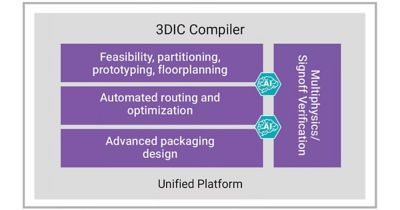
The Synopsys 3DIC Compiler platform supports co-design and optimization for 2.5D and 3D multi-die designs.
Find Your Solution
Synopsys engineering solutions consider individual components and whole systems, from initial chip design to the factory floor. But before semiconductors can power smart manufacturing processes, they must be well designed and manufactured.
Electronic design automation (EDA) tools play a critical role in chip design, verification, and silicon life cycle management (SLM). For example, the Synopsys 3DIC Compiler platform supports 2.5D and 3D multi-die designs. Advanced chip design supports complex data processing, high-speed communication, and automation. This drives real-time analysis and customization, a fundamental aspect of Industry 5.0.
While Industry 4.0 focused on technology and automation, Industry 5.0 focuses on the human relationship with those technologies. The European Commission describes Industry 5.0 as more comprehensive than Industry 4.0, emphasizing pillars for sustainability, human-centricity, and resilience.
Semiconductors support each pillar, particularly human-centricity, by processing high volumes of sensor data that inform customized industrial equipment and processes. This includes smart control systems that adapt to specific needs and hardware for unique applications.
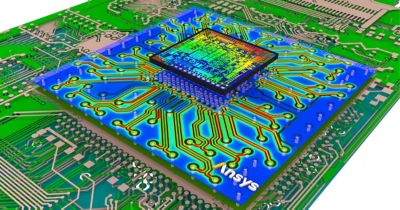
Multiphysics simulation and electronic design automation (EDA) solutions support semiconductor design and manufacturing processes.
Multiphysics simulation supports design and manufacturing across industries, including the semiconductor industry. For example, the Ansys HFSS-IC chip-to-system electromagnetic simulation platform provides signal and power integrity analysis for heterogeneous integrated circuit (IC)-to-system designs, enabling early design insights and increasing accuracy for sign-off. This expedites the time to market for foundry-certified designs.
Similarly, engineers integrate simulation techniques, such as model-based systems engineering (MBSE) and model-based process engineering (MBPE), to enhance manufacturing processes, from stamping, casting, and forming to mixing, bottle filling, and packaging.
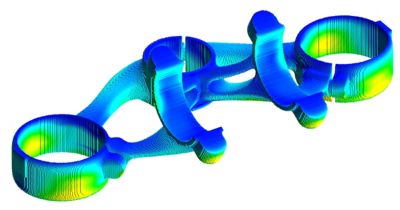
Ansys additive manufacturing solutions evaluate 3D-printed parts for stress and flaws.
Krones AG, a leading manufacturer of packaging and bottling line systems, recently applied Synopsys solutions, including GPU-native Ansys Fluent fluid simulation software, to create a virtual assembly line, which reduces waste and cuts simulation cycles from three to four hours to less than five minutes. The application was supported by Synopsys, industry leaders, and strategic partners, including Ansys Apex Channel Partner CADFEM Germany GmbH.
Multiphysics simulation encompasses all areas of physics from mechanics and fluids to electromagnetics and materials science, refining manufacturing processes and decreasing dependence on physical prototypes. Outside of multiphysics, Ansys digital twin solutions integrate AI/ML to test manufacturing processes further while Ansys additive manufacturing solutions assess 3D-printed parts for stress and flaws.
Danfoss Drives, a subsidiary of energy-efficiency powerhouse Danfoss, integrates simulation solutions from Ansys, part of Synopsys, and Industry 5.0 technologies to optimize production of its signature alternating current (AC) drives. By using simulation solutions, including AI/ML, digital twins, and Python-based tools, the company democratizes simulation, reduces physical prototypes, cuts costs, and saves time while supporting sustainability.
“Normally, we had four prototype design iterations: one concept prototype, two detailed design prototypes, and one production prototype,” says Michael Laursen, head of virtual design, test, and optimization at Danfoss Drives. “With Ansys simulation, we have been able to take one detailed design prototype iteration out of the loop, and that saves us six to nine months in development time and a lot of money. Time is super important, but the cost of early prototypes is also significant.”
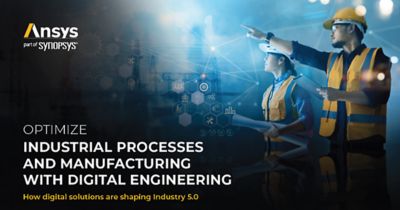
Explore how Synopsys supports industrial processes and equipment in the e-book “Optimize Industrial Processes and Manufacturing With Digital Engineering.”
Advance Your Manufacturing Processes Today
From silicon to systems, Synopsys engineering solutions equip smart factories with advanced digital tools that enhance innovation, operations, and performance.
Explore how Synopsys supports industrial processes and equipment with innovative solutions, and download the e-book “Optimize Industrial Processes and Manufacturing With Digital Engineering.”

The Advantage Blog
The Ansys Advantage blog, featuring contributions from Ansys and other technology experts, keeps you updated on how Ansys simulation is powering innovation that drives human advancement.