Skip to Main Content

Optimizing Autonomous Vehicle Safety With Phase Noise Modeling in FMCW Radar Systems

八月 19, 2025

READ ALOUD

PAUSE READ

Aaron Talwar | Senior Product Marketing Manager, Ansys, part of Synopsys
autonomous-vehicle-safety-banner

Advanced driver assistance system (ADAS) and autonomous vehicle (AV) technologies are significantly impacting the way we drive. In fact, it is estimated that 10 out of 14 ADAS features surpassed 50% market penetration in 2023 alone. The continued success of this self-driving technology, however, depends on accurate, reliable sensor systems and their ability to detect vulnerable road users (VRUs), including pedestrians and cyclists.

Further, with the introduction of additional safety regulations, manufacturers face the tough task of keeping radar sensor costs low while meeting escalating safety demands. These include NHTSA FMVSS 127, a regulation that requires the introduction of automatic emergency braking (AEB) as a standard feature across all vehicle segments.

In the case of NHTSA FMVSS 127, the challenge for original equipment manufacturers (OEMs) and tier one suppliers is to meet requirement thresholds for both safety and cost in a high-performing radar device.

Frequency modulated continuous wave (FMCW) radar is one such option, as it can deliver adequate long-range detection at a reduced cost. However, this technology can introduce phase noise, or small, random deviations in the radar's signal. These short-term, random fluctuations negatively impact radar system performance and, by extension, vehicle safety.

To address this, a new phase noise modeling feature has been released with Ansys AVxcelerate Sensors 2025 R2 autonomous vehicle simulation software, enabling more precise testing of radar systems like FMCW radar in real-world conditions.

What’s All the Noise About?

FMCW radar is essential for VRU detection. However, its application can lead to unstable phase variation, or random fluctuations in the phase of a signal of the local oscillator (LO), resulting in phase noise.

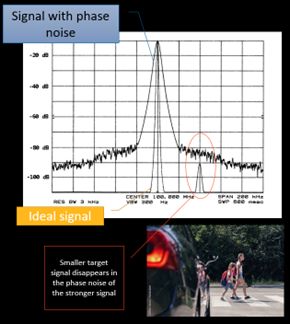
Phase noise arises from minor phase deviations in the chirp signal generated by the voltage-controlled oscillator (VCO) in radar sensors. These deviations cause sidelobes in the radar signal, often capturing undesired radiation patterns. During radar detection, these sidelobe scans mask small objects, especially at longer ranges.

In scenarios like detecting a pedestrian near a large truck, for example, phase noise can lead to missed detections, posing serious safety risks.

Radar sensors in ADAS and AV applications are designed to detect various objects, including VRUs such as pedestrians and cyclists, even in challenging environments like high-speed highways or urban settings with poor visibility.

fmcw-radar-1

Missed targets due to large signal phase noise masking

To ensure a radar system operates effectively in real-world conditions, it’s essential to account for phase noise during development. Putting radar perception to the test requires thorough performance analysis suited for a simulation environment. Overly idealized simulations, which omit phase noise and other environmental imperfections, fail to replicate these real-world conditions, leading to inaccuracies in performance assessments.

For instance, radar sensor performance might seem perfect in a controlled test environment where no noise or interference is present. In real-world scenarios, however, any tiny fluctuations in the radar signal can disrupt detection accuracy.

Fluctuations like these often occur due to factors like signal degradation, multipath interference from surrounding objects, or electronic noise within the radar unit itself. In the absence of noise modeling, however, engineers risk developing radar systems that underperform under real-world conditions, compromising safety and performance, especially in critical situations like emergency braking or collision avoidance.

Ansys Puts Perception and Phase Noise to the Test

Phase noise is characterized by its power spectral density (PSD), which indicates how noise is distributed over frequencies. Sensor manufacturers provide this data in the radar's spec sheet, enabling engineers to model phase noise accurately in simulations.

There are two main ways to model this noise:

  1. Pedestal model: uses the PSD directly from the spec sheet for simulations.
  2. Piecewise linear model: uses measured PSD data for a more detailed simulation and sensor definition.

By incorporating phase noise data into an Ansys AVxcelerate Sensors simulation environment, manufacturers ensure that radar systems perform well in realistic driving conditions. We have also introduced advanced noise models in the software that are specifically designed to simulate phase noise and other imperfections that can impact radar performance. These models help engineers test radar systems under conditions that closely mimic real-world environments, where imperfections like noise can significantly affect detection capabilities.

By accurately simulating phase noise, Ansys AVxcelerate Sensors software enables manufacturers to fine-tune radar systems to ensure they perform reliably, even in complex and dynamic environments.

In the near future, with the widespread adoption of ADAS and AV technology, nearly all vehicles on the road will have to meet stringent safety standards for vehicle perception, including those outlined in FMVSS 127 for AEB. Of course, the caveat is that integration be accomplished without incurring higher costs associated with more sophisticated, noise-resistant radar systems.

In this case, the ability to accurately pinpoint and address phase noise in a simulation environment ensures that radar sensors can detect small objects at a distance and perform optimally under a variety of driving conditions, from high-speed highways to low-visibility urban environments. With these improvements, it’s possible for manufacturers to build more robust, FMCW-based radar systems that meet safety regulations, offering reliable performance in the most cost-sensitive vehicle segments.

Building a Safe, Autonomous Future With Simulation

For radar to reliably detect VRUs — especially in complex environments like high-speed driving — you must account for phase noise. Failure to do so could result in missed detections, compromising safety. Simulating phase noise enables manufacturers to balance radar performance with cost efficiency, ensuring that even budget-friendly vehicles meet regulatory safety standards like FMVSS 127.

fmcw-radar-2

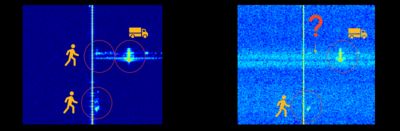
Without noise (left) in the radar simulation, the second pedestrian is detected. However, when taking thermal and phase noise into account (right), the second pedestrian is not detected, as they would not be on a real-world test.

The successful adoption of low-cost, highly performant technologies like FMCW radar will be key to meeting safety regulations and protecting VRUs, helping to pave the way for a safer autonomous driving future. With the release of AVxcelerate Sensors 2025 R2 software, manufacturers now have the tools to simulate phase noise in these applications more effectively and build radar systems that perform optimally in real-world conditions.

Learn more about AVxcelerate Sensors software.


Just for you. We have some additional resources you may enjoy.

TAKE A LOOK


Recommendations

Optimizing Autonomous Vehicle Safety With Phase Noise Modeling in FMCW Radar Systems

Optimizing Autonomous Vehicle Safety With Phase Noise Modeling in FMCW Radar Systems

A new phase noise modeling feature for Ansys AVxcelerate Sensors 2025 R2 software enables more precise testing of radar systems in real-world conditions.

Ansys AVxcelerate Sensors利用NI-RDMA进行硬件在环(HIL)测试

Ansys AVxcelerate Sensors利用NI-RDMA进行硬件在环(HIL)测试

最新版Ansys AVxcelerate Sensors软件包含的增强功能,可用于在硬件在环环境中进行感知软件测试。

Ansys Accelerates the New Era of Digital Engineering Using NVIDIA Technology

Ansys Accelerates the New Era of Digital Engineering Using NVIDIA Technology

Learn how Ansys is expanding our long-standing collaboration with NVIDIA to include exciting new opportunities in AI.

The Advantage Blog

The Ansys Advantage blog, featuring contributions from Ansys and other technology experts, keeps you updated on how Ansys simulation is powering innovation that drives human advancement.