Synopsys and Ansys power the future of innovation—connecting silicon to systems.
-
-
Software gratuito per studenti
Ansys potenzia la nuova generazione di ingegneri
Gli studenti hanno accesso gratuito a software di simulazione di livello mondiale.
-
Connettiti subito con Ansys!
Progetta il tuo futuro
Connettiti a Ansys per scoprire come la simulazione può potenziare la tua prossima innovazione.
Customer Center
Supporto
Partner Community
Contatta l'ufficio vendite
Per Stati Uniti e Canada
Accedi
Prove Gratuite
Prodotti & Servizi
Scopri
Chi Siamo
Back
Prodotti & Servizi
Back
Scopri
Ansys potenzia la nuova generazione di ingegneri
Gli studenti hanno accesso gratuito a software di simulazione di livello mondiale.
Back
Chi Siamo
Progetta il tuo futuro
Connettiti a Ansys per scoprire come la simulazione può potenziare la tua prossima innovazione.
Customer Center
Supporto
Partner Community
Contatta l'ufficio vendite
Per Stati Uniti e Canada
Accedi
Prove Gratuite

In elite cycling, victory is often measured in fractions of a second. But what separates first place from second isn’t just strength or endurance; it’s precision, data, and the relentless pursuit of marginal gains. Even the smallest improvements in helmet shape, body position, or tire width can translate into measurable gains on the road. Today, while the race is obviously won by the athletes, it could be lost months before in front of the computer.
As the 113th Tour de France gets ready to set off from Barcelona, we invited researchers, innovators, and professional cycling team members to give their perspective on the power of details in a series of three specific webinars.
The Wheels on the Bike Go ‘Round and ‘Round
On July 2, 2026, at 9 a.m. EDT (3 p.m. CEST), Victor Simonin of Équipe cycliste Groupama-FDJ United and Fabio Malizia of Heriot-Watt University present recent research aimed at establishing a computational fluid dynamics (CFD) framework for cycling wheel aerodynamics, highlighting best practices and key modeling considerations.
Cycling wheels are a key aerodynamic component of the bicycle–cyclist system, contributing to approximately 5–10% of total drag. Over time, various wheel designs, such as deep-section rims, tri-spoke, and disc wheels were created to optimize aerodynamic performance.
Today, these optimizations are increasingly supported by CFD simulations, especially during early-stage design when physical prototypes are not yet available. However, ensuring reliable and reproducible CFD results requires a robust and carefully validated methodology. An applied case study, developed in collaboration between Équipe cycliste Groupama-FDJ United and high-end component manufacturer Miche, demonstrates how aerodynamic insights translate into measurable performance gains on the road.
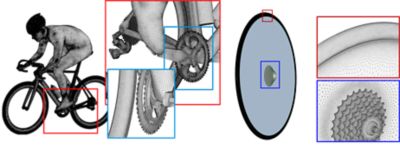
Meshing plays a critical role to get accurate and reliable computational fluid dynamics (CFD) results. Every geometrical details need to be properly captured and cells size must grow at the adequate pace to maintain acceptable computational time while guaranteeing reliable CFD results.
Pimp Your Ride
In 2015, a study by Bert Blocken and his research team in collaboration with Ansys, part of Synopsys, was the first to demonstrate that a team car following a cyclist can provide significant aerodynamic advantages to the cyclist. However, until now this work had been done only for a typical estate car, while the guidelines of the International Cycling Union (UCI) allow other types of cars, including larger SUVs.
On July 13, 2026, at 11 a.m. EDT (5 p.m. CEST), Blocken will present a new study by him and his team at Heriot-Watt University that analyzes the impact of other types of team cars on the cyclists’ aerodynamics. The cars include:
- The Mercedes Smart
- A Jaguar
- The Drivaer Estate model
- The AeroSUV model
- A Grenadier SUV
- Three vans
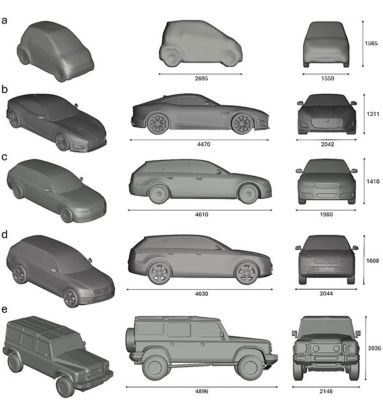
Five of the cars included in the study, dimensions in millimeters
Want a sneak peek at the results before choosing your team car? The drag reduction for the cyclist followed by a Grenadier SUV team car at a distance of 25 m is 0.28% higher than with the Drivaer Estate model. This corresponds to extra time savings of about 0.05 second per kilometer. For a 25-km time trial, the resulting time gain of 1.2 second could determine who wins the race.
On the Move
Aerodynamics is one of the most critical factors in time trial performance. To optimize it, Équipe cycliste Groupama-FDJ United relies on a combination of three methods: wind tunnel testing, on-road testing, and CFD. However, previous CFD studies have primarily relied on static cyclist models, which fail to capture the full scope of dynamic aerodynamic effects.
On July 20, 2026, at 11 a.m. EDT (5 p.m. CEST), Antoine Dulac, an engineering student of Équipe cycliste Groupama-FDJ United presents a study that tackles this limitation by implementing a pedaling cyclist in the CFD simulations using Ansys Fluent fluid simulation software and by adopting a dynamic CFD model previously developed for the team (by the company ZELIN). By introducing this dynamic motion, they could accurately simulate the complex airflow around a moving athlete. The results demonstrate a strong correlation with surface data collected from wind tunnel tests, particularly regarding drag coefficients, and enable a deep analysis of the cyclist's transient wake.
"Ultimately, this successful pilot study validates the overset method for our applications and establishes a robust foundation for exploring more advanced aerodynamic research in the future,” says Frédéric Grappe Head of Hub Innovation at Equipe Groupama-FDJ United.

Unlock the Science of Speed
The future of cycling performance is being shaped by data, simulation, and innovation. Whether you're designing the next generation of cycling gear, optimizing race strategy, or simply fascinated by the science of speed, these sessions will elevate your perspective.
- Wheel Aerodynamics in Cycling: Bridging Research and Performance
July 2 at 9 a.m. EDT / 2 p.m. GMT / 3 p.m. CEST - The Type of Team Car Can Determine Who Wins the Individual Time Trial
July 13 (1st Tour de France rest day) at 11 a.m. EDT / 4 p.m. GMT / 5 p.m. CEST - The Quest for Speed: Simulating the Pedaling Cyclist with Dynamic CFD
July 20 at 11 a.m. EDT / 4 p.m. GMT / 5 p.m. CEST (2nd Tour de France rest day)

Just for you. We have some additional resources you may enjoy.
Watch the Webinars
- Wheel Aerodynamics in Cycling: Bridging Research and Performance
July 2 at 9 a.m. EDT / 2 p.m. GMT / 3 p.m. CEST - The Type of Team Car Can Determine Who Wins the Individual Time Trial
July 13 (1st Tour de France rest day) at 11 a.m. EDT / 4 p.m. GMT / 5 p.m. CEST - The Quest for Speed: Simulating the Pedaling Cyclist with Dynamic CFD
July 20 at 11 a.m. EDT / 4 p.m. GMT / 5 p.m. CEST (2nd Tour de France rest day)
The Advantage Blog
The Ansys Advantage blog, featuring contributions from Ansys and other technology experts, keeps you updated on how Ansys simulation is powering innovation that drives human advancement.