Synopsys and Ansys power the future of innovation—connecting silicon to systems.
TOPIC DETAILS
What is Noise, Vibration, and Harshness?
Noise, vibration, and harshness (NVH) refers to the study and management of the sounds and vibrations humans experience when interacting with machines, especially automobiles, and how they perceive these sounds and vibrations. Engineers care about NVH because it drives the customer experience and impacts the mechanical durability of the machine.
NVH is a combination of engineering and psychology. Engineers are involved in predicting, measuring, and controlling noise and vibrations. Psychologists study psychoacoustics to measure and understand how humans perceive noise and vibration.
What Does NVH Stand For?
A good way to understand NVH better is to look at each term as it applies to vehicles.
Noise: What is Heard
Noise refers to unwanted sound inside or outside a vehicle. It can be generated by wind passing the car, the tires rolling over pavement, brakes squealing, air whistling from an almost-closed air-conditioning vent, or the motor. Tonal noises are a subset of noise characterized by a single frequency, or several single frequencies, and produce a whine, drone, whistle, or hum.
Vibration: What the source behavior is and how humans perceive it with the sense of touch
Vibration refers to physical oscillations of any object. It can impact the durability or it can be perceived by human touch. This could include a trembling steering wheel, a motor that shakes while idling, or a rattling glove box door.
Harshness: What is Perceived
Harshness refers to the subjective measure of the quality of a sound. It looks at what makes an engine sound powerful, a door latching sound secure, or if a cabin sounds peaceful.
NVH in the Automotive Industry and Beyond
Although NVH applies to any human-machine interaction, the automotive industry leads the way in the development and application of NVH. Even though they probably didn’t call it NVH, early chariots and charges dealt with the issue of rattling parts and a bumpy ride before roads were invented. Over time, simple wooden springs were added, parts were tied down, and components were thickened to make riding in a carriage less punishing.
NVH really took off when engineers added noisy engines and made NVH a part of automotive engineering, and the art of making the travel experience better turned into a science. All major automotive original equipment manufacturers (OEMs) have multiple groups of engineers dedicated to NVH because the sound and vibration in a car is part of the driving experience, and therefore, the brand impression. Most of the research, technological advancement, simulation tools, and testing processes around NVH come directly from the automotive industry's quest to deliver a quieter, more enjoyable ride.
However, other sectors care about how humans interacting with systems perceive sound and vibration.
Some of the more common non-automotive applications for NVH include:
- Home appliances like dishwashers and washing machines
- Powered lawn tools like leaf blowers and lawnmowers
- Aircraft, especially in passenger cabins and cockpits, and reduction of community noise around airports due to traffic
- Power tools and manufacturing equipment
- Wind turbines
Regardless of the industry, NVH engineering is about understanding noise and vibration sources, transmission modes, how humans perceive both, and working to manage them to meet regulation, business, aesthetic, safety, and durability goals. Teams use a variety of tools and processes to conduct NVH analysis and support the entire product development team in modifying designs as needed. The result is a better product and customer experience.
Sources and Transfer Paths of NVH
Both noise and vibration come from the shocks, random or cyclical movement of the mechanical components in a vehicle, or from the movement of fluids, usually air, around or through the components. The mechanical motion that generates vibration or sound is called the noise source. The way the noise or vibration energy reaches passengers is called the transfer path. Engineers study both and then modify the design to mitigate harshness — the perceived vehicle noise and vibration.
The most common sources of NVH issues in vehicles are:
- Powertrain
- Engine combustion: The primary source of noise and vibration in internal-combustion engines (ICEs) is combustion in the cylinders.
- Mechanism motion and contact: The crankshaft, cams, valves, and pistons in an ICE all generate vibration as they slide and contact one another.
- Electric motors: The cyclical high-frequency electromagnetic loading in the electric motor of an electric vehicle (EV) creates noise and vibration that is very different from that of a vehicle with an ICE.
- Driveshaft: The bearings, mounts, couplings, and other mechanical components can generate noise and vibration and resonate strongly at specific critical frequencies.
- Transmission: Both automatic and manual transmissions can produce noise from gear interaction.
- Road and tire interaction
- Tire tread: The unique tread pattern on each tire can resonate at certain speeds, creating unwanted noise.
- Road surface texture: The local texture of the road surface, like gravel, concrete, or asphalt, can cause vibration in the tires that generates noise and vibration.
- Road discontinuities: Cracks, bumps, expansion joints, grooves, and potholes impact the tire and are a significant source of ride harshness.
- Aerodynamic loading
- External turbulence: Vortices in turbulent airflow are a significant source of unwanted noise. Often referred to as wind noise, any protrusion on a vehicle, like a seam, mirror, windshield wiper, or pillar, can create turbulence that creates noise.
- Leakage: Air rushing through small openings around windows or door seams can cause a high-frequency whistling sound.
- Cavity resonance: Open windows can cause pressure resonance in a vehicle cabin, producing a pulsing sound.
- Exhaust system: In ICE-powered vehicles, exhaust gases from the engine pass through an exhaust system, and the resulting pressure waves resonate, generating vibration and noise.
- Auxiliary Subsystems
- Brake squeal: The rubbing of brake pads against the rotor or drum can cause resonance, producing a distinct, loud squeal.
- HVAC system: Heating and cooling systems have several noise sources, including blower noise, whistling in the ductwork, and turbulence in the vents. In modern cars with reduced aerodynamics and road noise, the HVAC system can be a dominant source of noise, especially for EVs.
- Turbochargers: Both the turbine and compressor on a turbocharger produce significant high-frequency noise at certain speeds.
- Cooling fans: The belts and fans that keep the engine or batteries cool often run when the vehicle is stationary or even when the motor is turned off.
- Latches: The mechanisms that secure doors, seatbelts, and storage compartments in a vehicle all produce noise and vibration when they open or close.
- Actuators: Modern vehicles contain dozens of electrical actuators that buzz and whine as they move windows, seats, door locks, parking brakes, windshield wipers, and other components.
- Buzz, squeak, and rattle (BSR): Loose vehicle components, such as body panels, speaker grills, trim clips, and heat shields, can resonate at high frequencies (buzz), rub against other parts (squeak), or impact other objects (rattle).
Transfer Path in NVH Analysis
Once engineers identify sources, the next step is to quantify how noise and vibration propagate from the sources to passengers. Noise usually travels through the air and is referred to as airborne conduction. Vibration energy is transmitted through solid components and is called structure-borne conduction. The distinction is important because the path affects how the passenger perceives noise or vibration, and it determines which methods engineers can use to control harshness.
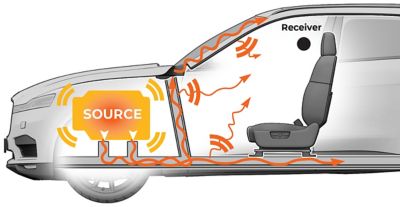
This image represents how noise and vibration from a powertrain can travel through the vehicle body and the air.
Measuring NVH
Automotive engineers use a variety of sensors to measure vibration and sound in prototype and production vehicles. They then use analysis software to convert the test data into useful information.
The most common sensors used for measuring NVH are:
- Accelerometers: Devices that measure motion over time in three dimensions simultaneously, giving acceleration at a given point on the vehicle.
- Force transducers: Instruments, often called load cells, placed between components to measure the load between them over time.
- Torque transducers: Sensors that measure the strain in a shaft and convert it into rotational load over time.
- Strain gauges: Devices that measure the distortion on the surface of an object over time.
- Microphones: Sensors that measure changes in air pressure over time (which is the sound).
- Laser vibrometers: Optical systems that measure the Doppler shift of a laser beam reflected back from a vibrating surface, giving the deflection of the surface over time, parallel to the laser beam.
Approaches for NVH Optimization
Automotive engineers have several approaches to optimize a vehicle's noise and vibration to minimize harshness. Automotive manufacturers try to deploy these remedies as early in the design process as possible, when the cost of design changes is minimal.
Engineers try to remove the signal, reduce its energy, or make it less harsh. The oscillation and amplitude of each frequency of the signal define a given vibration or noise. The analysis of each frequency amplitude is a spectrum. Any multiple instances at a specific frequency create a note or notes that are heard by the human ear. The amplitude of those fundamental vibrations signifies the volume of the sound. The correct term for the perception of volume is loudness, and it can be estimated using the loudness psychoacoustics indicator.
The four most common approaches that reduce amplitude or change frequencies are source modification, energy absorption, isolation, and active suppression.
Source Modification
The first place to start when addressing NVH challenges is to stop, reduce, or modify the noise or vibration at the source. If the signal is caused by resonance, engineers will change the stiffness or geometry to move the natural frequencies away from excitation frequencies or minimize the energy when excited. Rattles can be reduced or eliminated by attaching components more firmly. To reduce tonal noises at the source, engineers use pitch sequencing to broaden the frequency range or change the rotating speed RPM to shift the frequencies to a more pleasant range.
Energy Absorption
Once a signal leaves its source, engineers use various methods to convert its energy into heat, typically through damping or absorption. A good example of this is the use of housing, shock absorber, or acoustic foam in the ceiling panels to absorb noise from outside and to reduce the reflection of noise inside the cabin. Energy-absorbing materials are used in mechanical connections to absorb vibration.

An example of engineered sound-absorbing structures used in an automobile roof to absorb sonic energy
Isolation
Instead of absorbing the energy of a signal, another approach automotive engineers use is to block the signal from transmitting. Designers use bushings, rubber, hydraulic mounts, and flexible joints to block vibrations from moving through the vehicle.
Active Suppression
A more sophisticated remedy available to engineers is the use of amplified sound at certain frequencies, referred to as active noise cancellation (ANC), to reduce the amplitude of a signal through destructive interference. Destructive interference uses an artificial signal that is 180 degrees out of phase with the signal the engineers want to reduce. Another active suppression approach is to add a pleasant sound that masks the harsh noise.
Driving Better NVH Management with Simulation
It is a well-known maxim in product development that it is almost always less expensive to make a change in the early design stages. However, engineers can’t measure NVH until they have a prototype or production vehicle to test. This is where simulation comes in, providing the design team with information long before they build any physical components. In most cases, teams use a combination of multiple types of simulation to understand and improve NVH performance.
Engineers first use structural dynamics to determine the natural and forced-vibration responses of NVH sources and transmission pathways. A comprehensive and efficient package like Ansys Mechanical software can carry out a wide range of structural dynamics simulations, including natural frequency response, forced vibration, random vibration, and component mode synthesis (CMS) for large assemblies such as a vehicle's unibody structure.
For electric drivetrains, a simulation engineer will characterize vibration and noise from electromagnetic forces using a general-purpose tool like Ansys Maxwell software. For electric motors and actuators specifically, they can usea focused simulation tool like Ansys Motor-CAD software to more quickly model noise sources and evaluate NVH remedies. Motor-CAD software also serves as a great example of how NVH-specific post-processing tools can speed up the simulation process and deliver more meaningful information to engineers.
They also evaluate signal transmission and BSR using multi-body dynamics (MBD) structural analysis with a tool like Ansys Motion software. This type of simulation simplifies structures and focuses on how various components are connected and how they move dynamically. MBD simulations for NVH typically focus on a vehicle's suspension or drivetrain.
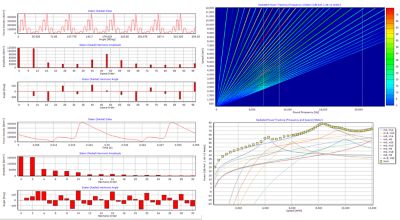
Various forms of noise, vibration, and harshness visual results are available in Ansys Motor-CAD software.
Lastly, they use computational fluid dynamics (CFD) programs such as Ansys Fluent software to predict and control aerodynamic noise. Aeroacoustics analysis combines both fluid dynamics and acoustics to predict and control wind noise. One important factor in predicting aerodynamic noise is accurately modeling turbulence and predicting when and where flow transitions from laminar to turbulent.

An example of different types of noise creating turbulence in a CFD simulation of a car
Once the engineers understand the sources and transmission of noise and vibration, they can use tools such as Ansys Sound software to listen to the result of the virtual prototyping. They can assess how passengers will perceive the sound based on a Jury Listening Test or just estimate the annoyance perception with the psychoacoustics metrics calculation like loudness, tonality, and sharpness. Most of these criteria follow standards such as ANSI, DIN, and ECMA. The next step is to then iteratively modify the design in the simulation toolset, varying materials, geometry, components, and connections to reduce loudness and harshness.

An acoustics engineer listening, analyzing and modifying the sound during run up using the time-frequency representation of the sound
In addition to these types of tools, teams often deploy an optimization platform like Ansys optiSLang software to deal with complex situations where they must weigh many inputs and outputs against each other.
Future Trends for NVH
The most significant change in NVH management has been the growth of electric vehicles and learning to deal with the high-frequency vibration generated in electric motors. In addition, teams are working on overcoming the fact that the combustion engine's noise no longer masks other sounds, and those noises need to be identified and minimized.
Beyond addressing the changes brought on by electric vehicles, the three biggest trends in NVH engineering are innovations in acoustic absorption, active noise cancellation, and active sound design (ASD). Companies are researching new materials and novel manufacturing methods, such as 3D printing, to create structures that dampen or absorb sound and vibration. Researchers are also looking at improvements in on-vehicle edge computing, improved sensor technology, and more efficient sound generators to more accurately measure and reduce unwanted noise. Once the noise has been reduced through passive or active means, there is room to create new sounds. For example, withASD, futuristic sounds can be developed to provide auditory feedback of an ePowertrain’s high torque or generate subtle 3D sounds for advanced driver assistance systems (ADAS) alarms.One mandatory EV active sound is the exterior sound at low speed, which is the acoustic vehicle alert system.
The most promising area of research is the use of artificial intelligence (AI) by R&D teams to understand and quantify harshness, moving it from a subjective interpretation to an objective, measurable quantity.
Related Resources
现在就开始行动吧!
如果您面临工程方面的挑战,我们的团队将随时为您提供帮助。我们拥有丰富的经验并秉持创新承诺,期待与您联系。让我们携手合作,将您的工程挑战转化为价值增长和成功的机遇。欢迎立即联系我们进行交流。