Synopsys and Ansys power the future of innovation—connecting silicon to systems.
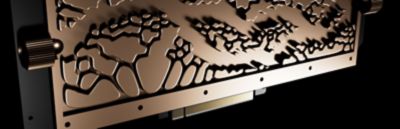
How AI-powered geometry exploration can help you expand the design space without locking you into a single tool chain.
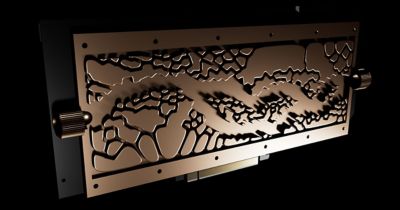
Cold plates are essential to advanced computing. The precision liquid-cooled heat exchangers need to efficiently transfer heat away from high-power applications like graphics processing units (GPUs). Ansys, part of Synopsys, wanted to see if there was room for improvement in cold plates and turned to Ansys GeomAI software to demonstrate how AI-trained models can be used to quickly suggest the best new designs. But how do you train a model without existing data? You look to the greatest design optimizer of all time: nature.
The task was to design a GPU cold plate for roughly 650 W of heat while minimizing both operating temperature and mass. Traditional workflows typically start with a parameterized computer-aided design (CAD) model, a limited set of variables, and an optimization loop that explores the design space those variables allow. That can be effective when the key design features are already known. But for advanced liquid cooling applications, where channel topology, manifold strategy, pressure drop, manufacturability, and thermal uniformity interact in complex ways, the most promising idea may sit outside the parameterization chosen at the beginning.
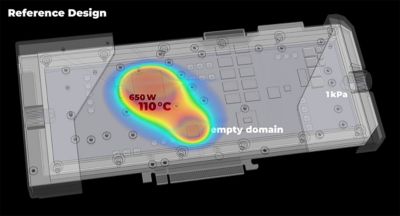
The problem: design a cold plate for a graphics processing unit (GPU) generating about 650W of heat, aiming to minimize both operating temperature and mass.
Rethinking the Cold Plate Design Loop
In the GPU cold plate demonstration, GeomAI was used to show a new approach to optimization: searching between different concepts represented by a single CAD model. Before, we could optimize each CAD model, compare the best we can do with different concepts, and then choose the best concept. However, we always knew that the best design was likely in between the concepts that we tried. With GeomAI software, we can search across and between different concepts to find the best concept.
The demonstration began with generated training data because a ready-made repository of cold plate designs was not available. To create that data, the team explored nature-inspired branching patterns that mimicked river networks, then evolved the approach toward smarter sampling algorithms that produce organic-looking fields.
“I don’t think an engineer would have come up with the GeomAI optimization results on their own,” says Martin Husek, the principal engineer who worked on the cold plate demonstration. “Normally, engineers would define the domain, inlet, and outlet, add a fin layout, and optimize it. The organic branching idea wouldn't have occurred to them.”
Once trained, the GeomAI model encoded those concepts into a “latent space.” Within that latent space, internal variables known as latent parameters describe geometry implicitly rather than mapping one-to-one to physical dimensions such as thickness, radius, or channel width. The result is a practical way to move beyond incremental parameter sweeps and into geometry exploration that can handle different topologies while staying connected to simulation-driven product development.
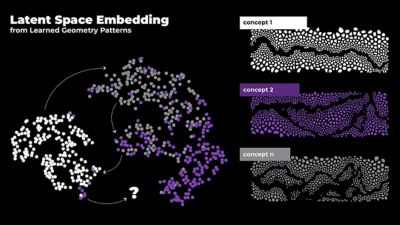
GeomAI uses a set of training geometries to learn recurring patterns and compress them into latent parameters that reside in the latent space.
This matters because the geometry of a cold plate is not just a container for the physics; it is the design. Small changes in channel width, branching, mixing features, inlet and outlet placement, or local surface area can have outsized impact on thermal performance and pumping power. A conventional parametric setup may capture some of these changes, but if you add too few parameters the search is constrained and if you add too many the workflow becomes difficult to manage, expensive to run, and harder to reuse.
GeomAI offers a different abstraction. By learning directly from geometry concepts — requiring at least two different objects to train — it enables design automation teams to generate new candidates without building a fully parameterized CAD model by hand. Those candidates can then be passed downstream to simulation, surrogate modeling, or optimization tools. In the demonstrated workflow, Ansys optiSLang process integration and design optimization software can automate exploration of latent parameters, GeomAI generates the corresponding geometry, and Ansys Discovery product simulation software generates training data for the physics AI models. Higher-fidelity solvers can then be used to validate performance of the final design.
Open Ecosystem Benefits the Workflow
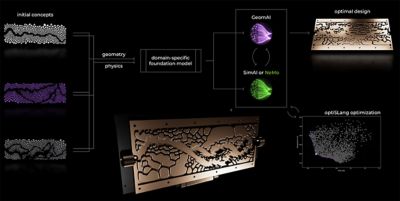
The design workflow behind an optimized graphics processing unit (GPU) cold plate. The workflow includes Ansys GeomAI, Discovery, SimAI, and optiSLang software to find the best arrangement of matter to satisfy a particular set of cooling requirements.
In a cold plate optimization workflow, GeomAI may generate geometry concepts, while complementary tools evaluate physics, accelerate prediction, or guide the search. That means GeomAI can generate the corresponding cold plate geometries, and an AI physics model such as one built with the Ansys SimAI artificial intelligence platform for simulation or NVIDIA PhysicsNeMo can rapidly predict behavior before the most promising candidates are validated with a high-fidelity solver. GeomAI can participate in a flexible automation architecture where geometry generation, AI physics, simulation, and optimization each play their role.
can rapidly predict behavior before the most promising candidates are validated with a high-fidelity solver. GeomAI can participate in a flexible automation architecture where geometry generation, AI physics, simulation, and optimization each play their role.
“When you combine GeomAI with AI tools for physics, you get hundreds of geometries in seconds,” says Husek. “If you send them to a solver, you’d be waiting hours for it to converge. But when you send them to an AI physics model built with Ansys SimAI or NVIDIA PhysicsNeMo, for example, you will get the response immediately.”
Once you’re done with the process of finding an optimal design, you can then validate the simulation with a high-fidelity solver like Ansys Fluent computational fluid dynamics (CFD) software.
From Parameter Sweeps to Generative Exploration
Smooth shape transitions enabled by GeomAI help optimization algorithms efficiently converge to the Pareto front.
Design automation has long been about building repeatable workflows that remove friction from engineering decision-making. GeomAI extends that idea upstream into the geometry creation process. Instead of automating only the evaluation of predefined variants, engineers can automate the generation of new geometry families and make those geometries available to the rest of the digital engineering pipeline.
That does not replace simulation expertise, optimization strategy, or design review. It makes them more valuable. Engineers still define the training data, choose objectives, set constraints, validate results, and decide which candidates deserve further development. AI physics predictions are most reliable when interpolating within the training data and may be less reliable when extrapolating to unfamiliar designs. For that reason, the final optimal design should always be confirmed with a high-fidelity solver before engineering decisions are made.
The cold plate example demonstrates convergence, optimization behavior, Pareto front trade-off exploration, and the value of AI-powered geometry exploration; it is not a pre-trained, commercial cold plate solution. Specialized topology optimization tools may still be more advanced for cold plate-specific optimization. GeomAI’s value is broader: It is a universal AI engine for generative geometry that can help organizations turn existing design knowledge into new candidate shapes across many applications.
For GPU cold plates, that means exploring cooling architectures that may not emerge from a conventional sweep. For design automation engineers, it means building workflows that are more adaptable, more connected, and more capable of combining best-in-class tools. With GeomAI software, and with open integration paths that can include technologies such as NVIDIA PhysicsNeMo, the optimization loop becomes more than a search over numbers. It becomes a search over engineering possibilities.

Just for you. We have some additional resources you may enjoy.
Visit Synopsys at DAC
Visit the Synopsys booth #631 to network with our experts and check out our technology demonstrations!


The Advantage Blog
The Ansys Advantage blog, featuring contributions from Ansys and other technology experts, keeps you updated on how Ansys simulation is powering innovation that drives human advancement.
现在就开始行动吧!
如果您面临工程方面的挑战,我们的团队将随时为您提供帮助。我们拥有丰富的经验并秉持创新承诺,期待与您联系。让我们携手合作,将您的工程挑战转化为价值增长和成功的机遇。欢迎立即联系我们进行交流。