Synopsys and Ansys power the future of innovation—connecting silicon to systems.

Representing a fast-growing area in oil and gas exploration, digital rock physics enables researchers to analyze the properties of rock samples, including permeability and pore characteristics. The creation of 3D models from different scan modalities, such as micro-CT and focused ion beam scanning electron microscope (FIB-SEM), can complement experimental testing and generate valuable data for analysis of rock types. Ansys Simpleware software provides 3D image data for digital rock physics, with a particular focus on streamlining multiple stages of image visualization, analysis, and model generation for simulation.
Digital Rock Physics
When working with geological samples, it is possible to create volume images that contain different material phases, enabling comprehensive analysis of grain structure, porous networks, and other characteristics. Quantifying these features and using finite element analysis (FEA) and computational fluid dynamics (CFD) enables a deeper understanding of the potential behavior of samples; this has applications in reservoir characterization, oil recovery, and hydrocarbon production potential, among many other areas. Analyzing samples at different length scales means being able to better understand flow and transport properties for even very small pore connections.
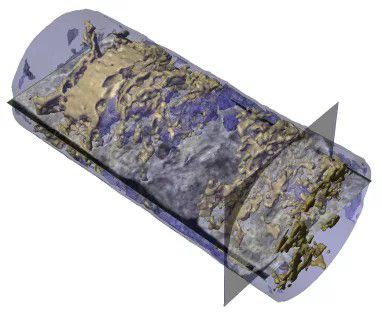
Core sample visualized in Ansys Simpleware
Visualizing and Processing Image Data
Our solution for digital rock physics starts with visualizing image data, acquired as a stack of images that can be converted from 2D pixels into 3D pixels, also called voxels, in Simpleware software. From this image data, different material phases can be segmented into regions of interest (ROI) using semi-automatic and manual tools; for example, to create solid and fluid masks. In addition, filters can be applied to reduce scan noise and better visualize image data, making it easier to view different features.
Options are also available for obtaining quantified data on the properties of samples, including porosity analysis. Mask and model statistics can be quickly obtained for the volume and surface area of data, as well as on tortuosity, connectivity, and pore sizes. We have also developed image processing and measurement features that are useful for analyzing multi-phase and porous materials, including watershed segmentation for analyzing particles and centerlines. With this approach, it is possible to quickly visualize, segment, and obtain statistics from samples taken from 3D scans.
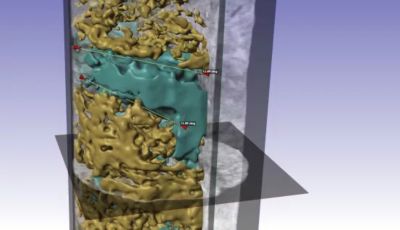
3D image data can be comprehensively processed
Multi-phase Meshing for Digital Rock Physics
We have developed image-based meshing techniques that enable robust FE and CFD models to be generated directly from image data with conforming interfaces and shared nodes. There are several meshing approaches available when working with rock physics data, including a grid-based mesher (+FE Grid), and an adaptive meshing algorithm (+FE Free). The grid-based algorithm in Simpleware software generates mixed hexahedral and tetrahedral meshes; voxels are effectively converted directly to hex elements and then converted to test elements at the interfaces for a smooth surface. This image-based approach takes into account partial volume effects and preserves topology and volume from the original scan. It is also possible to use +FE Free to adaptively re-mesh data.
+FE Free re-meshes multi-part surfaces while preserving the original geometry generated using a grid-based approach. Mesh inspection tools are also available to ensure that the model exported to FE and CFD solvers is robust. For digital rock physics, models can be created that support multiple phases and enable FEA and CFD simulations of stress and permeability, among other physical stimuli. Being able to mesh multiple segmented parts solves the problem of working with very complex scans when generating models.
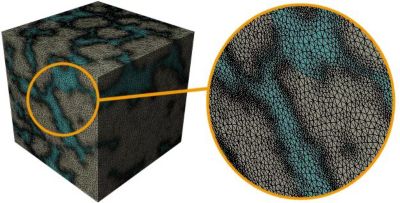
Mesh generated from Berea sandstone sample (Data source: the Rock Physics Network, ETH Zurich)
Calculating Effective Material Properties
Our software’s image-based techniques can also be used to calculate effective material properties from scanned samples. This approach is particularly useful when working with porous media or multi-phase composite. A complex heterogeneous material can be substituted with a homogeneous material, whereby effective properties are chosen so that its response to external loads resembles as closely as possible the original material. A built-in finite element solver calculates effective properties and exports results as tensors and fields. Stiffness tensor and elastic moduli can be calculated with the +SOLID module, absolute permeability with the +FLOW module, and electrical conductivity and permittivity, thermal conductivity, and molecular diffusivity with the +LAPLACE module.
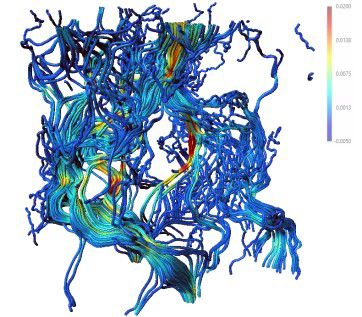
Visualization of fluid velocity streamlines using +FLOW
When using these techniques, it is possible to obtain detailed information on the material properties of rock samples. For example, calculating effective material properties can be useful when analyzing scans of different rock types obtained during reservoir characterization. The intuitive features of the Physics Modules, including convergence graphs to indicate whether obtained results are accurate, and multiple visualization options, help with analysis of rock samples.
There are many ways in which 3D image data can be used in digital rock physics. Obtaining qualitative and quantitative information from samples provides information that can be used alongside experimental testing of rocks. By integrating multiple digital rock physics tools into a single software environment, we have aimed to make it easier to process and generate models from scan data. With demand growing for digital rock physics workflows to take into account very fine porous structures and more unusual rock types found during exploration, keeping these processes easy-to-use is crucial. The models created in our software are very robust, validated, and capable of being used for different types of rock physics simulations.
Learn more about Ansys Simpleware software.


The Advantage Blog
The Ansys Advantage blog, featuring contributions from Ansys and other technology experts, keeps you updated on how Ansys simulation is powering innovation that drives human advancement.