Synopsys and Ansys power the future of innovation—connecting silicon to systems.

How Intel® Xeon® 6 Performance-cores and MRDIMM memory accelerate time to insight for CFD teams
Selecting the right processor for engineering simulation is rarely straightforward. For teams running Ansys Fluent computational fluid dynamics (CFD) workloads, raw core count alone does not tell the full story. The winning platform is the one that pairs high sustained per-core performance with the memory bandwidth needed to keep those cores fed. Solver performance depends on a combination of central processing unit (CPU) architecture, memory bandwidth, model size, licensing behavior, and the business value of faster engineering turnaround.
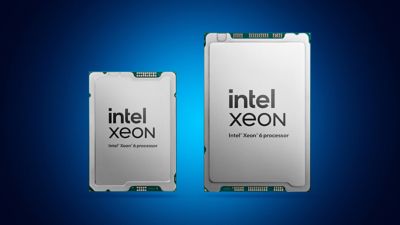
That is why the latest Intel white paper, Choosing Intel Xeon Processors for Ansys Fluent Workloads, is especially useful. Instead of relying on generic CPU specifications, the paper evaluates Intel Xeon 6 processors with Performance-cores against earlier Intel Xeon generations and against comparable AMD EPYC processors using official, custom representative Fluent benchmark cases ranging from 2 million to 280 million cells.
Why Processor Selection Matters for Fluent Software
Fluent simulations are often used in industries such as aerospace, energy, automotive, and industrial equipment to model complex flow behavior, turbulence, acoustics, and fluid-structure interactions. As models become larger and more detailed, simulation runs can take days or even weeks. Reducing solver time can directly improve design productivity, enable more design exploration, and help engineering teams reach better decisions faster. In competitive segments like automotive, aerospace, and industrial design, every additional Fluent run per week is another design iteration — and a shorter path to a validated, market-ready product.
The white paper shows that Intel Xeon 6 processors deliver a significant performance improvement over 4th Gen and 5th Gen Intel Xeon processors across the Fluent benchmark suite, in both multicore and single-core comparisons — with up to ~2.5-3.1x higher throughput on multicore Fluent cases versus 4th Gen Xeon 8480+. For teams refreshing older CPU infrastructure, this is a compelling business case. The value of a new system should be measured not only by peak performance but by how much additional simulation throughput it can deliver within the same engineering schedule.
Memory Bandwidth Defines the Xeon 6 Advantage for Fluent Software
One of the most important takeaways is that more cores are not always better for every Fluent workload. The Intel Xeon 6980P processor delivered the highest multicore performance across most benchmarks, but some larger models performed better on the 96-core Intel Xeon 6972P because memory bandwidth per core becomes significant at higher core counts. This is not a limitation of Xeon 6 — it reflects the physics of large CFD, and the Xeon 6 family is engineered to give customers a workload-matched choice for either scenario.
This is a practical reminder for simulation teams: The best CPU choice depends on the actual workload. Smaller and midsize cases may benefit from maximum aggregate throughput while larger memory-intensive models can favor a more balanced configuration with stronger bandwidth availability per core.
Intel Xeon 6 platforms with P-cores were first to market with MRDIMM memory, which is an important contributor to performance, particularly for Fluent workloads. MRDIMM delivers a peak speed of 8,800 MT/s, 37.5% higher than commonly used RDIMM modules in data centers, and Fluent workloads often involve many random memory accesses where bandwidth can become a constraint. In joint Intel and HPE testing on the ProLiant Compute XD230, this MRDIMM advantage contributed up to 2.57x higher Fluent CFD throughput and a 2.42x improvement across 24 CFD models versus the prior generation.
Single-Core Performance Still Matters
Many simulation users focus on total system throughput, but per-core performance remains highly relevant when licensing is tied to core usage. The white paper highlights that the Intel Xeon 6960P delivered the best single-core performance among the Intel processors tested for Fluent software.
This matters because a processor refresh is not only a question of how many simulations can run in parallel. It is also a question of how efficiently each licensed core contributes to time to solution. For organizations managing both hardware budgets and software licensing efficiency, per-core performance becomes a key part of the business case.
Scaling Fluent Software Across Multinode Xeon 6 Clusters
Fluent performance also scales effectively beyond a single server. In a cluster configuration of up to 16 nodes, each equipped with dual 86-core Intel Xeon 6787P processors, DDR5-6400 memory, and NDR 400 interconnect, Fluent software scales to a total of 2,752 CPU cores available on 16 nodes.
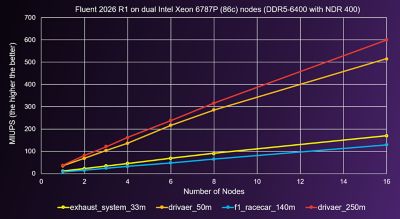
Benchmark models, such as a steady-state simulation of flow through a vehicle exhaust system with 33 million cells (exhaust_system_33m), exhibit close to linear scaling — and in some cases even superlinear scaling (up to 110% efficiency) as the larger aggregate L3 cache improves data locality. For teams running larger CFD workloads or design-of-experiments studies, this demonstrates that Xeon 6-based clusters can provide a practical path from workstation-scale analysis to high-throughput, multinode Fluent simulation.
What Xeon 6 Means for Your Business
For simulation-driven organizations, the Xeon 6 story lands in three places that matter to profit and loss (P&L).
- First, time to insight: Up to ~2.5-3x more Fluent runs per node per day (versus 4th Gen Xeon) means more design iterations before a product is committed to tooling and shorter engineering cycles.
- Second, license return on investment (ROI): The per-core efficiency of Xeon 6 — especially the Xeon 6960P — extracts more useful work from the Ansys high-performance computing (HPC) licenses you already own.
- Third, cluster total cost of ownership (TCO): Fewer nodes are needed to hit the same simulation service-level agreement (SLA), which reduces rack, power, cooling, and administration overhead — and improves the sustainability profile of the computer-aided engineering (CAE) environment.
In short, choosing Intel Xeon 6 with MRDIMM is not just a specification upgrade; it is a step function improvement in the economics of CFD.
Turning Benchmark Data Into a Strategic TCO Conversation
Performance data is essential, but hardware decisions are rarely made on performance alone. Engineering managers, information technology (IT) teams, and procurement stakeholders also need to understand TCO: server cost, consolidation potential, energy use, licensing efficiency, and the productivity value of faster simulation turnaround.
That is where the new related TCO calculator for Fluent workloads can help. The Intel Xeon Processor Advisor Tool Suite is designed to support CPU recommendations and data center TCO optimization, and the Ansys-specific experience provides recommendations for upgrading from 4th Gen Intel Xeon to Intel Xeon 6.
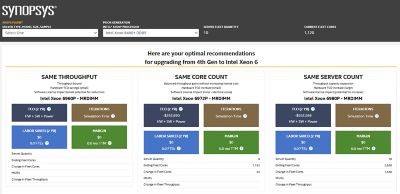
The CPU total cost of ownership calculator
The Fluent-specific CPU TCO calculator can help teams evaluate which processor configuration best matches their current infrastructure, workload profile, and business goals. The value is not only in identifying the fastest system but in finding the most appropriate balance of performance, cost, power, and licensing efficiency — a balance that Intel Xeon 6 was purpose-built to deliver for CFD.
Available Across Leading HPC Platforms and the Cloud
For teams ready to evaluate or deploy Xeon 6 processors for Fluent workloads, the ecosystem is already taking shape. Xeon 6 processors are offered by our hardware partners in the HPE ProLiant Compute XD230 server, Dell PowerEdge R770AP, Supermicro FlexTwin, and Lenovo ThinkSystem SC750 V4 Neptune, as well as on Amazon EC2 x8i instances. This provides engineering and IT teams with flexible options to evaluate, scale, and operationalize Fluent performance improvements across both on-premises and cloud environments.
Start With the Data, Then Model Your Own Environment
For Fluent users considering a CPU refresh, the message is clear: Standardize on Intel Xeon 6 with MRDIMM, sized to your workload — Xeon 6980P for maximum aggregate throughput, Xeon 6972P for the largest memory bandwidth-bound models, and Xeon 6960P where per-core Ansys HPC license ROI is the priority.
Download the Intel white paper, “Choosing Intel Xeon Processors for Ansys Fluent Workloads,” to review the benchmark findings in detail. Then use the new related Fluent TCO calculator to explore how Intel Xeon 6 processor options could affect performance, cost, and infrastructure decisions for your own environment.

Just for you. We have some additional resources you may enjoy.
Learn More
- Download the Intel white paper, “Choosing Intel Xeon Processors for Ansys Fluent Workloads,” to review the benchmark findings in detail.
- Use the new related Fluent TCO calculator to explore how Intel Xeon 6 processor options could affect performance, cost, and infrastructure decisions for your own environment.


The Advantage Blog
The Ansys Advantage blog, featuring contributions from Ansys and other technology experts, keeps you updated on how Ansys simulation is powering innovation that drives human advancement.
现在就开始行动吧!
如果您面临工程方面的挑战,我们的团队将随时为您提供帮助。我们拥有丰富的经验并秉持创新承诺,期待与您联系。让我们携手合作,将您的工程挑战转化为价值增长和成功的机遇。欢迎立即联系我们进行交流。