Synopsys and Ansys power the future of innovation—connecting silicon to systems.

Additive manufacturing (AM) is becoming increasingly important for the aerospace industry, and notably for non-destructive evaluation of components that would otherwise be costly to model. ELEMCA and the French space agency Centre National d’Etudes Spatiales (CNES) used Ansys Simpleware software to build models from X-ray CT imagery suitable for finite element analysis (FEA) in Ansys Mechanical structural simulation software of defects. This workflow was crucial to studying an aluminum AM part designed for the TARANIS satellite, comparing the image-based model with results from computer aided design (CAD).
The TARANIS satellite from CNES is designed to observe stormy regions above the Earth. The attitude and orbital control system (AOCS) of the TARANIS microsatellite is significant for controlling the orientation of the satellite, and uses a sun assembly sensor (SAS) to detect the sun’s position. It is therefore crucial that the support is stiff enough to maintain primary modal frequencies and performance within the dynamic environment of the rocket during the satellite’s launch.
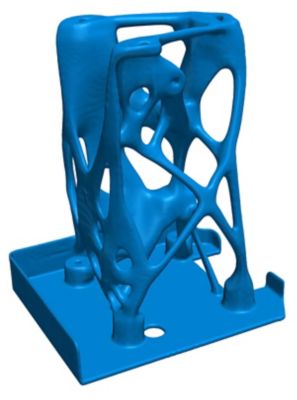
SAS model created in Simpleware software
Simpleware software offers a quick and intuitive environment for processing 3D image data. In this case, X-ray CT scanning was used to create a set of images of the aluminum parts, including defects. Simpleware software was used by ELEMCA to segment the component and process the data to capture important elements for simulation.
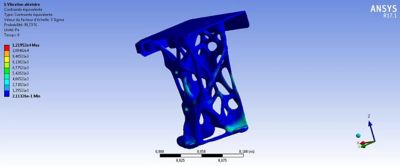
Simulation of Von Mises stress in Ansys Mechanical
A finite element mesh was then generated using the Simpleware FE Module and exported to the Ansys Workbench platform to examine Von Mises stress, with results compared to CAD simulations. The results showed good agreement, and validated the workflow for image-based simulation. The potential benefits of the method are to reduce experimental testing costs and speed up workflows by adding more virtual testing to manufacturing and design tasks.
The workflow used by ELEMCA and CNES is significant for increasing the range of options available for manufacturing critical components for aerospace and other industries. Being able to study the as-manufactured part allows for more realistic predictions of performance than using traditional experimental methods, and helps reduce the challenges of qualifying parts produced by additive manufacturing for aerospace.
Learn more about Ansys Simpleware software.

The Advantage Blog
The Ansys Advantage blog, featuring contributions from Ansys and other technology experts, keeps you updated on how Ansys simulation is powering innovation that drives human advancement.