Synopsys and Ansys power the future of innovation—connecting silicon to systems.

In this installment of “Where Are They Now,” Arbe shares how solutions from Ansys, part of Synopsys, continue to drive perception in automotive radar.
A lot has changed for Ansys Startup Program alum Arbe Robotics since 2020, when the automotive supplier began using Ansys simulation software to help design a 4D radar chipset for automotive applications.
For Arbe, selling silicon chips and proving system integrity involved enlisting an entire team of engineers from the automotive, defense, and semiconductor industries with expertise in radar, informatics, mathematics, physics, and electronics. Plus, it required access to the right simulation tools and solvers, which it achieved with help from the Ansys Startup Program.
Since joining the Ansys Startup Program, Arbe has evolved from an emerging radar innovator into a global leader in ultra-high-resolution perception radar, enabling automakers and tier ones to build safer, scalable perception systems for autonomous driving applications.
In 2023, the company was recognized as a CES Innovation Award Honoree for its 360-degree radar-based perception solution. In 2025, Arbe won the AutoTech Breakthrough Award and the Just Auto Excellence Award. At CES 2026, Arbe showcased its automotive-grade radar system qualified to run on NVIDIA-accelerated computing, highlighting the role of imaging radar in autonomous driving architectures.
We recently spoke with Ram Machness, the newly appointed chief executive officer of Arbe, to discuss how Ansys continues to play a supporting role in automotive radar development.
For those who aren’t familiar already, can you share a bit about Arbe?
Machness: Our company specializes in chipsets for radar, especially for the automotive market. Not only for the automotive market, but also for other applications that require high-resolution sensing in any environmental condition. For self-driving and ADAS (advanced driver-assistance system) applications, perception systems must detect and distinguish objects at long range, operate reliably in darkness and adverse weather, and maintain performance in cluttered environments.

Ram Machness, chief executive officer at Arbe
Arbe’s HD radar is designed to address these gaps by delivering real-time 4D imaging that complements cameras and strengthens the vehicle’s perception stack. What makes Arbe’s radar architecture unique is its 48 transmit channels and 48 receive channels, enabling ultra-high-resolution radar with low false alarms and a highly accurate image generated by the radar.
How does your high-resolution radar support autonomous vehicle function?
Machness: Together with the vehicle’s cameras, Arbe’s radar provides high-fidelity perception data that helps the vehicle build a reliable understanding of its surroundings. This is essential for safe operation across diverse weather, lighting, and road conditions, and supports the development of advanced assisted and automated driving capabilities. Once I am able to rely on the vehicle to drive autonomously, I can focus on something else. For example, I could read emails, attend a conference call, or focus on something other than driving.
What challenges does your team face during radar optimization?
Machness: The purpose of a sensor is to provide the vehicle with accurate detection of the surroundings. One of the biggest challenges in radar optimization is capturing the wide range of real-world scenarios needed to train algorithms and evaluate performance. It is not practical to record data from every possible environment, condition, and edge case. Simulation helps address this challenge by enabling us to model real-world scenes, as well as antenna behavior and expected performance, before the hardware is built.
How does simulation help you reach your development objectives?
Machness: Simulation tools are valuable throughout the development process, from early-stage design to model development and refinement, and as members of the Ansys Startup Program we had the privilege to have those advanced tools, as well as expert support, from the get-go.
This is particularly important for machine learning, where simulation enables us to generate large volumes of radar data quickly and efficiently, without relying solely on thousands of hours of real-world recordings. While simulation does not replace real-world testing, it significantly expands the range of scenarios engineers can evaluate. It allows us to generate edge cases, assess antenna behavior before hardware is built, and accelerate model development in parallel with real-world validation.
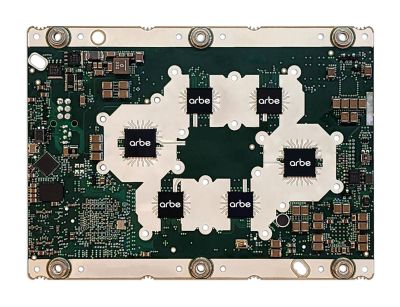
Arbe’s unmatched chipset enables next-generation radar, delivering high resolution and performance.
Can you share what, if any, benefits you have derived from simulation?
Machness: One major benefit is the time saved. Simulation can reduce years of work that would otherwise require multiple teams to record, analyze, augment, and annotate data. It also enables us to generate data that may be difficult or impossible to capture in real life, including rare scenarios and edge cases. This significantly accelerates development.
The second benefit is time to market. For a relatively young company bringing a new innovation to market, speed is critical. Simulation has helped us save months and even years by giving us faster access to the insights we need to develop, validate, and bring our product to market.
Have you made any recent discoveries working in a simulation environment that surprised you?
Machness: Simulation has helped us uncover insights that would have been difficult or even impossible to identify through real-world testing alone. For example, it allows us to understand how sensitive a given scene is to specific parameters and determine which factors most influence radar performance. In some cases, the parameters that had the greatest impact were unexpected or behaved differently than we initially anticipated.
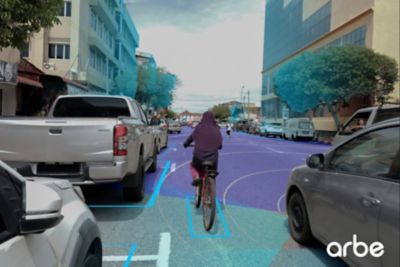
Detecting vulnerable road users, including pedestrians and cyclists
I understand there’s an exciting collaboration between Arbe and NVIDIA underway. Can you tell us more about this?
Machness: We recently announced Arbe’s radar has been qualified on the NVIDIA DRIVE AGX Orin platform. Arbe’s ultra-high-resolution imaging radar provides automakers with a qualified solution within NVIDIA’s sensor ecosystem, enhancing sensor fusion and meeting the demanding performance requirements associated with next-generation ADAS and autonomous driving systems. With NVIDIA, we are working to provide car manufacturers with a sensor solution that supports safe, reliable, and comfortable driving experiences.
Are there any plans for simulation on the horizon at Arbe?
Machness: To develop algorithms and deep learning models effectively, you need large amounts of high-quality data. The more relevant and diverse the data, the better trained and more robust the model becomes. Simulation is extremely valuable because it allows us to generate this data at scale, including rare edge cases, unique scenarios, and complex environments that are critical for training and validation.
In many cases, these scenarios are much easier to create in simulation, and sometimes they are not feasible to reproduce in real life. From my perspective, the use of simulation will continue to grow, especially in imaging radar and environmental sensing. It is becoming a must-have tool for accurately representing the sensing environment and advancing radar perception.

Providing detailed separation at full highway speeds
Arbe’s journey demonstrates how advanced simulation can help bring complex sensing technologies from concept to market. Today, as an Ansys Startup Program alum, Arbe continues to use Ansys tools to accelerate radar innovation, optimize performance, and support the development of next-generation perception systems. If you’re a startup with big ideas and dreams, Ansys can help with simulation software.



The Advantage Blog
The Ansys Advantage blog, featuring contributions from Ansys and other technology experts, keeps you updated on how Ansys simulation is powering innovation that drives human advancement.