Synopsys and Ansys power the future of innovation—connecting silicon to systems.

Developing reliable aerospace systems that meet performance objectives is a growing challenge for design teams. System complexity and stringent regulations drive the development process. System engineers must optimize their designs for three key factors: performance, reliability, and cost. Robust design methodologies provide the techniques for ensuring system reliability despite variations in design parameters and operating conditions. Ansys Saber power electronics and system simulation environment is a complete tool set for implementing a robust design flow. Advanced analysis and comprehensive model libraries enable the design of complete aerospace systems.
Power Network: Generation, Conversion, and Distribution
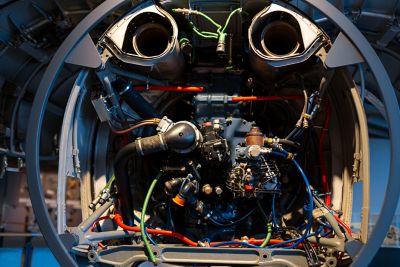
As electronic content in aircraft and spacecraft increases, so do the challenges in meeting this rising energy demand on the power network. Designers must create efficient power generation and distribution systems that perform reliably.
Design teams use robust design methodologies to manage complex energy generation and distribution problems, such as designing an alternator charging system or considering system and environmental variations that affect performance. Saber software’s' comprehensive simulation, modeling resources, and analysis capabilities enable design teams to deploy robust design methods to meet the challenges of powernet design.
Advantages of Saber software:
- Accurately size system components to match energy generation with corresponding consumption.
- Eliminate surprises in power network loading and distribution through early verification.
- Test the complete system earlier with hardware and software co-simulation.
- Save time and eliminate errors with industry-proven power model libraries.
- Enable design portability using industry standard VHDL-AMS and MAST languages.
- Maximize reliability with advanced sensitivity, statistical, and fault analyses.
- Increase analysis throughput with distributed simulations across multiple central processing units (CPUs).
Avionics Network
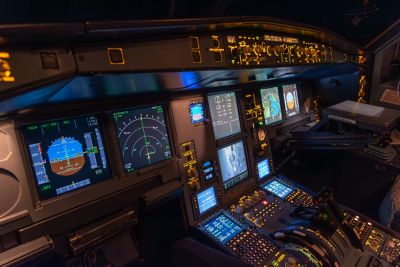
Aerospace avionics networks provide controller area network (CAN)-based communication channels for systems that control flight, improve performance, ensure safety, and provide passenger comfort. Network reliability is critical to aircraft operation, requiring verification of the network’s logical and physical layers. While logical layer design and verification can begin early in the design process, physical layer verification has traditionally required hardware prototypes and is often delayed until late in the development cycle. Complex networks, however, require early physical layer verification. Avionics engineers are turning to robust design methodologies, coupled with modeling and simulation, to meet physical layer verification objectives.
Saber software’s comprehensive analog and mixed-signal simulation and modeling capabilities, coupled with well-defined robust design methodologies, create a standalone environment for verifying the physical layer of avionics networks. Engineers develop network designs with transceiver and controller models from the Saber library. Using Saber software’s comprehensive time domain, frequency domain, and statistical analyses, the network’s physical layer is verified long before a hardware prototype is available.
Advantages of Saber software:
- Verify network concepts and topologies early in the development cycle.
- Analyze network variants, including minimum versus maximum number of electronic control units (ECUs).
- Analyze the impact of topology types and electromagnetic compatibility (EMC) protection on signal integrity.
- Include wire characteristics in system simulations to analyze possible topology extensions.
- Model and characterize aerospace communication networks using industry standard VHDL-AMS and MAST modeling languages.
- Verify nominal network performance using standard analyses and ensure reliability with advanced sensitivity, statistical analysis, worst case analysis (WCA), and fault simulations.
- Increase analysis throughput with distributed simulations across multiple CPUs.
Flight Control
Modern aircraft depend on fly-by-wire technology to control flight. Fly-by-wire technology combines flight computers with control sensors and actuators in a complex mechatronic system. Design teams must analyze the flight control system to verify interactions between control surfaces and understand how variations in design and environmental parameters affect performance and reliability. System complexity requires robust design methodologies coupled with systems simulation to verify correct and reliable operation.
Saber software’s design environment combines advanced, comprehensive analyses with a model library to meet the challenges of aircraft flight control design. From architecture level to physics-based modeling of real-world devices, and simple operating point to complex statistical analyses, design teams can analyze flight control systems to ensure nominal function and confirm robust operation across a variety of operating conditions.
Advantages of Saber software:
- Create flight control system designs using models from the industry’s largest mechatronics model library.
- Analyze systems at the component, sub-system, or system level.
- Optimize cost, performance, and reliability with advanced stress, sensitivity, and statistical analyses.
- Include wire characteristics in system simulations to analyze possible topology extensions.
- Model complex flight control functions using industry standard VHDL-AMS and MAST modeling languages.
- Verify hardware and software interaction with co-simulation.
- Increase analysis throughput with distributed simulations across multiple CPUs.
Wire Harness
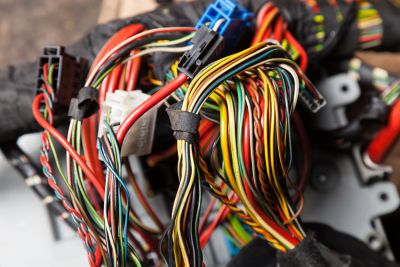
The wire harness forms the backbone of the entire electrical system of automobiles and aircraft. The correct and reliable implementation of the wire harness represents one of the most expensive and technically challenging aspects of vehicle systems design. SaberES Designer provides proven design and verification capabilities in conjunction with the Saber Simulator to create correct-by-design wire harnesses. Designers can create schematic drawings and connectivity diagrams, export component and wire data, import geometry information from mechanical computer aided design (MCAD) tools, simulate electrical functions, create bundles with connector positions and generate data for manufacturing — all within an easy-to-use design tool.
Advantages of Saber software:
- Analyze electrical systems before layout and manufacturing to avoid system failure in production.
- Provides an integrated data flow for electrical system design from concept to manufacturing.
- Minimizes data entry and manual checking tasks, automates data processing steps while maintaining data integrity.
- Integrate with popular 3D CAD tools, such as Catia V5, UGS, and Pro/E.
- Supports team and concurrent engineering working methods, saving valuable design time and maintaining data integrity.
- Verify hardware and software interaction with co-simulation.
- Provides an easy-to-use design editor.
The Saber design environment from Ansys stands as a robust and comprehensive solution for the design and analysis of aircraft systems. Equipped with advanced analyses, model libraries, and simulation capabilities, it empowers design teams to optimize the performance, reliability, and cost of their systems, successfully overcoming the escalating challenges in aircraft design. Saber software finds application in diverse areas such as powernet design, avionics network verification, flight control system analysis, and wire harness design and simulation. These tools provide a plethora of benefits like early verification, system-level testing, error elimination, design portability, reliability maximization, and increased analysis throughput. By integrating robust design methodologies with the Saber environment, engineers are positioned to effectively meet their design objectives and ensure the reliability of their aerospace systems.
Learn more about how Ansys Saber can help with your aircraft systems.




The Advantage Blog
The Ansys Advantage blog, featuring contributions from Ansys and other technology experts, keeps you updated on how Ansys simulation is powering innovation that drives human advancement.