Synopsys and Ansys power the future of innovation—connecting silicon to systems.

For computational fluid dynamics (CFD) engineers working on electric vehicle (EV) battery systems, thermal management presents a familiar dilemma: The physics demand high fidelity, but the development process demands speed.
Liquid-cooled battery packs operate under strongly transient conditions — variable drive cycles, changing heat generation rates, and actively controlled coolant flow. Capturing these effects accurately with full conjugate heat transfer (CHT) CFD is possible but rarely practical at scale for engineers doing system-level analysis. Transient CFD with variable flow rates quickly becomes computationally prohibitive for system engineers, particularly when exploring design variants, control strategies, or pack-level architectures.
Reduced-order modeling (ROM) offers a way forward but only if it respects the underlying physics.
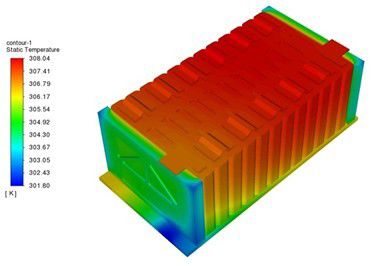
Electric vehicle (EV) battery thermal management simulation in Ansys Fluent fluid simulation software
Learn more about reliable battery thermal management with Ansys Fluent fluid dynamics software.
Why Traditional ROM Approaches Fall Short
Most CFD-derived battery thermal reduced-order models (ROMs) rely on a linear time-invariant (LTI) assumption. This works well for convective cooling problems with constant flow rates, among a few other reasonable assumptions. In that regime, state-space models calibrated from CFD step responses can reproduce transient behavior with impressive accuracy at negligible runtime cost.
However, battery thermal systems are not purely LTI.
In liquid-cooled packs, coolant flow rate is often time-dependent, controlled dynamically in response to load, temperature, and ambient conditions. Changing flow rates violates the LTI assumption, limiting the applicability of conventional ROMs.
Decomposing the Physics: LTI Solids Plus Nonlinear Cooling
A more robust approach is to decompose the thermal system based on physical behavior rather than forcing linearity across the entire domain.
From a heat transfer standpoint:
- Solid components (cells, tabs, cold plates, structural elements) exhibit linear behavior under constant material properties.
- Coolant channels exhibit nonlinear behavior due to flow rate-dependent convection.
By modeling these subsystems separately — and coupling them explicitly at the fluid-solid interface (FSI) — it becomes possible to retain CFD-level accuracy while accommodating variable flow conditions.
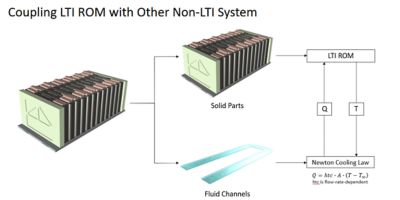
Reduced-order model (ROM) generation by coupling two subsystems at the fluid-solid interface
Building Blocks of the ROM
1. Solid Subsystem: State-Space ROM From CFD
The solid domain is represented using an LTI state-space model derived from CFD-generated step responses. Inputs typically include:
- Volumetric or total cell heat generation
- Heat flux at the FSI
Outputs include:
- Volume-averaged cell temperatures
- Temperatures at user-defined monitor points
- Area-averaged FSI temperature
For CFD users, the key advantage is that the ROM directly inherits the spatial and temporal thermal characteristics of the high-fidelity CFD model, including conduction paths, contact resistances, and geometric effects.
Importantly, the accuracy of this subsystem depends strongly on how boundary conditions — particularly FSI heat flux — are represented during ROM training.
2. Representing Non-Uniform FSI Heat Flux
In detailed CFD, heat flux at the fluid-solid interface is rarely uniform. Flow acceleration near inlets, bends, and U-turns produces localized peaks in convective heat transfer.
Applying a spatially uniform heat flux during ROM generation can therefore introduce localized temperature errors, even if global averages appear acceptable.
A more accurate strategy is to use distributive heat flux at the FSI during step-response generation. This preserves dominant spatial patterns observed in CFD while keeping the ROM compact and computationally efficient. Such a distributive heat flux can be approximated using a piece-wise constant distribution or can be computed more accurately using singular value decomposition (SVD) from a few representative heat flux distributions calculated from a few different flow rates.
For CFD practitioners, this approach aligns naturally with post-processing insights already familiar from CHT simulations.
3. Coolant Subsystem: Flow-Dependent Heat Transfer
The coolant channel is modeled separately using Newton’s law of cooling, where the heat transfer rate depends on:
- Area-averaged FSI temperature
- Coolant inlet temperature
- Heat transfer coefficient (HTC)
Crucially, the HTC is treated as a function of coolant flow rate, extracted directly from parametric CFD studies. This preserves the nonlinear dependence of convection on flow without embedding the full fluid domain in the ROM.
From a CFD perspective, this means that:
- CFD is used where it adds the most value — capturing flow physics and HTC trends.
- The ROM leverages those results efficiently during transient simulation.
4. Coupling the Subsystems
The solid and coolant subsystems are dynamically coupled through the FSI:
- The solid ROM outputs FSI temperature.
- The coolant model computes heat flow based on flow rate and HTC.
- The resulting heat flow is fed back into the solid ROM.
This coupled LTI-HTC ROM accurately reproduces transient thermal behavior under time-varying heat loads and coolant flow rates while running orders of magnitude faster than full CFD.
Validation against transient CFD shows temperature prediction errors typically within a few percent — well within engineering requirements for design exploration, controls development, and system-level studies.
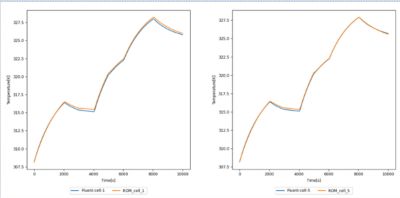
Validation testing of the ROM against Fluent computational fluid dynamics (CFD) data shows extremely close agreement between the two.
Why This Matters to CFD End Users
For CFD engineers, this workflow does not replace high-fidelity simulation — the workflow extends simulation’s reach.
- CFD remains the source of truth for geometry, flow distribution, and heat transfer physics.
- ROMs translate that fidelity into models suitable for rapid iteration and integration.
The result is a simulation strategy that scales from detailed component analysis to pack-level transient studies without sacrificing physical credibility.
Enabling the Next Generation of Battery Thermal Workflows
As EV batteries continue to push higher power densities and faster charge rates, thermal margins shrink and transient behavior becomes increasingly critical. Simulation workflows must evolve accordingly.
By combining CFD-anchored ROM with flow-aware thermal coupling, engineers can:
- Evaluate thermal performance across full drive cycles
- Explore cooling and control strategies early in development
- Reduce dependence on long-running transient CFD for routine studies
For CFD practitioners and system engineers, this approach represents a practical, physics-based path to faster, more scalable battery thermal simulation — without compromising the rigor that modern EV programs demand.
Learn more:

Just for you. We have some additional resources you may enjoy.



The Advantage Blog
The Ansys Advantage blog, featuring contributions from Ansys and other technology experts, keeps you updated on how Ansys simulation is powering innovation that drives human advancement.