Synopsys and Ansys power the future of innovation—connecting silicon to systems.
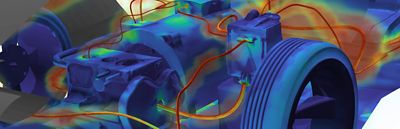
It’s hard to imagine grabbing a handle and cranking down the driver’s side window to reach for drive-thru takeout. For most of us, the convenience of pressing a backlit power button is decidedly more familiar. We can thank the introduction of the first power windows in a 1941 Packard for that.
Of course, automotive electronics have come a long way since then.
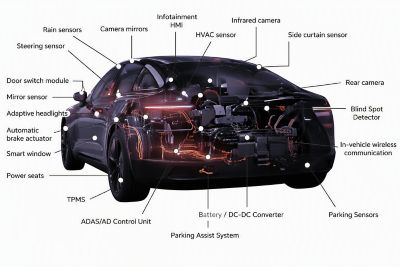
The prevalence of electronics in modern vehicles
With the advent of software-defined vehicles (SDVs), the systems powering our vehicles have evolved from simple mechanical ones involving basic electrical components to complex, interconnected electrical/electronic (E/E) networks supporting centralized, software-defined architectures.
This new perspective unlocks advancements in electrification, along with higher levels of autonomy and connectivity for consumers. It also presents a much higher level of engineering complexity for original equipment manufacturers (OEMs).
One byproduct in the coexistence of all of these electronics on a single vehicle platform is electromagnetic interference (EMI), or the disruption of unwanted electrical energy among devices during normal vehicle operation.
Essentially, EMI is what happens when electromagnetic energy from one source is transferred to another incompatible device, interfering with proper vehicle function. The net result can potentially lead to system failure across one, or even multiple vehicle systems affecting things like safety, or autonomous vehicle function.
To remedy this, electromagnetic compatibility (EMC) is needed to ensure all electronic devices work as they are intended, without creating or being impacted by EMI. Let’s look at the challenges around achieving EMC, why EMC testing is difficult, and how simulation is helping automakers to realize EMC despite these challenges.
EMC Is Now a Program-Level Constraint
Achieving EMC compliance isn’t easy. The level of electrification, high-speed electronics, and connectivity needed to meet market demands is creating a level of complexity that is outpacing traditional EMC processes.
It’s an engineering challenge fueled by the increasingly intricate interplay between electronic systems and regulatory requirements. As vehicle functionality continues to mature, so will the integration of more high-frequency components, antennas, and electrified powertrains, further intensifying automotive electronics design complexity.
Putting all of this technology in motion requires seamless interaction among systems sourced from multiple suppliers, each with proprietary designs and standards. It’s a tall order for original equipment manufacturers (OEMs) who must reconcile EMC in autonomous and electric vehicle (EV) applications.
“Electrification is one of the biggest challenges from an EMC perspective, as all of these devices are really interfering with the rest of the electronics and they have really strict requirements,” says Flavio Calvano, senior manager, applications engineer at Ansys, part of Synopsys. “It’s costly, especially when you factor in time to market, as this kind of constraint can really delay a project.”
Another big challenge for automotive engineers, according to Calvano, is autonomy.
“You're dealing with an automated driving system that involves multiple electronic control units, plus sensors, antennas, and of course, software,” he says. "Addressing EMC issues early in the design stage to cut time and costs is the imperative for OEMs.”
Why EMC Testing Is Difficult
By its very nature, successful EMC analysis is difficult to achieve. So, it’s not surprising that many simulation-first efforts stall.
There are several reasons for this.
First, there are cross-scale interactions, which can complicate the EMC design process, whether they’re happening with semiconductors at the micro-level, or in the system-level integration of vehicle platforms. More often than not, these interactions can muck up the business of simulating how accurately the behavior of components and subsystems is captured when combined.
The availability of accurate, comprehensive models from suppliers also presents challenges, as intellectual property concerns often limit data sharing. This lack of detail makes it difficult to thoroughly predict and validate system behavior.
Lastly, simulating multiple test modalities requires significant resources to achieve precise results, increasing the computational burden. Engineers are often challenged to correlate simulation outputs with physical lab measurements due to manufacturing tolerances, assembly variations, and the complexity of full-vehicle systems on the way to realizing EMC.
“For example, we can simulate antennas using Ansys HFSS software,” says Juliano Mologni, principal product manager at Ansys. “An antenna is just a component and it's difficult to get the same results from the lab. In HFSS you can do it, but it's one component. Now imagine that antenna inside of a radio inside of a car with the chassis, with all the cables and many other antennas, and you're going to measure that. And people want to simulate that and compare the results. It’s a whole new level of complexity involved. It’s not like you’re simulating at the component level anymore, you're simulating the whole system.”
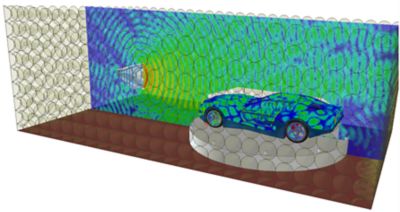
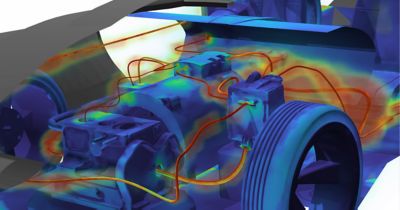
ISO11451-2 automotive immunity full-vehicle simulation using Ansys HFSS Mesh Fusion software
So, at this level of complexity, what does success look like? One that can design in EMC using predictive, cross-scale simulation, then validate designs with fewer, higher-confidence physical tests.
EMC in a Single Simulation Platform
With the right tools and solvers, it’s possible to configure a simulation-driven workflow to overcome EMC challenges and systematically address design complexity across an entire development cycle through:
- Early-stage predictive modeling to analyze potential sources of electromagnetic interference by incorporating data from semiconductors, PCBs, and other critical components, then mitigate any issues before they escalate.
- Subsystem modeling to ensure components function harmoniously within their assemblies, and to reduce interference risks by addressing issues such as shielding effectiveness and cable routing at a granular level.
- 3D component modeling supports the seamless exchange of 3D/2D and circuit models between OEMs and Tier suppliers and includes encryption, if needed, to protect IP.
- Platform-level analysis, including the use of tools to simulate dynamic interactions between complex wiring systems and high-speed electronics, to achieve more reliable performance subject to increasing system complexity.
- Advanced vehicle-level validation to analyze interactions across an entire system, including those occurring among antennas, chassis, and high-speed electronics, then fine tune performance to industry standards and diverse operational environments.
- Automation and standardized templates to streamline the entire workflow, optimize processes, and minimize manual efforts, enabling engineering teams to set aside repetitive tasks in favor of ideation that leads to product innovation.
- AI-driven assistance for EMC applications offering answers to technical questions, simulation workflow suggestions, and documentation interpretation related to EMC simulation.
- Model reuse through the application of verified designs to save both time and resources as system complexity continues to grow.
The Ansys-driven workflow takes a structured, iterative approach to EMC challenges by enabling comprehensive automotive system validation and seamless integration using various Ansys multiphysics tools and solvers in a way that leads to better engineering outcomes.
Putting It All Together With Simulation
Why does this approach work so well? When dealing with EMC, what it really comes down to, according to Calvano, is having the knowledge needed to identify the source of the problem and the right tools to achieve it.
“For example, with electrification, we need to be aware of the semiconductor that is behind that,” he says. “In some cases, those resources are not available. So, the measurement of the current, for example, can be the EMC simulation of a cable that can be excited directly from measurement. In other cases, you can model the source by a simpler circuit from another vendor.”
Once the source of the radiation is modeled, it’s then possible to build on that information to extrapolate further by importing additional components, such as the electrical card or printed circuit board (PCB) to do modeling at the component level.
“Now we can start to check if this PCB is compliant,” he says. “And we can also start to model the subsystems. Logically, if we put the PCB into a chassis or shielding, or if we want to integrate a control unit into the car, we can do a few tests to see how the car chassis is impacting everything.
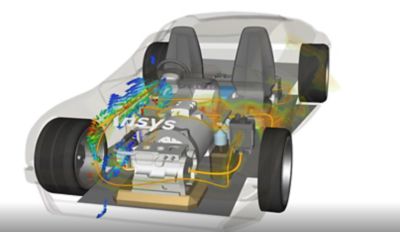
Simulation is necessary to understand and address unexpected electromagnetic effects of essential systems, such as antennas, radios, and control units.
From here, we can move to platform level coupling to model all of the cabling of the car, from design to integration with all of the emitting devices. So the control unit, the antennas and so on.”
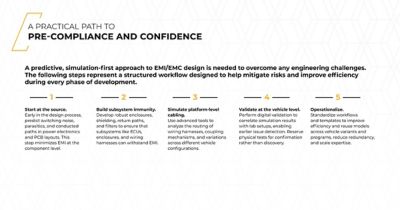
This cadence is part of a broader solution mapping process that begins with discovery and eventually arrives at full-vehicle validation from an EMC point of view. With the help of advanced simulation tools, it’s possible to trace these interactions, from the component level to the subsystem level, and then on to the entire vehicle platform with confidence.
This blog is just a preview of what Ansys tools can do as part of a broader simulation effort to achieve EMC across an entire vehicle platform. To learn more, download our e-book Overcoming Automotive EMI/EMC Complexity or see our recent case study to discover how Ferrari’s use of predictive simulation techniques helped the OEM realize a 40% reduction in physical prototypes.



The Advantage Blog
The Ansys Advantage blog, featuring contributions from Ansys and other technology experts, keeps you updated on how Ansys simulation is powering innovation that drives human advancement.