Synopsys and Ansys power the future of innovation—connecting silicon to systems.
Selecting the right graphics processing unit (GPU) hardware for engineering simulation has become increasingly challenging. For users running Ansys Fluent fluid simulation software or Ansys Mechanical structural finite element analysis software, the difficulty stems from real‑world performance depending on a mix of factors, making it hard to judge which GPU will actually perform best for a given workload. Solver type, model size, current central processing unit (CPU) baseline, GPU generation and count, high-performance computing (HPC) licensing behavior, and even power efficiency all influence how a GPU performs in practice.
As GPU options continue to expand from entry-level devices to ultra-high-end accelerators, engineers frequently face the same question: “Which GPU configuration will actually deliver the best return for my workloads?”
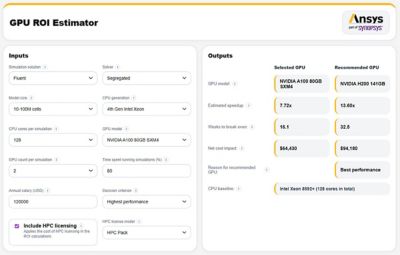
That’s exactly why we created the GPU ROI Estimator feature for Fluent and Mechanical software. The tool helps engineers estimate GPU‑accelerated speedup against their current CPU system, assess hardware payback through engineering time saved, and explore GPU recommendations aligned with their priorities and application needs.
Why Traditional ROI Calculators Fall Short for Simulation
Generic return-on-investment (ROI) calculators, often based on synthetic or system-level metrics, can be useful for broad information technology (IT) planning, but they fall short for engineering simulation. In real-world computational fluid dynamics (CFD) and finite element analysis (FEA) workloads, performance varies significantly with the solver, model size, portion of the workflow that benefits from GPU acceleration (in the case of Mechanical applications), and hardware and licensing context around it. As a result, general-purpose ROI tools simply cannot capture the nuances of Ansys-specific simulation behavior.
This is not a new challenge. In my earlier workstation ROI blog, I already emphasized that simulation performance and ROI depend on factors such as application, solver, model size, and performance of the user’s current workstation. That same principle applies even more strongly to GPU investments.
What the GPU ROI Estimator Tool Delivers
The GPU ROI Estimator instrument helps engineers make better-informed hardware decisions by answering questions that matter most:
- How much faster could my simulations run with GPUs compared with my current CPU configuration?
- How quickly could GPU investment pay back through engineering time saved?
- Which GPU hardware options best match my priorities, whether I care most about speed, cost efficiency, or another decision criterion?
Instead of relying on generic assumptions, the estimator provides workload-aware guidance tailored to Fluent and Mechanical software. It reduces guesswork around whether to choose a single GPU, multiple GPUs, or a different class of accelerator entirely.
Built on a Robust ROI Computation Framework
To ensure that the GPU ROI Estimator tool provides meaningful guidance for real engineering teams, the framework is built on a broad, rigorously collected benchmark foundation for Fluent and Mechanical software. It leverages a comprehensive dataset spanning a wide range of CPU and GPU configurations, incorporates more than 1,200 standardized Ansys benchmark data points, and applies flexible comparison logic that adapts to different solvers, physics models, hardware architectures, and licensing scenarios.
This extensive dataset is essential because while Fluent and Mechanical software can achieve substantial performance and efficiency gains on GPUs, the size and nature of those gains vary significantly by use case.
- For Fluent software, recent results highlight that modern GPUs can deliver order‑of‑magnitude improvements in simulation throughput while also significantly reducing hardware footprint and energy consumption. Large‑scale examples, from high‑fidelity turbulence simulations to complex multiphase flows, showcase impressive acceleration on NVIDIA and AMD GPU platforms, enabling faster turnaround and lower total cost of ownership.
- For Mechanical software, benchmarks have demonstrated substantial solver speedups when leveraging supported NVIDIA and AMD GPUs. Examples include up to an 8.6X acceleration on an NVIDIA H100 GPU and as much as 24X faster performance using four AMD MI210 GPUs in specific structural mechanics scenarios. These gains translate directly into quicker design iterations and increased engineering productivity.
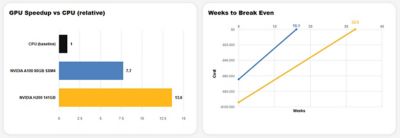
The key takeaway is that GPU acceleration offers real, measurable benefits but varies by workload. The GPU ROI Estimator tool helps convert broad benchmark results into personalized expectations for your specific models and system.
Why This Matters to Engineers and IT Decision-Makers
A GPU purchase is rarely justified by raw performance numbers alone. Teams also need to understand business impact. How much engineering time can be saved? How does that translate into productivity? How long will it take for the investment to pay back? And which configuration makes the most sense given licensing and power considerations?
While the GPU ROI Estimator tool is grounded in modeled productivity gains and selected cost inputs, it is important to note that GPU acceleration often delivers additional business benefits that are difficult to quantify generically without knowledge of a specific industry, application, or development process. These include faster time to market through shorter simulation turnaround times, the ability to explore more design alternatives within the same schedule, and improved product outcomes driven by higher‑fidelity models and more informed engineering decisions. These qualitative benefits frequently represent a substantial portion of the real‑world value of GPU acceleration, even though they are not explicitly captured in the estimator’s calculated payback metrics.
By combining performance estimation with payback analysis, the GPU ROI Estimator tool helps engineers build a more complete case for hardware refresh or expansion. It can support conversations not only within simulation teams but with managers, procurement stakeholders, and IT decision-makers who need a clearer picture of value.
Start Exploring the Right GPU for Your Workload
If you run Fluent or Mechanical simulations and are considering GPU acceleration, the new GPU ROI Estimator feature can help you make a more confident, data-driven decision.
Try the GPU ROI Estimator tool to see which GPU configuration offers the best combination of speedup, payback, and workload fit for your simulations — and be sure to check back regularly, as we will continue to update the estimator with support for new GPU platforms as they become available.

Just for you. We have some additional resources you may enjoy.
Estimate Your ROI
Try the GPU ROI Estimator tool to see which GPU configuration offers the best combination of speedup, payback, and workload fit for your simulations.


The Advantage Blog
The Ansys Advantage blog, featuring contributions from Ansys and other technology experts, keeps you updated on how Ansys simulation is powering innovation that drives human advancement.