Synopsys and Ansys power the future of innovation—connecting silicon to systems.

For decades, product design followed a familiar rhythm. Mechanical came first, electronics followed, and software wrapped around it all. Each discipline moved fast but rarely together. That model no longer works.
Today’s products are no longer static objects; they are intelligent, adaptive systems. Cars are defined as much by compute platforms as by chassis. Connected medical devices are miniature data processors. Industrial equipment learns and predicts failures before they happen. Artificial intelligence (AI) is becoming physical. In this world, innovation doesn’t just happen at the edges — it happens at the intersections.
The future of product design belongs to organizations that can connect silicon decisions early and continuously to system-level outcomes.
Intelligence Is Now the Core Design Material
Silicon is now the foundation of modern differentiation, not just a hidden enabler. The proliferation of specialized compute, advanced packaging, and embedded intelligence has made silicon architecture inseparable from product architecture. Performance, power, area, thermal behavior, reliability, safety, verification, validation, and cost are not post-design considerations; they are determined early in the design process, often at the very beginning.
This “shift left” in engineering addresses critical design considerations, verification, testing, and problem-solving earlier in the development process rather than later. The term comes from the idea of moving tasks to the “left” on a project timeline, which typically flows from left (early stages) to right (later stages, such as manufacturing or post-silicon validation).
As intelligence becomes pervasive, design teams must think holistically about hardware and software, electronics and physics, devices and systems. This shift demands a new mindset that Synopsys refers to as re-engineering engineering. It requires co-design across domains, where decisions made in silicon ripple predictably through mechanical, electrical, thermal, and software layers.
In this model, the question is no longer just “Will it work?” but “How will this behave in the real world, at scale, over time?”
The End of Linear Development
Traditional, sequential design, build, test, fix, and repeat development pipelines break down under the weight of today’s complexity. Physical prototypes arrive too late. Errors discovered downstream are too expensive to correct. Timeto-market pressures leave little room for rework.
Iterating late is too costly. Surprises discovered after semiconductor tape-out or physical product prototyping can derail schedules, budgets, and credibility.

Download the IDC study “Transform Product Innovation with Multiphysics Simulation for Digital Engineering,” which was sponsored by Ansys, part of Synopsys.
Instead, product innovation has moved toward continuous exploration and validation, where designs are evaluated as complete systems long before they exist physically. This approach enables teams to explore more ideas, reduce risk earlier, and align trade-offs across disciplines while change is still inexpensive.
What enables this shift is not any single tool but integration across the entire engineering stack — from silicon IP and electronic design automation to multiphysics analysis and system simulation. When these domains speak the same language, innovation accelerates.
Engineering and Productivity at the Speed of AI
AI-powered engineering workflows are emerging not as replacements for human ingenuity but as force multipliers, helping teams navigate massive design spaces, optimize trade-offs, and automate the work that slows innovation. Reinforcement learning, generative techniques, and agentic workflows are increasingly embedded into design processes, quietly reshaping how products are conceived and delivered.
The result is a step change in productivity that enables engineers to focus less on rework and more on creativity, system intent, and differentiation.
Silicon to Systems as a Design Philosophy
The real transformation underway is philosophical. The most competitive organizations no longer think in terms of components or disciplines. They think of solution-driven outcomes: performance per watt, safety margins, life cycle resilience, and user experience.
This is where silicon-to-systems thinking becomes essential. When silicon, software, physics, and system behavior are designed together, innovation is compounded, and intelligent systems are built. When they are disconnected, complexity becomes a tax.
Future-ready companies are building platforms that span the entire life cycle, from architecture and design through verification, manufacturing, deployment, and ongoing optimization. Digital twins have evolved into living representations of products in operation. As products operate in the field, data flows back into the design process to inform updates, improve reliability, and shape the next generation. Product development becomes cyclical rather than linear, adaptive rather than fixed.
Designing What Comes Next
The next era of product development will not be defined by isolated breakthroughs but by how seamlessly intelligence is engineered into everything we build. The winners will be those who can design boldly without sacrificing predictability, who can move fast while managing complexity.
Innovation at this level requires more than speed. It requires coherence across domains, confidence in decisions, and the ability to see the whole system before it exists.
The future belongs to companies that think holistically. Semiconductor companies increasingly design with system-level intent. Systems companies are diving deeper into silicon architecture, blurring traditional boundaries.
The silicon-to-systems approach recognizes that modern products are deeply interdependent ecosystems:
- Silicon defines capability, efficiency, and scalability
- Software determines adaptability and the user experience
- Physics govern real-world behavior
- Systems integration determines whether it all works together reliably
Innovators who succeed will be those who can design across these layers simultaneously, resolving trade-offs early rather than reacting to them late.
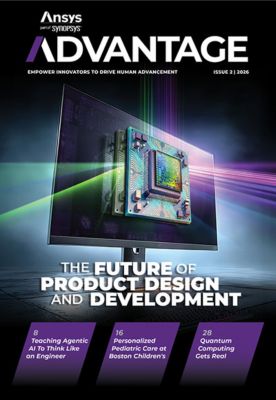
You’ll find some of those success stories in this issue of Ansys Advantage magazine — from personalized healthcare to industrial automation, to what’s next with quantum computing and agentic AI. We hope you enjoy the issue.

Just for you. We have some additional resources you may enjoy.


The Advantage Blog
The Ansys Advantage blog, featuring contributions from Ansys and other technology experts, keeps you updated on how Ansys simulation is powering innovation that drives human advancement.