Synopsys and Ansys power the future of innovation—connecting silicon to systems.
Since its release in 2006, the Sony PlayStation 3 (PS3) has sold more than 87.4 million units. While most of these PS3s were used for their original purpose — playing games — a few had a unique use: the Air Force Research Laboratory (AFRL) combined more than 1,700 PS3s to build a supercomputer in Rome, New York, called the Condor Cluster.
But why, you may be asking, would AFRL decide to make a PS3-powered supercomputer? Well, the goal here was to use commercial off-the-shelf (COTS) components to develop a low-cost, high-performance supercomputer. This turned out to be a great success, with the Condor Cluster becoming one of the most powerful supercomputers at the time with a performance of 500 trillion floating point operations per second (TFLOPS) and a price tag far under the cost of other, more conventional, supercomputers.
The Condor Cluster is an example of a distributed computing system. At its simplest, distributed computing involves using multiple computers in distributed locations to process and store data, often yielding benefits such as increased flexibility, redundancy, and performance.
This same distributed computing concept can also be used to advance space technology. For instance, you can swap out the PS3s in this example for satellites. Single satellites and groups of satellites can perform distributed computing in space, the latter by forming communication pathways among satellites, essentially creating a data center or supercomputer in space.
Satellites using distributed computing can rely on extremely efficient nodes (individual edge computers or clusters of them) that scale to match the available power generated onboard the spacecraft and the thermal limitations of the spacecraft or spacecraft design, which is a key advantage. These distributed computing data centers function essentially as giant edge computers, which, in short, move data storage and computation closer to the data sources.
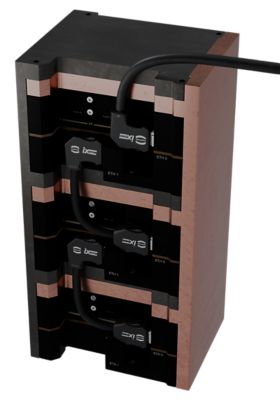
Multiple systems that form a distributed computing setup together. Photo credit: Aethero
Using edge computing onboard spacecraft results in an array of benefits, including increased processing speeds, which is necessary to enable real-time missions involving high-speed spacecraft and autonomous decision-making, and avoiding congestion in bandwidth-constrained environments by processing on orbit. Another benefit of space-based data centers is their ability to address data and privacy concerns by storing data in distributed data centers in space.
Unlike Earth-bound technology like the PS3 supercomputer, any computing performed in space must withstand this harsh environment to achieve these benefits. That’s where Aethero — a company pioneering the next generation of space data infrastructure — comes in.
Benefiting the Entire Space Industry by Modernizing Space Computing
Space is an incredibly challenging environment to operate within and requires designs comprised of components that can withstand intense radiation and endure extreme thermal environments such as intense solar heating and the deep cold of shadowed regions. Aethero helps address this difficulty by providing high-performance space-rated computers with radiation-hardened system design architectures. Aethero’s computers support individual, multiple redundant, and distributed edge computing modules (ECM), as well as high-performance computing (HPC) clusters.
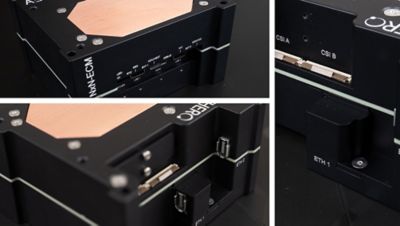
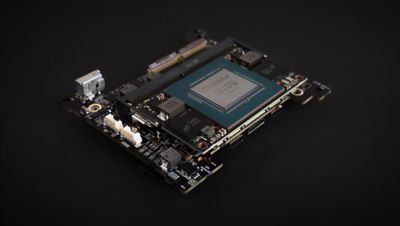
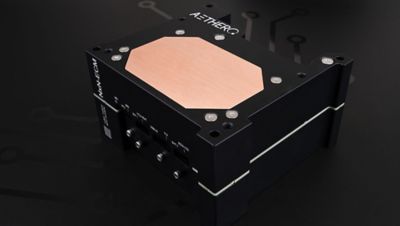
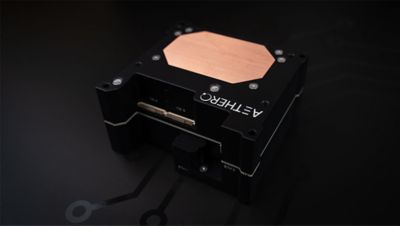
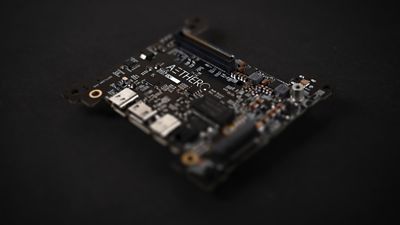
Images showing Aethero’s high-performance space-rated computers. Photo credit: Aethero
Aethero’s designs differ from its competitors in a few major ways. First, as with the Condor Cluster, Aethero also uses COTS components to increase performance while decreasing costs. “Aethero’s hybrid approach of utilizing radiation-hardened and tolerant components alongside COTS components allows us to push the boundaries of space computing,” says Amit Pinnamaneni, chief technology officer and co-founder at Aethero. Unlike traditional onboard processing system manufacturers, who use radiation-hardened and tolerant components for Class 1 space products and COTS components for lower-class products, Aethero’s hybrid approach — which also includes shielding and hardware/software mitigation — enables the company to optimize for performance, efficiency, and cost in all its designs.
Modularity is another key benefit of Aethero’s technology. “Aethero supports an ecosystem of expansion boards that allow each user to tailor the system to the specific use case,” says Pinnamaneni. “Users have the ability to swap out GPU modules, flash storage, and a variety of compatible Aethero-built expansion boards. Internally, each expansion board is also modular, allowing for upgrades or swaps of individual components — such as the individual field-programmable gate array (FPGA) or global positioning system (GPS) modules. The system can also easily be configured into modular or distributed computing variants.”
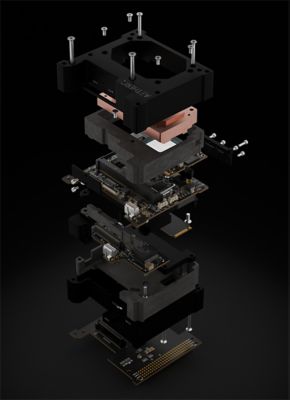
Render showing Aethero’s modular technology in an exploded view. Photo credit: Aethero
Maintaining a modular design is essential to Aethero, as its computers are designed to function in a variety of platforms, from a small CubeSat to a massive space station. Aethero’s designs can scale the number of nodes in a distributed computing data center or supercomputer in a spacecraft to match the spacecraft’s capabilities.
This is all achieved while enabling many functions, such as autonomous spacecraft operation, machine vision operations, video and imagery processing, radio frequency (RF) signal processing, artificial intelligence (AI) and machine learning (ML), software-defined radio (SDR), and data compression and management. By using Aethero’s computers, engineers and operators can also leverage well-established machine learning packages and easily reprogram their systems even after deployment through over-the-air (OTA) updates.
Such versatility unlocks a great deal of applications for Aethero’s products across many industries. A few of the many potential use cases include powering a visual positioning system with automated annotation, training, and development for Earth observation; point-of-interest tracking, such as government efforts to track illegal fishing; and autonomous precision maneuvers, docking, and rendezvous, proximity, and operations (RPO).
Additionally, “you can utilize our distributed computing data center approach in order to implement a content delivery network (CDN) provider that can directly link to a phone or other on-ground compute devices using RF standards such as 5G,” says Pinnamaneni. This use case aids in bringing people together and builds upon “the principles of cooperation and collaboration" that are intrinsic to the aerospace industry.
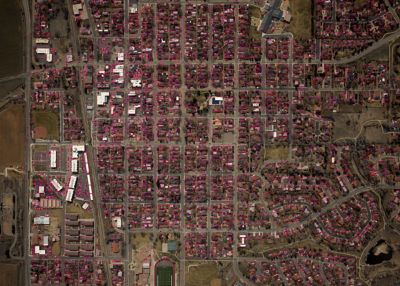
Earth observation annotated image. Photo credit: Aethero
As a specific example, consider a spacecraft autonomously performing an on-orbit docking maneuver. To achieve this, the spacecraft relies on its propulsion systems and sensor fusion from attitude determination and control system (ADCS) sensors. The process involves using data from multiple cameras, sensors, and AI/ML vision models in tandem to identify the spacecraft’s current position and guide it to the appropriate docking location.
In space, this process has a few challenges. First, sending the sensor data down to Earth for processing before sending it back up to the spacecraft would be a prohibitively slow process. Instead, Aethero’s space-rated computers can efficiently perform real-time sensor fusion and image processing in space via Aethero’s onboard computing capabilities — avoiding the time-consuming process of sending data between Earth and space.
To successfully achieve this and other benefits while continuing to advance space computing, Aethero relies on Ansys simulation software.
Achieving New Heights With Simulation
As a member of the Ansys Startup Program, Aethero utilizes simulation solutions throughout its software and hardware design and development process — as well as in operations — to overcome a few of the key challenges it faces in creating space-rated computing solutions for radiation-hardened environments.
Reducing the Design and Production Time
Designing for the radiation-hardened environment of space is a historically lengthy process involving creating and testing physical prototypes with long development cycles. To reduce this timeline, Aethero used simulation solutions in their design and development processes.
As a specific example, Aethero uses simulation to analyze the effects of radiation on their computers, enabling them to identify weak points before moving to production. This helps reduce costs and development and testing times. “The simulation results are verified by our test-as-you-fly approach through real-life testing, and we have found results to be identical,” says Pinnamaneni.
Ensuring Optimized Designs in a Rapidly Advancing Industry
As the hardware used in space becomes increasingly miniaturized, powerful, and energy-efficient, it also grows in complexity. This results in a need for powerful analysis tools to optimize such intricate designs. One way that the Aethero team addressed this need is by using Ansys simulation software. “Ansys tools allow us to balance and optimize the required shielding, enclosure design, and hardware design to support the requirement of operation in the space environment,” says Pinnamaneni.
In particular, for their electrical analyses, Aethero used Ansys HFSS high-frequency electromagnetic simulation software for 3D layout and electromagnetic field analyses and the Ansys SIwave signal integrity, power integrity, and EMI analysis for PCB design tool for power and signal integrity verification. Aethero also used Ansys EMC Plus electromagnetic interference and compatibility simulation software for individual, component-level radiation tolerance analyses and Ansys Icepak electronics cooling simulation software for individual component and PCB thermal simulation.
Analyzing the Entire Mission Environment
When planning a space mission, ensuring that you are accounting for the full space environment is no easy task. That’s why Aethero turned to Ansys Systems Tool Kit (STK) digital mission engineering software to study overall system performance in a space environment. With Ansys simulation, including the Ansys Systems Tool Kit Space Environment and Effects Tool (STK-SEET) capability, they can achieve everything from predicting satellite communications with ground stations and the effects of radiation and solar heat at different points to planning the concept of operations (ConOps) procedures.
As part of this comprehensive analysis, the Aethero team used Ansys Thermal Desktop thermal-centric modeling software for overall system flow fields and temperature simulation.
Ensuring Accurate and Timely Real-time Decision-making in Space
Making instantaneous (or nearly so) decisions is necessary for autonomous space technology. For example, when a satellite needs to make a critical decision, satellite operators want to avoid sending every single command themselves — especially for basic functions. Instead, they want to create satellites that can autonomously make real-time decisions and corrections.
One scenario in which this occurs is when a spacecraft experiences spinning or tumbling during docking or RPO. Here, the spacecraft can be designed to autonomously detumble and reorient itself. With STK software and the Ansys Orbit Determination Tool Kit (ODTK), engineers on the ground can analyze the tumbling beforehand and devise a ConOps procedure for handling this situation. Then, the procedure can be entered into the Aethero edge computer prior to launch so it is ready to be deployed when necessary, enabling spacecraft to autonomously and immediately fix the issue. In this way, edge computing in space enables real-time autonomous decision-making. Further, these products can enable autonomous self-improvement in accurate and precise maneuvering over time via reinforcement learning with a rewards model.
A Sneak Peek at the Future of Aethero and Space-based Computing
As the space industry advances, engineers and operators will increasingly look to keep their models up to date by performing training and interference via edge computing. However, the existing FPGA-based systems that many other products use cannot efficiently support this computing. Already, Aethero is providing a forward-thinking alternative with its NxN-ECM system, which supports 20-157 tera operations per second (TOPS). Aethero also released the NxA-ECM, which can reach up to 4000 TFLOPs with two compute elements since it supports both the NVIDIA Jetson AGX/IGX Orin and Thor modules.
Looking ahead, the Aethero team sees the growth of AI technology leading to more space-based computing use cases focusing on inference and training. “Enabling spacecraft to fine-tune their onboard AI/ML models is the only way to achieve the advanced applications for automation and adaptive space platforms that we want to pursue at Aethero,” says Pinnamaneni. “It opens up applications for edge computing in further destinations such as geosynchronous equatorial orbit (GEO), cislunar, or even Martian environments.”
Improvements in this area can also lead to edge computing being used for resource mining, on-orbit in situ assembly and manufacturing (ISAM), and other dynamic situations, which will become instrumental for the future of the space economy, says Pinnamaneni. This prediction is aided by the fact that we’ve already seen this same technological evolution on Earth.
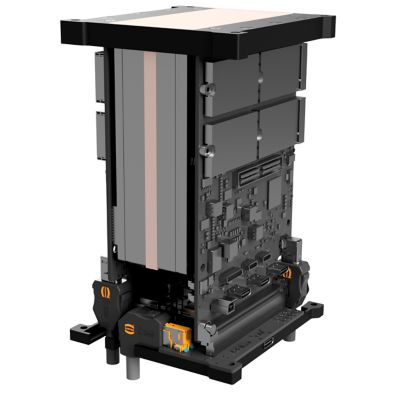
Aethero’s NxA-ECM. Photo credit: Aethero
Part of excelling in this work will include partnering with companies that can better achieve their missions by using Aethero’s products. This will let Aethero “pre-integrate our edge computers on proven satellite platforms to give customers a full and rapidly deployable solution with minimal nonrecurring engineering (NRE) [costs],” says Pinnamaneni.
To further aid in this growth, Aethero is working toward securing a Small Business Innovation Research (SBIR) grant with support from Ansys. Through this partnership, Aethero could run STK software on one of its modules onboard a spacecraft to simulate the ConOps before conducting them. In this way, the Aethero team will be able to make critical predictions, such as communications performance, “with far greater accuracy since STK is taking in data from the spacecraft in real time,” says Pinnamaneni.
If you’re interested in learning more about the exciting advancements occurring in space, explore how simulation is revolutionizing the space sector.

“The simulation results are verified by our test-as-you-fly approach through real-life testing, and we have found results to be identical."
— Amit Pinnamaneni, chief technology officer and co-founder, Aethero


The Advantage Blog
The Ansys Advantage blog, featuring contributions from Ansys and other technology experts, keeps you updated on how Ansys simulation is powering innovation that drives human advancement.