Synopsys and Ansys power the future of innovation—connecting silicon to systems.

The concept of model-based systems engineering (MBSE) was developed as a better alternative to the traditional document-based approach that engineers had used to design and develop systems. Using documents meant that changes to a design had to be manually updated in each relevant document, leading to inconsistencies across documents and difficulties in accurately validating the system against requirements.
Under this new methodology, teams created digital models to represent characteristics, behaviors, and requirements that define all relevant aspects of a system’s design. These models made it easier to maintain consistency and verify system requirements.
A key component of MBSE is the systems modeling language (SysML), a graphical modeling language used to model entire systems (or systems-of-systems) from the hardware down to the software, information, and processes that compose the system. The four pillars that make up the digital representation of a system in SysML are the structure, behavior, parametrics, and requirements. From these elements, system engineers can create models that are both readable by humans and executable by machines. This is very powerful because automated tools can validate the design and create traditional outputs like reports and graphs with no ambiguity on the architecture of the system, while engineers are able to communicate design aspects to stakeholders through diagrams and views of the model.
Nearly 20 years after the release of the original SysML v1.0 specification in 2006, SysML v2 was released earlier this year. The recent updates enhance its extensibility and modularity, and solve many of the issues that came with modeling and designing systems using SysML v1.
Ansys, part of Synopsys, has been closely involved in the SysML v2 development process. With the Ansys System Architecture Modeler (SAM) capability, users can visualize, design, and manage complex systems with SysML v2. The Ansys System Architecture Modeler cloud-native application enables real-time collaboration through a web browser and has an open ecosystem to support integration with many tools.
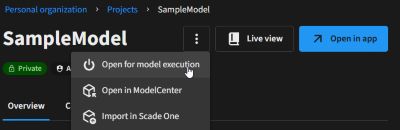
Launching the Ansys Behavior Execution Engine (BEE) from the Ansys System Architecture Modeler (SAM) capability
Ansys also offers the ability to connect system architecture defined in SysML to the simulation and analysis toolset engineers use to evaluate designs. This enables system engineers to rapidly iterate on designs and directly tie simulation to the architecture source of truth to ensure consistency across models. In particular, the Ansys Behavior Execution Engine (BEE) leverages behaviors defined in the model and integrates with physics-based analysis tools drive time-synchronized, event-based, physics-enabled simulation. This powerful capability helps users:
- Enhance the accuracy of digital prototypes by enabling them to analyze and refine their SysML behavior models through automated simulation execution
- Integrate complex calculations and simulations from physics-based analysis tools to drive system behaviors
- Support explicit time orchestration across the entire digital operating environment to ensure complete and accurate cross-system simulation
With Ansys 2025 R2, BEE now supports the execution of SysML v2 models and can be launched directly from the SAM capability. This provides a seamless transition from architecture modeling to simulation execution and ensures that BEE is using the most up-to-date information from the model. BEE will read the model directly from the online source, while users can still provide custom delegate modules locally to support model execution.
The new BEE release also supports units used in expressions and includes the necessary features for defining time-relative events. As industry begins to adopt SysML v2 and the language continues to evolve, BEE and the SAM capability enable the latest MBSE workflows to evaluate system design more rapidly and efficiently.
Learn more about the SAM capability and BEE.




The Advantage Blog
The Ansys Advantage blog, featuring contributions from Ansys and other technology experts, keeps you updated on how Ansys simulation is powering innovation that drives human advancement.