Synopsys and Ansys power the future of innovation—connecting silicon to systems.
-
-
Software gratuito per studenti
Ansys potenzia la nuova generazione di ingegneri
Gli studenti hanno accesso gratuito a software di simulazione di livello mondiale.
-
Connettiti subito con Ansys!
Progetta il tuo futuro
Connettiti a Ansys per scoprire come la simulazione può potenziare la tua prossima innovazione.
Customer Center
Supporto
Partner Community
Contatta l'ufficio vendite
Per Stati Uniti e Canada
Accedi
Prove Gratuite
Prodotti & Servizi
Scopri
Chi Siamo
Back
Prodotti & Servizi
Back
Scopri
Ansys potenzia la nuova generazione di ingegneri
Gli studenti hanno accesso gratuito a software di simulazione di livello mondiale.
Back
Chi Siamo
Progetta il tuo futuro
Connettiti a Ansys per scoprire come la simulazione può potenziare la tua prossima innovazione.
Customer Center
Supporto
Partner Community
Contatta l'ufficio vendite
Per Stati Uniti e Canada
Accedi
Prove Gratuite

It’s not every day that you come across a company with a product that has the potential to improve the lives of a large group of people. But that’s exactly what BluJ Aero — a company building vertical takeoff and landing (VTOL) aircraft — intends to do.
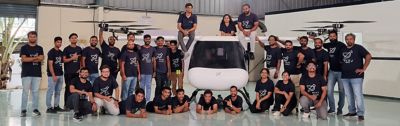
The BluJ Aero team
Utham Kumar Dharmapuri, co-founder and chief technology officer of BluJ, says the company “reaches people of every walk of life” by making flexible, world-class aviation products with potential applications ranging from regional air travel and same-day deliveries to uncrewed emergency evacuation. BluJ’s products address some of the key challenges facing the aviation industry today, including high costs and inefficiencies in regional transportation and the need to keep pace with increasing demand for delivery services.
As for how the company is achieving this, “BluJ was formed with the vision of making aviation simple and sustainable,” says Dharmapuri. This sustainability comes in two parts:
- Environmental sustainability: BluJ relies on hydrogen-powered fuel cells that reduce emissions.
- Economic sustainability: BluJ focuses on creating versatile designs that enable a wide range of applications in different geographies, ensuring that its aircraft are affordable to a large group of people in the long term.
As part of the advanced air mobility (AAM) industry, BluJ is also diverging from traditional aviation solutions and increasingly using autonomous technology, nontraditional propulsion systems, compact designs, and customized areas for landing and takeoff, such as vertiports or skyports.
“The idea is to get closer to the doorstep of whoever wishes to fly on these aircraft or even move their goods to the end destination,” says Dharmapuri. “You don't need a runway. All you need is a safe space for something to land and take off from.”
Already, BluJ has taken to the skies and flown its first VTOL prototype. “Science fiction is closer than we thought,” says Dharmapuri. Continuing its path forward will require overcoming a few hurdles common in the AAM space.
What’s Needed To Grow in the AAM Space
Turning science fiction into reality is no easy task. First, there’s the financial part of the equation. There is the need for a “large capital requirement and appetite of investors globally to bet on such long-term ideas,” says Amar Sri Vatsavaya, co-founder and CEO of BluJ. And after this money is successfully raised, there is the challenge of commercialization and demonstrating the importance of this technology to potential clients.
Second, there’s regulation. “Regulators or even the general community are not used to having things flying next to their apartment windows,” says Dharmapuri. “That's what we imagine in the near future with these vehicles. So, regulation will be a big part of that.” Here, BluJ has worked with the Directorate General of Civil Aviation (DGCA) from the beginning to help address this challenge.
Finally, AAM relies on new technology and uses existing technology in new and innovative ways. While this opens up new possibilities, it also comes with new technical challenges — for instance, designing a VTOL that can travel for hundreds of kilometers before quietly landing back in a dense urban environment.
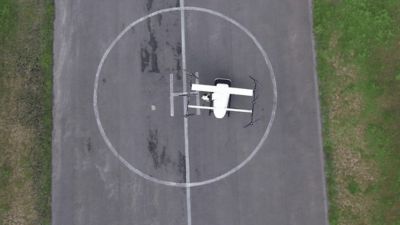
A BluJ vertical takeoff and landing (VTOL) aircraft on a vertiport
At the end of the day, these challenges are multifold, and AAM designs “need to be built responsibly to address the tech, as well as the regulation,” says Dharmapuri. To find an answer that works technically and for investors, regulators, and potential users, the BluJ team turns to simulation from Ansys, part of Synopsys.
Efficiency: A Solution Tailored for Startups
While reducing costs is important for all companies, this goal is particularly important for startups. Here, the BluJ team turned to the Ansys Startup Program and gained support from Telled Marketing.
By joining the startup program, BluJ gets access to “a bundle of all the simulation solutions that are required for a company like ours,” says Vatsavaya. By having a variety of Ansys solutions in one place, the bundle not only is affordable but helps with budget planning.
“It let us focus more on how we are going to use these tools rather than looking at how we can afford them or how we can buy them in the most efficient token or license combinations,” says Vatsavaya. “That's been the biggest positive surprise with the Ansys Startup Program. … The startup bundle for the first year was much more affordable than what we would have had to invest without the program, so that's very helpful in the early journey.”
Importantly, the bundle also includes high-performance computing (HPC), which is a unique offering for a startup package.
Accuracy: The Ansys Product Suite
Through the Ansys Startup Program, the BluJ team has access to the advanced software that it requires, including Ansys Fluent fluid simulation software to study flow interactions inside and around aircraft. This includes analyzing how air and fluids are recirculated within the VTOL, how aerodynamic BluJ’s VTOL designs are, and if they maximize energy use. Meanwhile, Ansys Mechanical structural finite element analysis (FEA) software helps the team build an optimized VTOL design that meets all requirements and regulations.
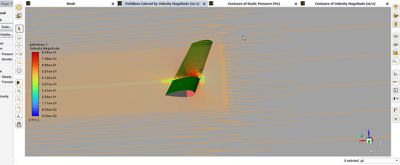
Velocity magnitude flow simulations on a VTOL wing
The team also relied on the Ansys Composite PrepPost (ACP) tool for composites to design Type IV composite pressure vessels for hydrogen storage and Ansys LS-DYNA nonlinear dynamics structural simulation software to help it solve its models more seamlessly. The team is also beginning to integrate the Ansys Maxwell advanced electromagnetic field solver into its processes.
As one example of its use of simulation software, consider BluJ’s propellers, which it makes from scratch. Propellers are a notoriously challenging design component, and Ansys software enables BluJ “to quickly check to tell what's working and what's not working,” says Dharmapuri. “Once you have ideas, you can cycle through them quickly.”
After running its simulations, the BluJ team compared the results from its high-fidelity Ansys models with existing propeller designs. In doing so, “we could verify and cross-validate with the tool, and we found that Ansys (software) could predict the actual real-world results within 5% of variation, which is a very close correlation for a propeller,” says Dharmapuri. “If you're within 5% of an actual (propeller) made by a reputed vendor, that's a good place to start.”
And propellers are only one of the many ways that BluJ uses simulation in its work. With simulation software, engineers can rapidly analyze iterative design changes and performance in a large variety of environmental conditions. In doing so, “you cut down the time to production, and you cut down the time to iterate and try out designs, which would otherwise take a longer time,” says Dharmapuri.
Performing simulation analyses is imperative for modern-day engineers. “You will not be able to test all aspects of any structure in the real world,” says Dharmapuri. “The only way to do that is to fly, but it's too late if you want to test it at that stage.” Instead, simulation must be used from the start.
No matter what the team’s current goal is, “simulation is a big part of anything we develop,” says Dharmapuri. “I've been in this industry for 18 years, and I don't design anything without simulation anymore. … It's a compliment to the simulation tools themselves that you don't even design without them.”
From Sketch to the Skies
BluJ has come a long way in just about three years. From a team of two and a professor with initial sketches of their aircraft to a flying prototype, the sky is not the limit but an opportunity for BluJ. The company intends to enter the market in 2026 and introduce its aircraft as a solution for moving goods.
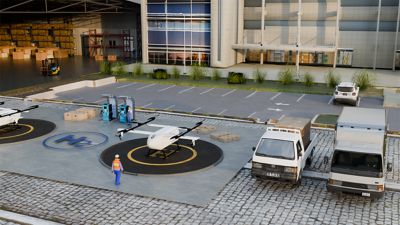
A render of a BluJ VTOL at a charging station
Looking to the future, BluJ plans to continue to scale and take on new potential applications for its technology. Further, “we would love to automate the complete workflows as much as possible, and with Ansys moving toward a Python scripting layer, it's going to be really helpful,” says Vatsavaya. This development will aid BluJ in further cutting down its design time.
Additionally, the team will continue to work toward certification. Ansys software “is a certified and accepted tool in the aviation industry,” says Dharmapuri, and “that is going to contribute to us being able to certify our products faster.”
The team also plans to use multiphysics simulations to solve for multiple goals at once, such as designing a VTOL that is not only aerodynamic but fuel-efficient and quiet.
Throughout it all, “simulation is what cuts down time and is able to produce things at a much faster rate,” says Dharmapuri.
Learn how the Ansys Startup Program helps startups take off through access to simulation solutions.

“Simulation is what cuts down time and is able to produce things at a much faster rate.”
— Utham Kumar Dharmapuri, co-founder and chief technology officer, BluJ Aero

The Advantage Blog
The Ansys Advantage blog, featuring contributions from Ansys and other technology experts, keeps you updated on how Ansys simulation is powering innovation that drives human advancement.