Synopsys and Ansys power the future of innovation—connecting silicon to systems.
-
-
Software gratuito per studenti
Ansys potenzia la nuova generazione di ingegneri
Gli studenti hanno accesso gratuito a software di simulazione di livello mondiale.
-
Connettiti subito con Ansys!
Progetta il tuo futuro
Connettiti a Ansys per scoprire come la simulazione può potenziare la tua prossima innovazione.
Customer Center
Supporto
Partner Community
Contatta l'ufficio vendite
Per Stati Uniti e Canada
Accedi
Prove Gratuite
Prodotti & Servizi
Scopri
Chi Siamo
Back
Prodotti & Servizi
Back
Scopri
Ansys potenzia la nuova generazione di ingegneri
Gli studenti hanno accesso gratuito a software di simulazione di livello mondiale.
Back
Chi Siamo
Progetta il tuo futuro
Connettiti a Ansys per scoprire come la simulazione può potenziare la tua prossima innovazione.
Customer Center
Supporto
Partner Community
Contatta l'ufficio vendite
Per Stati Uniti e Canada
Accedi
Prove Gratuite

Cardiovascular diseases significantly impact global health, leading to millions of deaths and creating a heavy burden on healthcare systems. Conditions like arrhythmia, coronary artery disease, and heart valve disorders affect how the heart pumps blood, disrupting normal body functions and causing severe complications. These diseases are often influenced by a combination of lifestyle factors, genetics, and aging, making prevention and treatment complex.
Addressing these conditions requires precise interventions that not only target the disease but account for individual patient differences. Advanced technologies, such as computational modeling and simulation (CM&S), artificial intelligence (AI), and digital twins, enable healthcare professionals and researchers to explore how cardiovascular systems respond to treatments or medical devices in a virtual environment. This approach provides deeper insights into disease progression and device interactions, offering a clearer pathway to develop effective therapies. By addressing these challenges with innovative tools, the healthcare industry can create more effective and accessible solutions for cardiovascular care.
Simulation technology is reshaping how cardiovascular challenges are addressed by providing a powerful means to analyze and improve heart-related treatments. It enables a detailed examination of cardiovascular systems without invasive procedures, offering insights that were previously difficult to obtain. By simulating heart functions and interactions with medical devices, engineers and researchers can predict performance under various conditions, making development processes faster and more reliable.
CM&S not only reduces reliance on traditional testing but enhances the ability to address patient-specific needs, offering a more tailored approach to healthcare. This innovative use of virtual modeling enables medical teams to assess the impact of interventions with greater confidence, significantly improving the design and testing phases of cardiovascular solutions. With these advancements, simulation is becoming an indispensable tool in transforming the way cardiovascular diseases are managed and treated, opening new pathways for innovation in healthcare solutions.
An Ansys, part of Synopsys, framework that combines the power of photorealistic visualization, artificial intelligence (AI), and advanced simulation built on the NVIDIA AI and Omniverse platforms.
Complexities of Modeling the Heart
Modeling the human heart demands precision due to its intricate structure and dynamic nature. Capturing the interplay of its chambers, valves, and electrical impulses is essential to reflect real-world conditions accurately. Medical device manufacturers and clinicians must account for factors like blood flow, tissue mechanics, and electrical signals, ensuring that simulations closely replicate the heart's behavior. The heart's constant movement, coupled with variations across individuals, further adds to the complexity. Any inaccuracies in the models can lead to unreliable outcomes, which may impact the safety of medical devices.
The ability to address these challenges requires advanced simulation tools capable of integrating anatomical and functional details. This precision enables better evaluation of device performance and its interaction with the heart, fostering confidence in developing treatments for cardiovascular diseases.
Reducing Risks With Simulation
CM&S serves as a powerful tool in advancing cardiovascular devices by enabling the creation of virtual heart models. These models simulate how medical devices interact with the heart under various conditions, providing critical insights that traditional testing methods often cannot achieve. CM&S facilitates the analysis of intricate processes like blood flow, tissue mechanics, and electrical signals in the heart, enabling engineers to evaluate and optimize device designs with precision. This virtual approach enables manufacturers to assess the performance of devices in diverse patient populations, addressing variations in anatomy and physiology without invasive procedures.
By integrating CM&S into the development pipeline, medical device companies can refine their products efficiently, reducing the need for physical prototypes and extensive animal and human testing while fostering innovative solutions for cardiovascular care.
The Role of CM&S in Regulatory Approvals
CM&S has become a vital tool in securing regulatory approvals for cardiovascular devices by providing robust data that demonstrates device safety and effectiveness. By simulating device performance in various physiological conditions, CM&S provides manufacturers with a reliable way that is accepted by regulators around the world to demonstrate safety and effectiveness without solely relying on traditional methods like physical prototyping, animal testing, or clinical trials. This capability enables developers to refine designs early, thereby reducing the risks associated with patient exposure to unproven technologies during clinical trials.
Regulatory agencies, such as the U.S. Food and Drug Administration (FDA) and the Australian Therapeutic Goods Administration (TGA), have started incorporating in silico evidence into their approval processes, offering a clear framework for its use. With CM&S, manufacturers can conduct detailed studies of how devices interact with patient-specific variables, improving the design and alignment of medical devices to real-world conditions. This leads to higher credibility in submissions while potentially decreasing the time and resources needed for approval.
Furthermore, CM&S offers the ability to analyze large virtual patient cohorts, which helps developers predict device performance across diverse populations. This reduces reliance on large-scale clinical trials, minimizes delays, reduces cost, and ensures that devices are optimized for safety and efficacy before market entry. Such simulations also permit a more informed risk assessment, decreasing uncertainties during the regulatory journey.
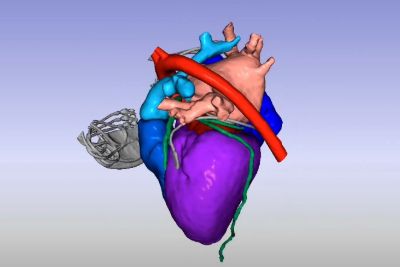
3D model of a heart and pacemaker in Synopsys Simpleware software
The Future of Personalized Medicine With Simulation
CM&S is driving the development of cardiac digital twins, virtual models that replicate a patient’s heart and adapt as his or her health changes. These advanced models use data from imaging and monitoring tools to create a precise representation of an individual’s cardiovascular system. With this capability, healthcare providers can simulate treatments and predict their outcomes, ensuring that interventions are tailored to each patient’s unique condition. Digital twins can incorporate real-time updates from wearable devices or implantable sensors, offering continuous insights into a patient’s health and enabling proactive adjustments to care plans. This personalized approach supports more accurate decision-making and optimizes treatment efficacy. As simulation tools continue to advance, the ability to provide patient-specific care becomes increasingly feasible, offering transformative potential for managing complex cardiovascular conditions and enhancing patient outcomes.
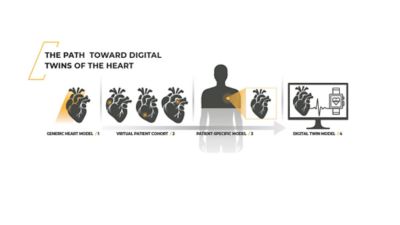
Computational modeling and simulation (CM&S) technologies lead toward digital twins of the heart.
Simulation technologies have fundamentally changed how cardiovascular care is approached, delivering lasting improvements in both patient outcomes and industry processes. By integrating virtual modeling into device development, manufacturers can efficiently address complexities while maintaining high safety standards. This technology not only accelerates product timelines but ensures that treatments are more adaptable to diverse patient needs. Additionally, simulation’s ability to reduce reliance on physical trials lowers costs and minimizes risks, fostering greater confidence in innovation. As these tools evolve, they support more personalized healthcare strategies, empowering clinicians to make informed decisions tailored to individual patients.
For organizations, adopting simulation technologies represents a commitment to advancing medical innovation and delivering impactful solutions. This shift toward data-driven development positions the healthcare sector for ongoing progress, addressing current challenges and preparing for future demands in cardiovascular care.
Learn more about how Ansys, part of Synopsys, can help with your cardiovascular applications.



The Advantage Blog
The Ansys Advantage blog, featuring contributions from Ansys and other technology experts, keeps you updated on how Ansys simulation is powering innovation that drives human advancement.